
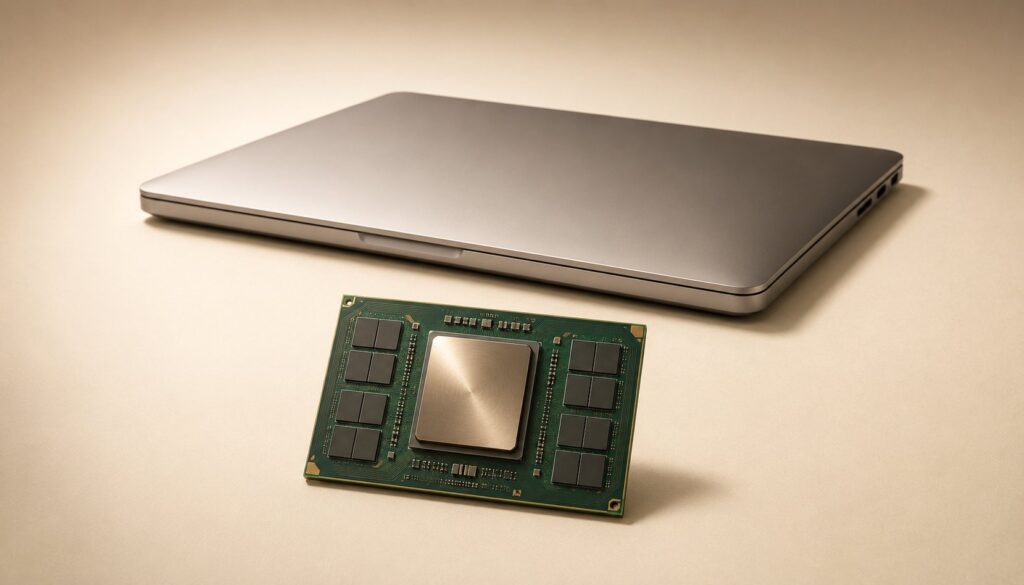
NVIDIA is not selling a laptop with its own logo on the lid. NVIDIA is doing something arguably more significant: it is selling the silicon that will power a new lineup of Windows laptops from Dell, HP, Lenovo, Asus, MSI, and Microsoft, with the goal of redefining what the Windows AI PC category actually means. The product is the NVIDIA RTX Spark Superchip, unveiled by Jensen Huang at Computex 2026 in Taipei on June 1, 2026, and confirmed across the OEM ecosystem in the weeks since. With the Jalapeño announcement from OpenAI yesterday driving conversation about the AI silicon market more broadly, the RTX Spark launch is the consumer-side parallel: NVIDIA’s first serious entry into the consumer Windows PC silicon market, in direct competition with Qualcomm Snapdragon X, AMD Ryzen AI, and Intel’s Lunar Lake and Panther Lake.
This piece covers what the chip actually is, the OEM laptop lineup it powers, what it enables that the prior generation of Windows AI PCs could not, the competitive context, and what the Fall 2026 availability means for buyers considering an AI-capable laptop refresh. The framing matters because the consumer narrative around the announcement has often been "NVIDIA is making a laptop," which is incorrect in a small way that obscures what is actually new. NVIDIA is making the silicon platform. The laptops will carry the same chip from one OEM to the next, with each OEM differentiating on chassis design, display, thermals, and brand. The platform-and-OEM pattern is how the broader PC industry has worked for decades. NVIDIA is now playing the role on the AI-PC silicon side that Intel and AMD play on the general-purpose-CPU side.
The short version is that RTX Spark is a 1-petaflop system-on-chip that pairs a Blackwell-architecture RTX GPU with 6,144 CUDA cores (matching the desktop RTX 5070’s shader count) and a custom 20-core ARM v9.2 Grace CPU, linked via NVLink-C2C with up to 128 gigabytes of unified memory. It is built on TSMC’s 3-nanometer process node. The OEM laptop lineup uses RTX Spark to deliver capabilities that the prior generation of Windows AI PCs could not: local inference on 120-billion-parameter language models, 4K AI video generation, 12K video editing, and AAA gaming at 1440p at over 100 frames per second. The combination of local LLM capacity, professional-creator workloads, and gaming on a single platform is the differentiated value proposition.
What was announced
The announcement is best understood as a coordinated multi-party launch with three pieces.
The first piece is the NVIDIA RTX Spark Superchip itself, unveiled at Jensen Huang’s Computex 2026 keynote. The chip’s specifications were disclosed in the keynote and confirmed in NVIDIA’s press materials at nvidianews.nvidia.com/news/nvidia-microsoft-windows-pcs-agents-rtx-spark. The chip is the production form of the N1X silicon, the chip NVIDIA has been developing in partnership with MediaTek and that has been the subject of speculation since 2024. The N1 (the consumer mainstream variant) and N1X (the premium performance variant) are the two SKUs in the family; RTX Spark is the marketing name for the laptop and small-form-factor desktop applications.
The second piece is the joint NVIDIA-Microsoft messaging about what the chip enables for Windows. The framing in the announcement materials is "reinventing Windows PCs for the age of personal AI agents." The narrative is that the combination of a high-capability local AI accelerator, a unified memory architecture sized for large language models, and Windows software designed around agentic workflows produces a fundamentally different category than the AI-PC generation that has shipped over the past two years. Microsoft Surface is the halo OEM partner, with the Microsoft Surface Ultra Laptop as the flagship demonstration device.
The third piece is the OEM lineup. Over 30 laptops from Dell, HP, Lenovo, Asus, MSI, and Microsoft Surface, plus approximately 10 compact desktops, were announced at Computex. Acer and Gigabyte have indicated they will join the lineup in early 2027. The breadth of OEM commitment is the most concrete signal of how the industry is treating the launch: this is not a one-OEM partnership, it is a broad ecosystem rollout with the major Windows-PC manufacturers participating.
The chip architecture
RTX Spark is a unified system-on-chip rather than a CPU paired with a discrete GPU. The architecture is the same conceptual pattern that Apple has used in M-series silicon and that NVIDIA has used in its Grace Hopper server chips, applied to the consumer Windows PC form factor.
The GPU half uses NVIDIA’s Blackwell architecture, with 6,144 CUDA cores. This shader count is the same as the desktop RTX 5070, which gives a useful baseline for relative performance against the discrete GPU lineage. The GPU has full RTX feature support, including ray tracing acceleration, DLSS 4, and the tensor core capabilities that underpin AI inference workloads.
The CPU half is a custom 20-core ARM v9.2 design. The choice of ARM rather than x86 is significant. ARM gives NVIDIA architectural control of the CPU side that x86 would not (NVIDIA cannot ship its own x86 CPU under current Intel and AMD licensing). It also aligns the Windows-PC silicon strategy with NVIDIA’s server Grace CPUs, which simplifies the cross-product software stack. The ARM choice means Windows applications must either run natively on ARM or run through the Windows on ARM compatibility layer. Microsoft has been working toward strong native ARM support across the Windows ecosystem since the Snapdragon X launches in 2024, and the application compatibility story is meaningfully better in 2026 than it was at the start of the Windows-on-ARM push.
The GPU-CPU interconnect is NVLink-C2C, the chip-to-chip variant of NVLink that NVIDIA has been using in its Grace Hopper and Grace Blackwell server products. NVLink-C2C provides much higher bandwidth between the CPU and GPU than the PCIe links that connect discrete GPUs to discrete CPUs in traditional laptop designs. The high-bandwidth interconnect is what makes the unified memory architecture work: the CPU and GPU access the same physical memory pool, and the interconnect bandwidth is high enough that the access pattern does not bottleneck.
The unified memory pool is up to 128 gigabytes. The headline number matters because the practical constraint on running large language models locally has been memory capacity, not compute. A 70-billion-parameter LLM in standard quantization requires roughly 40 gigabytes of memory. A 120-billion-parameter LLM requires roughly 70 gigabytes. The 128-gigabyte configuration accommodates both with substantial headroom for the operating system and other applications. This is the specification that most distinguishes RTX Spark from the prior generation of Windows AI PCs, which typically maxed out at 32 to 64 gigabytes of memory and could not run large models locally without aggressive quantization.
The process node is TSMC’s 3-nanometer. This is the same node used by NVIDIA’s data-center Blackwell chips and by Apple’s M5 family. The 3-nanometer choice gives RTX Spark competitive transistor density and power efficiency for the laptop form factor.
The OEM lineup
The OEM lineup is the broadest the new Windows-AI-PC category has seen. The named participants and their product positioning:
Microsoft Surface is the halo OEM with the Surface Ultra Laptop. The Surface lineup has historically been the Microsoft reference design demonstrating what is possible with current Windows silicon, with other OEMs differentiating around it. The Surface Ultra Laptop carries the strongest brand cobranding with the NVIDIA-Microsoft AI PC narrative.
Dell has announced multiple RTX Spark laptops spanning the XPS, Latitude, and Precision lineups. The Precision workstation variants are positioned for professional creator workloads. The XPS variants target the consumer premium segment. The Latitude variants are commercial.
HP has announced RTX Spark laptops in the Spectre, EliteBook, Omen, and ZBook lineups. The breadth is similar to Dell’s: consumer premium (Spectre), commercial (EliteBook), gaming (Omen), and professional workstation (ZBook).
Lenovo has announced RTX Spark laptops in the ThinkPad, Yoga, and Legion lineups. ThinkPad is the commercial flagship; Yoga is consumer premium; Legion is gaming.
Asus and MSI have announced RTX Spark laptops primarily in their gaming and creator lineups (Asus ROG and ProArt; MSI Stealth, Raider, and Creator).
The pattern is that every major OEM has at least one RTX Spark device in each segment they serve, with the marquee devices positioned at the premium end of each segment. The Fall 2026 launch will see the most prominent devices ship first, with broader rollout into early 2027.
The pricing varies by OEM and configuration. NVIDIA has not published reference pricing for the RTX Spark chip itself; the laptops will be priced by their OEMs according to standard PC pricing models, with the RTX Spark devices generally at the premium end of each OEM’s lineup. Early indications from OEM briefings suggest most RTX Spark laptops will be priced in the $1,500 to $3,500 range, with workstation-class devices going higher.
What "personal AI agent" means at this capability
The joint NVIDIA-Microsoft framing of RTX Spark is "reinventing Windows PCs for the age of personal AI agents." The specific capability targets that justify the framing:
Local inference on 120-billion-parameter language models. This is the headline capability and the most differentiated from prior Windows AI PCs. A 120-billion-parameter model running locally is approximately the capability ceiling of what consumer hardware can support, and it puts the laptop in the same model-capability tier as the frontier cloud-API offerings of two years ago. The practical implication is that on-device agentic workflows can use models powerful enough to handle non-trivial tasks without round-tripping to a cloud API.
4K AI video generation. The GPU compute is sufficient to run video generation models that produce 4K-resolution output. The use case is for content creators producing AI-generated video assets and for video editors using AI-assisted color, retiming, and effect work in their editing pipelines.
12K video editing. The high memory bandwidth and the unified memory pool support video editing workloads at 12K resolution, which is the production resolution for high-end cinema and VFX work. RTX Spark devices are pitched at professional video editors as workstation-class capability in a laptop form factor.
AAA gaming at 1440p at over 100 frames per second. The same GPU that handles AI workloads handles gaming workloads. The 6,144-CUDA-core Blackwell GPU is competitive with desktop RTX 5070 performance, which is sufficient for premium 1440p gaming on current AAA titles.
The combination of these capabilities on a single device is the differentiated value proposition. Prior Windows AI PCs typically did one of these well (AI inference on Snapdragon X laptops, gaming on RTX 4070-class discrete GPU laptops, video editing on creator-focused workstations) but not all three. RTX Spark is the platform for the user who wants all of them.
Competitive context
The Windows AI PC silicon landscape in mid-2026 has four major contenders:
Qualcomm Snapdragon X (Snapdragon X Elite, X Plus, and the newer X2 generation) has been the dominant Windows-on-ARM platform since its 2024 launch. The Snapdragon X devices have led in battery life and in NPU performance for the prior generation of small-model AI workloads (summarization, image editing assistance, on-device transcription). The Snapdragon X positioning is "all-day battery life with AI capability built in." The competitive gap that RTX Spark exploits is that Snapdragon X NPUs are not sized for large-model local inference; they are sized for the smaller assistant-class models that ship with Windows 11 features.
AMD Ryzen AI is AMD’s x86 alternative, with the Strix Halo lineup being the premium competitor to RTX Spark. Strix Halo’s positioning is similar to RTX Spark’s at the high end (combined CPU+GPU performance for creator and prosumer workloads), but the GPU and AI accelerator capabilities are not at RTX Spark’s tier. Strix Halo devices are typically priced lower than RTX Spark equivalents.
Intel Lunar Lake and Panther Lake are Intel’s responses. Lunar Lake (released late 2024) emphasized power efficiency for thin-and-light laptops. Panther Lake (the 2026 successor) extends Intel’s AI capability with stronger NPU performance and improved GPU integration. The Intel positioning is mainstream Windows PC silicon with AI capabilities, rather than premium AI PC silicon. Most of the volume Windows laptop market will remain Intel-based; RTX Spark targets the premium segment above the high-volume Intel devices.
Apple M-series silicon is the architectural model that RTX Spark explicitly imitates. The unified memory architecture, the high-bandwidth CPU-GPU interconnect, the ARM CPU choice, and the laptop-as-AI-workstation positioning all map to what Apple has been delivering with M-series chips since 2020. The competitive question for the Windows side is whether RTX Spark closes enough of the gap with Apple’s M5 family to attract creator and developer users who have been migrating to Mac for these workloads. NVIDIA and Microsoft’s pitch is that the combination of RTX Spark’s GPU capability (substantially stronger than Apple’s GPUs at the same memory tier), the Windows software ecosystem, and the AI agentic features specifically built for Windows is enough to bring the migration to a halt or to reverse it.
What this means for the buyer
For buyers considering an AI-capable laptop refresh in late 2026, RTX Spark is the most capable Windows platform but is not the right answer for every workload.
It is the right choice for buyers who want local AI inference on large models, professional video editing, AAA gaming, or AI-assisted creative workloads all on a single device. The combined capability is genuinely new in the Windows category and there is no equivalent at the same price point.
It is not the right choice for buyers whose priority is battery life and thin-and-light portability. RTX Spark laptops will not match Snapdragon X battery life because the higher compute capability has higher power draw. Battery-priority buyers should continue to consider Snapdragon X and Apple M-series options.
It is also not the right choice for buyers whose AI workloads are entirely cloud-based. If the model invocations all go to ChatGPT, Claude, or Gemini cloud APIs, the local compute does not have to be high-end. A mainstream Snapdragon X or Intel Lunar Lake device serves these workloads adequately, and the RTX Spark premium is not justified.
The strongest fit is the "I want one device for everything" buyer. The combination of gaming, creator workloads, large-model local inference, and the agentic Windows features is novel enough that RTX Spark is the only single-device answer in the Windows market for this user.
What is still unknown
Several pieces of information are not yet fully public:
Specific pricing for the named OEM devices. Most OEMs have indicated price ranges but not finalized retail pricing for the Fall 2026 launches.
Battery life under real-world workloads. The high-compute spec implies meaningful power draw; the actual battery life will depend on the specific OEM’s thermal and power-management design.
Sustained performance under thermal load. Laptop form factors limit thermal headroom, and the difference between peak performance and sustained performance varies substantially across OEM designs.
Software support beyond the launch titles. NVIDIA has committed to broad CUDA support and to the major creator and AI application stacks. The compatibility story for less-mainstream applications running on Windows on ARM is still developing.
The N1 (mainstream) variant launch timeline. RTX Spark is the N1X premium variant. The N1 mainstream variant for higher-volume mid-range laptops has not had its specific launch timing confirmed.
Frequently asked questions
Is RTX Spark the same as DGX Spark?
No. DGX Spark is the desktop AI workstation NVIDIA announced at GTC March 2025. RTX Spark is the consumer-class superchip for laptops and small desktops announced at Computex 2026. The “Spark” branding is used across both products but they are different SKUs.
Will my existing Windows applications run on an RTX Spark laptop?
Most modern Windows applications run natively on ARM, or run through the compatibility layer with acceptable performance. The application compatibility for Windows on ARM has improved substantially since the 2024 Snapdragon X launches. Niche applications, older 32-bit applications, and applications with kernel-level drivers may still have compatibility issues; this is the same compatibility story that applies to all Windows-on-ARM devices.
Is gaming performance comparable to a discrete RTX laptop?
Yes, at the 1440p tier. The 6,144 CUDA cores match the desktop RTX 5070, which is sufficient for premium 1440p gaming. Discrete RTX 5080 and RTX 5090 laptops will deliver higher frame rates at higher resolutions, but RTX Spark is competitive at the 1440p level that most premium gaming laptops target.
Can I upgrade the RAM on an RTX Spark laptop?
No. The unified memory architecture means the memory is soldered to the SoC package. The memory configuration is chosen at purchase and cannot be upgraded later. This is the same constraint that applies to Apple M-series laptops and to Snapdragon X laptops.
How does the battery life compare to Snapdragon X laptops?
Lower, in the expected range. Snapdragon X devices typically deliver 18 to 24 hours of moderate-use battery life. RTX Spark devices are expected to deliver in the range of 8 to 14 hours depending on OEM thermal and battery design. The performance premium comes with a battery life cost.
Is the AI capability available to any application or only Microsoft AI features?
The CUDA programming model is open to any application that compiles for it. The AI acceleration is available to any application that uses the standard CUDA or ONNX inference paths. Microsoft AI features in Windows are one consumer of the capability, but they are not the only one.
When do the laptops actually ship?
Fall 2026 for the initial wave. The marquee devices (Microsoft Surface Ultra Laptop, Dell XPS Spark, HP Spectre Spark) are expected in September-November 2026. Broader OEM rollout continues into early 2027.
Should I wait for the next generation?
Probably not unless you have a specific reason to. The next generation of NVIDIA consumer AI PC silicon is unlikely to ship before late 2027. If you need an AI-capable laptop in late 2026 or early 2027 and your workload fits the RTX Spark capability profile, the current generation is the right choice. If your needs are more modest, the Snapdragon X and Intel Lunar Lake / Panther Lake devices remain appropriate at lower price points.
How does this affect the Mac vs Windows decision for AI/creator buyers?
The Mac vs Windows decision was tilting toward Mac for several years because Apple Silicon’s unified memory architecture made local AI workloads easier on Mac than on Windows. RTX Spark closes most of that architectural gap. The decision is now more about software preference and ecosystem fit than about underlying silicon capability.
What does this mean for cloud AI services like ChatGPT?
The cloud services remain the right choice for the largest models and for workloads that need the latest cloud-only capabilities. RTX Spark enables a new tier of local AI workload that previously required either cloud APIs or workstation-class desktops. The likely pattern is that users will run a mix of local AI (for privacy-sensitive workloads, for offline use, and for high-volume tasks) and cloud AI (for the most capable models and the most demanding workloads). The platforms are complementary rather than substitutes.
This piece is a same-week followup to OpenAI’s Jalapeño chip announcement, covering the consumer-PC silicon parallel. We will continue to update as RTX Spark laptops ship through Fall 2026 and as real-world performance reviews land.