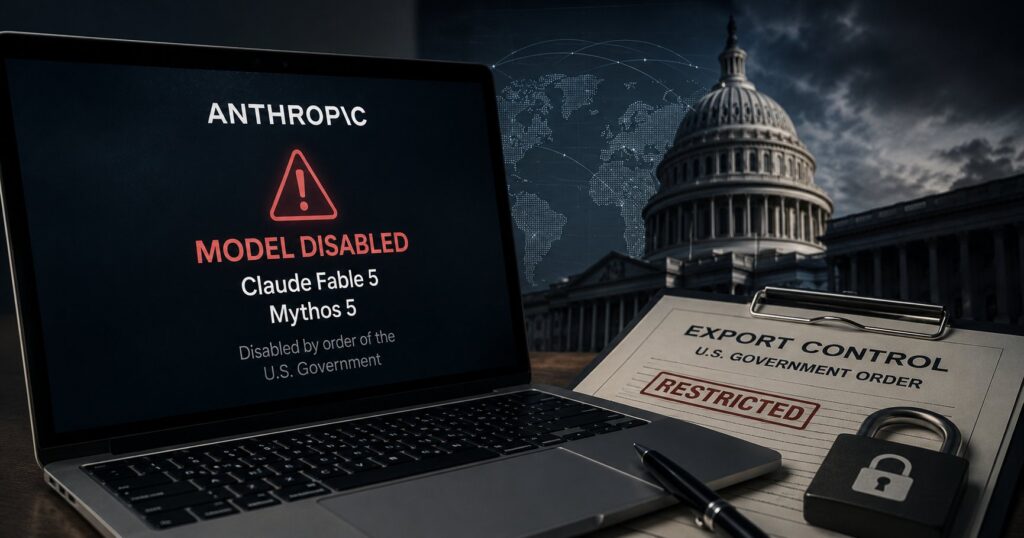
Anthropic has disabled Claude Fable 5 and Claude Mythos 5 for all customers, complying with a US government export-control directive that arrived at the company yesterday (June 12, 2026) at 5:21 PM ET. Commerce Secretary Howard Lutnick sent CEO Dario Amodei a letter citing national-security authorities and barring access by any foreign national, including Anthropic’s own foreign-national employees, inside or outside the United States. Because Anthropic cannot filter foreign-national access in real time, the company opted to disable both models for everyone within hours to ensure compliance. Both models had launched only three days earlier, on Tuesday June 9, 2026, in what we covered as a major milestone (our Fable 5 launch coverage ran the same day). The suspension is now the first government-forced takedown of a publicly deployed frontier AI model in the United States.
Anthropic is complying while disputing the rationale in public. The company’s reading: the government believes someone found a "jailbreak" of Fable 5 by asking the model to read code and identify flaws, but the demonstrated vulnerabilities were narrow, previously known, and minor, and comparable models (the company specifically named OpenAI’s GPT-5.5) can find the same vulnerabilities without any bypass at all. Anthropic’s public statement called the situation a "likely misunderstanding," pledged to work toward restoring access, and apologized for the disruption to customers. The trigger appears to be a jailbreak claim from another AI company that alarmed the administration. The Trump administration had reportedly tried to delay the original launch earlier in the week, and Anthropic declined; the export-control letter followed three days later.
This post covers what happened in the four-day arc from launch to takedown, the export-control directive and its scope, the jailbreak claim Anthropic disputes, which Claude models are affected (and which aren’t), the immediate impact on customers and partner workflows, the broader precedent this sets for frontier AI deployment, the migration story for builders who were on Fable 5, and what to watch next. The story is developing, and Anthropic has said it will share more detail in the next 24 hours; we’ll update as it does.
The four-day arc from launch to takedown
The timeline matters because it’s tight and unprecedented.
Tuesday June 9, 2026. Anthropic publicly launches Claude Fable 5, the first publicly-available Mythos-class model, alongside Mythos 5 (restricted to Project Glasswing partners). Pricing is $10 per million input tokens and $50 per million output tokens, double Opus 4.8. Through June 22, Fable 5 is included free on Pro, Max, Team, and seat-based Enterprise plans. The release lands amid significant industry attention, and early adopters begin running real workloads through the model immediately.
June 9-12. Customers run early tests. Stripe reportedly compressed months of engineering into days, running a codebase-wide migration on a 50-million-line Ruby codebase. Hebbia ranked Fable 5 highest on its financial-analysis benchmark. On vision, Fable 5 rebuilt a web app’s code from screenshots and beat Pokémon FireRed using a vision-only harness. Mythos 5 partners through Project Glasswing reportedly accelerated drug-design workflows by roughly ten times, and Mozilla alone reported resolving hundreds of vulnerabilities using the model defensively. Meanwhile, another company (not named in public reporting as of this writing) claims to have jailbroken Mythos, per Axios reporting.
Friday June 12, 5:21 PM ET. Commerce Secretary Howard Lutnick sends Anthropic CEO Dario Amodei a letter citing national-security authorities. The directive subjects Mythos 5 and Fable 5 to export controls covering any location outside the United States and any foreign person within the country. A license is required for export, re-export, or domestic transfer of the affected models.
Friday June 12, evening ET. Anthropic publishes a statement acknowledging the directive and announcing the immediate disablement of both Fable 5 and Mythos 5 for all customers. Other Claude models remain available. The API string claude-fable-5 now errors. Customer workloads using either model break.
Saturday June 13 (today). Industry coverage hits widely. Anthropic’s stated position is that the directive is based on a "likely misunderstanding" and the company is working to restore access. The administration has not publicly elaborated on the specific national-security concern beyond the letter itself.
Four days from launch to forced shutdown is the tightest such interval the frontier AI industry has seen for a public deployment.
The export-control directive and its scope
The legal mechanism Lutnick used is the Export Administration Regulations, the framework that the Commerce Department’s Bureau of Industry and Security applies to dual-use technologies that have both civilian and military applications. Export controls have been the dominant policy instrument for AI hardware (the chip restrictions on China) and for some AI software (model weights of state-of-the-art frontier models had been the subject of policy discussion for over a year before this directive). Applying export controls to a specific deployed frontier model is a new application of the framework.
The directive’s scope as understood from public statements:
- Access is suspended for any foreign national, defined to include anyone who is not a US person, regardless of where they are located physically. A foreign national in California is covered; a foreign national in any country outside the US is covered; an Anthropic employee who is a foreign national is covered.
- A license would be required from Commerce for any export, re-export, or domestic transfer of the affected models. In practical terms, this means Anthropic cannot serve traffic from the affected models to foreign nationals without first obtaining a Commerce license, which is a multi-month process at best and an unbounded delay at worst.
- Access by US persons is theoretically allowed under the directive, but Anthropic stated that it cannot in real time filter foreign-national traffic from US-person traffic and the only practical compliance path is to disable the models for everyone. This is the choice the company made within hours of receiving the letter.
Anthropic also noted that the letter did not specify the national-security concern. The company’s understanding (the "jailbreak" theory) is inferred from the surrounding context rather than stated in the directive itself.
The jailbreak claim Anthropic disputes
The precipitating event appears to be a jailbreak claim from another AI company that reached the administration. Per Anthropic’s understanding of the situation, the government believes a method exists to bypass Fable 5’s safeguards and force the model to identify software vulnerabilities. The Trump administration’s concern is that the resulting capability could be used by foreign nationals to identify exploitable vulnerabilities in US systems.
Anthropic’s public position on the jailbreak: the demonstrated technique elicited identification of a small number of previously known, minor vulnerabilities, and comparable models in the public market (OpenAI’s GPT-5.5 was named specifically) can find the same vulnerabilities without any bypass at all. The company argues that the demonstrated capability is widely available and that a narrow, non-universal jailbreak should not justify a full takedown. Anthropic also reminds readers that the company red-teamed Fable 5’s safeguards extensively before launch: an external bug bounty ran for over 1,000 hours and found no universal jailbreak, and external red-teaming partners including the US government and the UK AI Safety Institute participated in the safety review.
The technical fact pattern matters because the policy precedent depends on it. If Fable 5 represents a uniquely dangerous capability that competitor models don’t possess, the directive is defensible as a specific national-security action. If Fable 5 represents a marginal capability difference over models that remain freely available, the directive is harder to defend and the precedent (any frontier model can be unilaterally taken down on a narrow jailbreak claim) is much harder for the industry to live with.
Anthropic’s framing positions the situation in the second category. The administration’s framing (or the framing that will emerge as the story develops over the next several days) may or may not align.
Which Claude models are affected
The takedown is specifically scoped to two models. Everything else in the Claude lineup remains available:
Disabled for all users:
- Claude Fable 5 (Mythos-class, public until June 12, API string
claude-fable-5now errors) - Claude Mythos 5 (Mythos-class, was restricted to Project Glasswing partners)
Still online and unaffected:
- Claude Opus 4.8 (recommended fallback target for builders today)
- Claude Sonnet (current generation, all surfaces)
- Claude Haiku (current generation, all surfaces)
- Claude Mythos Preview (restricted Glasswing access, predates the affected models)
For builders, the practical takeaway: switching the model string in your API calls from claude-fable-5 to claude-opus-4-8 is the immediate mitigation. The Opus 4.8 model isn’t Mythos-class capability, but it’s the same model that Fable 5’s own safeguards fell back to for cybersecurity, biology, chemistry, and distillation queries (per Anthropic’s pre-launch documentation), so any workload that had previously been routed to Opus 4.8 via Fable’s classifier system was already running on Opus.
A graceful fallback pattern in code (paraphrasing Anthropic’s own suggestion from their public statement):
import anthropic

client = anthropic.Anthropic()

def ask(prompt, primary="claude-fable-5", fallback="claude-opus-4-8"):
    for model in (primary, fallback):
        try:
            return client.messages.create(
                model=model,
                max_tokens=1024,
                messages=[{"role": "user", "content": prompt}],
            )
        except anthropic.APIStatusError as err:
            print(f"{model} unavailable: {err.status_code}")
    raise RuntimeError("No model available")
The pattern attempts Fable 5 first, falls back to Opus 4.8 on error, and surfaces a clear failure if neither works. For production code, you can hard-pin to claude-opus-4-8 and skip the fallback while the suspension holds.
The impact on customer workflows
The early use cases that emerged in the four days between launch and takedown give a sense of what’s now disrupted:
Stripe had reportedly used Fable 5 to compress months of engineering into days, running a codebase-wide migration on a 50-million-line Ruby codebase. That workload now needs to fall back to Opus 4.8, which Anthropic’s own documentation indicates is meaningfully less capable on the long-horizon coding tasks that defined Fable 5’s pitch.
Hebbia ranked Fable 5 highest on its financial-analysis benchmark over the four-day window. Hebbia’s workload now falls back to whatever model was second-highest, which depending on the benchmark composition is likely either GPT-5.5 or Opus 4.8.
Mythos 5 Glasswing partners including Mozilla had used the model defensively for security research. Mozilla alone reported resolving "hundreds" of vulnerabilities using the model. Those defensive workflows are now paused. The irony is sharp: the model that was helping Mozilla find and fix security flaws has been taken down because of a security concern.
Drug-design partners in Project Glasswing reportedly accelerated parts of internal drug-design workflows by approximately ten times. That work is now paused.
For most public-facing applications, the disruption is recoverable: switch to Opus 4.8, accept the capability degradation for the workloads that benefited most from Mythos-class capability, wait for restoration. For the defensive cybersecurity and scientific-research workloads that were Fable/Mythos 5’s most differentiated use cases, the loss is more meaningful and harder to substitute.
The precedent and what it means for the industry
This is the first government-forced takedown of a publicly deployed frontier AI model in the United States. Several second-order implications worth flagging:
Frontier model launches now carry takedown risk. Any model that ships with capabilities the government later deems too risky can be forced offline by export-control directive. The decision criteria appear to be discretionary (the directive itself didn’t specify the safety concern) and the timeline can be fast (four days from launch to forced shutdown). For frontier AI labs, this is a new operational risk that has to be priced into launch planning.
The international competition story shifts. Anthropic’s public position is that competing models (GPT-5.5 was named specifically) can perform the same capabilities Fable 5 was taken down for. If that’s accurate and the directive doesn’t extend to those models, the policy creates a uneven competitive landscape that favors competitors over Anthropic specifically. If it does extend (and OpenAI, Google, and others face similar directives), the entire US frontier AI industry slows. Both outcomes are bad for different reasons, and Anthropic’s stated position is that neither outcome is justified by the underlying capability.
The trust story matters more. Customers who built workloads on Fable 5 between June 9 and June 12 now have to absorb the unrecoverable migration cost. Future Anthropic launches will be evaluated through the lens of takedown risk, which will likely depress adoption velocity for any newly-released top-tier model. The Mythos 5 + Fable 5 takedown is bad for Anthropic’s product trajectory in ways that go beyond the immediate revenue impact.
Anthropic’s IPO context. Anthropic filed confidentially for IPO earlier this month, and the timing of the takedown lands in a sensitive window. Public-market investors evaluating Anthropic will now have to factor in the regulatory risk that frontier models can be forced offline on short notice. That’s a material risk disclosure that wasn’t part of the standard frontier-AI investment thesis a week ago.
For broader industry context on the agentic AI competitive landscape, our Claude Opus 4.8 coverage covers the model that’s now serving as the fallback target, and our Claude Code vs OpenAI Codex comparison covers the coding-agent landscape that depended on Fable 5’s capability.
What to watch next
Six developments worth tracking as the story unfolds:
- Anthropic’s promised follow-up disclosure within 24 hours. The company has said it will share more detail about the jailbreak claim and its specific technical assessment. Watch for the substantive engagement that goes beyond yesterday’s statement.
- The administration’s specific justification. The export-control letter did not detail the national-security concern publicly. If the administration releases a more substantive explanation, the policy precedent becomes evaluable on its merits rather than on inference.
- Whether similar directives reach OpenAI, Google, or other frontier labs. If GPT-5.5 (which Anthropic specifically named as a comparable capability) faces no similar action, the inconsistency becomes a structural policy issue. If similar directives land at OpenAI and Google, the US frontier AI ecosystem enters a new regulatory regime.
- The license process for restored access. Anthropic has said it’s working toward restoration. Whether that goes through diplomatic channels, technical mitigations the government accepts, or a Commerce-licensed access path that excludes foreign nationals will determine how the model returns and on what terms.
- Customer migration patterns. Stripe, Hebbia, and the Glasswing partners are the publicly-named early adopters. The pattern of customer responses (stay on Anthropic Opus 4.8, switch to GPT-5.5 or Gemini, or wait for restoration) will signal how the broader market processes the takedown.
- The broader regulatory landscape. The US frontier-model takedown happens in parallel to ongoing AI regulation conversations in the EU AI Act, the UK AI Safety Institute’s expanding remit, and various state-level US efforts. The Fable 5 takedown will likely accelerate the regulatory discussion across all these venues.
The deeper question this raises is whether deployed frontier AI is now a regulated category at the operational level rather than just at the policy-discussion level. Until the past 24 hours, the assumption has been that frontier AI deployment was lightly regulated in the US compared to the EU. After the Fable 5 takedown, that assumption needs revisiting. The next round of frontier launches from Anthropic, OpenAI, Google, and Meta will reveal whether the Fable 5 precedent was a one-off or the first instance of a new operational pattern.
Frequently Asked Questions
What happened to Claude Fable 5?
On June 12, 2026 at 5:21 PM ET, Commerce Secretary Howard Lutnick sent Anthropic CEO Dario Amodei a letter citing national-security authorities and subjecting Claude Fable 5 and Claude Mythos 5 to export controls covering any foreign national inside or outside the United States. Anthropic disabled both models for all customers within hours because the company cannot in real time filter foreign-national traffic from US-person traffic. The takedown happened three days after the models’ public launch on June 9. All other Claude models (Opus 4.8, Sonnet, Haiku) remain available.
Why did the US government order the takedown?
Per Anthropic’s public statement, the directive cited national-security authorities but did not specify the underlying concern. Anthropic’s understanding (inferred from context) is that the government believes someone found a method to “jailbreak” Fable 5 by asking it to read code and identify flaws. Anthropic disputes the rationale, saying the demonstrated jailbreak elicited only previously known, minor vulnerabilities that comparable models (the company named OpenAI’s GPT-5.5 specifically) can find without any bypass at all. The trigger appears to be a jailbreak claim from another AI company that alarmed the administration.
Which Claude models are still available?
Claude Opus 4.8, Claude Sonnet, and Claude Haiku are all unaffected and remain fully available on every Anthropic surface (Claude API, Claude.ai, Claude in Chrome, Claude Code, enterprise integrations). Claude Mythos Preview, which predates the affected models and was restricted to Project Glasswing partners, also remains available under its existing access terms. Only Claude Fable 5 and Claude Mythos 5 are disabled.
What should developers do if their code uses Fable 5?
The immediate mitigation is to change the model string in your API calls from `claude-fable-5` to `claude-opus-4-8`. Opus 4.8 was already the documented fallback target for Fable 5’s classifier-blocked queries (cybersecurity, biology, chemistry, distillation), so any workload that had been hitting those fallbacks was already on Opus. For workloads that benefited most from Fable’s Mythos-class capability, expect a meaningful but not catastrophic degradation. A try-Fable-then-fall-back-to-Opus error-handling pattern in code lets you switch back automatically if Fable returns.
Is this the first government takedown of a frontier AI model?
Per public reporting, yes. This is the first time the US government has used export-control authorities to force a publicly-deployed frontier AI model offline. Prior policy actions on AI have focused on hardware (chip export restrictions to China) or on model-weights publication (discussions about open-weight frontier models). Applying the Export Administration Regulations to a deployed model is a new use of the framework. The precedent is significant for the broader frontier AI industry.
What does Anthropic say about the directive?
Anthropic is complying while publicly disputing the rationale. The company called the situation a “likely misunderstanding” based on a narrow non-universal jailbreak, emphasized that comparable models in the market can perform similar capabilities without any bypass, and pledged to share more detail in the 24 hours following the takedown. The company apologized to customers for the disruption and said it is working to restore access. The full statement is available at anthropic.com/news/fable-mythos-access.
How does this affect Anthropic’s IPO?
Anthropic filed confidentially for IPO earlier this month, and the timing is sensitive. Public-market investors evaluating Anthropic now have to factor in regulatory risk that frontier models can be forced offline on short notice. That’s a new material risk disclosure that wasn’t part of the standard frontier-AI investment thesis a week ago. The medium-term IPO impact depends on whether the Fable 5 takedown was a one-off or a sign of a new regulatory pattern that affects future Anthropic releases.
What does this mean for the broader AI industry?
The Fable 5 takedown creates a precedent that any deployed frontier model can be forced offline by export-control directive on short notice if the government identifies a national-security concern. For OpenAI, Google, and Meta, this is a new operational risk to factor into frontier-model launch planning. For customers building on frontier models, takedown risk is a new dimension of vendor evaluation. For the regulatory conversation across the EU AI Act, UK AI Safety Institute, and US state-level efforts, the precedent will likely accelerate broader regulatory action. The full implications will become clearer as the story develops over the next several weeks.