
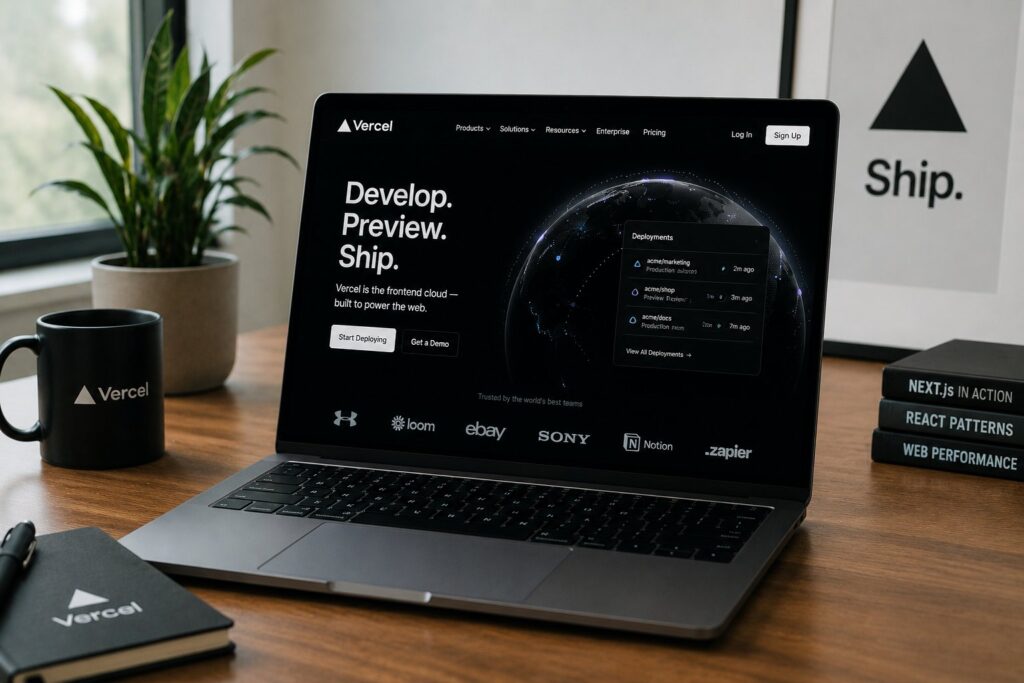
Update, July 26, 2026: this post’s storage section has been corrected. Vercel retired its first-party Vercel Postgres and Vercel KV products in December 2024, migrating them to Neon and Upstash respectively under the Vercel Marketplace. Vercel Blob and Edge Config are now the only first-party storage products. Our guide to Vercel storage covers the current lineup in full.
Vercel is the frontend cloud platform built and maintained by the team behind Next.js, the most widely used React framework on the web. Founded in 2016 (originally as ZEIT, renamed Vercel in 2020), the company has grown from a deployment service for static sites into a multi-product developer platform that covers application hosting, serverless and edge functions, managed databases, an AI SDK for building LLM-powered apps, and v0, an AI-first app builder that generates production-ready Next.js applications from a natural-language prompt. The company has positioned the platform increasingly as the "AI cloud" in 2025-2026, with v0 and the Vercel AI SDK now central to its product strategy.
This post is the introductory pillar for our Vercel coverage. It covers what Vercel actually is and what it ships, the Next.js relationship that defines the company’s reach, the core platform capabilities (deployments, preview URLs, edge network, functions, storage), the v0 + AI SDK product line that has become the company’s growth story, the pricing tiers and what each is actually for, where Vercel fits against the natural competitors (Netlify, Cloudflare Pages, AWS Amplify, traditional PaaS), and who Vercel is and isn’t the right choice for. It is not a tutorial; subsequent satellite posts will cover specific workflows, comparisons, and migration patterns.
What Vercel actually is
Vercel is a managed deployment platform for web applications, optimized for the modern JavaScript ecosystem and most heavily optimized for Next.js specifically. The product surface has expanded substantially across the last several years, but at its core the platform does three things.
First, it deploys your application from a Git repository. You connect a GitHub, GitLab, or Bitbucket repository; Vercel builds and deploys your application on push; every push to a non-production branch creates a preview deployment with its own URL; merging to your production branch promotes the build. The deploy-on-push pattern is industry-standard now, but Vercel’s preview-URL implementation is unusually polished and is one of the most-cited reasons developers choose the platform.
Second, it runs your application on a global edge network. Static assets are served from a CDN; serverless functions execute in regional locations close to your users; edge functions execute on the same network of points-of-presence that handles the CDN traffic. The result is low-latency response times for both static content and dynamic application logic, without the developer having to think about geographic distribution.
Third, it provides the surrounding services that real applications need: storage (Vercel Blob for files, Edge Config for configuration, and managed databases through Marketplace partners), analytics, observability, custom domain management, environment variables, team collaboration features. The platform handles the operational layer so application developers can focus on application code.
The cumulative effect is a platform that abstracts away most of the infrastructure work for modern web applications. The trade-off, as with any managed platform, is cost and lock-in: you pay a platform premium versus running the same workload on raw cloud infrastructure, and the platform’s specific implementations (especially the Next.js optimizations and the Vercel Functions runtime) create switching costs if you ever want to migrate.
The Next.js relationship
Vercel’s distinctive position in the hosting market is its ownership of Next.js, the most widely used React framework on the web. The relationship runs both directions: the Next.js project is led by Vercel employees and the framework is engineered with Vercel’s platform capabilities in mind; Vercel’s platform features (most notably the rendering modes, ISR, Image Optimization, Edge Middleware) are designed to be most powerful when running a Next.js application on Vercel specifically.
For Next.js developers, this is largely an advantage. Vercel runs Next.js better than anywhere else; framework-level features land on the platform first and most reliably; the support story is short (the people who built the framework also run the hosting). For developers using other frameworks (React with Remix, SvelteKit, Astro, Nuxt, Solid Start, vanilla static sites), Vercel still works, but the framework-specific optimizations don’t apply.
The other side of the same coin is the lock-in question. Building heavily on Vercel-specific Next.js features (the Vercel Edge Middleware runtime, ISR with on-demand revalidation, the specific shape of Vercel Functions) creates real switching costs if you ever want to move. Open-source projects like OpenNext (which ports the Next.js App Router runtime to AWS, Cloudflare, and Netlify) have made the lock-in lighter than it was two years ago, but the gravity is still real. Teams that prioritize portability tend to make different architectural choices than teams that lean fully into the Vercel stack.
For background on how the broader CMS-and-frontend architecture has been evolving, our coverage of headless content management systems covers the model that pairs naturally with Vercel-hosted frontends, and our CMS overview covers the broader category.
Core platform: deployments, preview URLs, edge network
The deployment experience is the foundation of Vercel’s product, and it’s the part most users encounter first.
The Git-integrated workflow is straightforward. You connect a repository, configure a project (Vercel auto-detects most common frameworks), and the platform builds and deploys on every push. Production deployments come from your main branch; preview deployments come from every other branch, pull request, or commit. Every preview deployment has its own unique URL, persisted indefinitely, that you can share with reviewers, designers, or stakeholders. The preview-URL pattern is one of the platform’s strongest workflow features and a recurring reason teams cite for choosing Vercel.
Rollbacks are immediate. Promoting a previous successful deployment back to production is a single click; the new deployment serves traffic within seconds. The model is "every deployment is a separate immutable artifact, and the production pointer is a thin layer on top," which gives you the rollback property as a side effect of the architecture.
The edge network handles geographic distribution. Static assets are served from a CDN that covers most major regions. Edge Functions (the cheaper, faster runtime) execute on a global point-of-presence network. Serverless Functions (the heavier runtime, used for anything that needs longer execution time or larger memory) execute in regional data centers. The split is the platform’s answer to "do I want this fast or do I want this powerful?": edge for low-latency request/response work, serverless for heavier compute.
Custom domains, environment variables, team collaboration, and analytics are all part of the platform surface. The administrative experience is generally clean and modern; the developer-facing CLI (vercel) is well-designed; the dashboard is one of the more polished operational interfaces in the hosting category.
Vercel Functions, Storage, and the edge runtime
Beyond static deployment, Vercel ships a substantive backend story.
Vercel Functions is the serverless and edge function runtime. The same function code can target either the Edge runtime (V8 isolates running on Vercel’s edge POPs, optimized for low-latency request/response work, with constraints on supported APIs) or the Node.js serverless runtime (full Node.js feature set, regional execution, supports longer-running work). The choice is a configuration flag; many real applications mix both runtimes depending on the work each endpoint does.
Postgres on Vercel. Vercel retired its own first-party Vercel Postgres product in December 2024 and moved existing databases to Neon, which now provides Postgres through the Vercel Marketplace. The integration experience is similar: connection details surface as environment variables, and provisioning happens from the Vercel dashboard, but the database is a partner service rather than a Vercel product.
Redis on Vercel. Vercel KV was likewise retired in December 2024 and migrated to Upstash Redis, also delivered through the Marketplace. It remains the natural choice for session storage, rate limiting, caching, and other small-value lookups that do not need full relational semantics, with the same environment-variable integration pattern.
Vercel Blob, one of only two remaining first-party storage products alongside Edge Config, is a managed object storage service for files (uploads, generated assets, anything you’d put in S3). Pairs naturally with the Vercel Functions runtime for typical "upload a file, store it, retrieve it" workflows without operating an S3 bucket and its IAM policies yourself.
Vercel Sandbox is the sandboxed code-execution environment that v0 and other AI-first workflows run code inside. It’s a managed, isolated runtime for executing untrusted or AI-generated code safely, with support for running Docker containers and persistent state across sessions (persistence reached general availability in 2026). For teams building agentic workflows or AI tools that need to execute generated code, Sandbox is the underlying primitive that lets that happen without designing the isolation layer yourself.
The storage products are positioned as "easiest path to a working database/cache/file-store from Vercel-hosted code." They’re not necessarily the cheapest option at scale, and large workloads often migrate to direct cloud equivalents (managed Postgres on AWS or GCP, native S3, Redis on Elasticache) once the volume warrants the operational investment. For prototyping, small-to-mid production workloads, and applications where development velocity matters more than per-GB pricing, the Vercel storage products are genuinely the path of least resistance.
v0 and the Vercel AI SDK: the AI-first product line
The most significant product evolution at Vercel over the last two years is the AI-first product line, anchored by v0 and the Vercel AI SDK. This is where the company has invested most heavily, and it’s increasingly central to how the platform is positioned.
v0 is Vercel’s AI-first app builder. Originally launched as a generative UI tool (describe a UI component in natural language, get React code), v0 has evolved into a full Next.js application builder. A user describes the application they want, and v0 generates a complete Next.js project: pages, API routes, server actions, database schema (via Supabase integration), and the supporting code, all deployable to Vercel with a click. The February 2026 v0 update added Git integration, a VS Code-style editor, database connectivity, and agentic workflows where v0 can iterate on the codebase autonomously to fulfill higher-level requests.
The v0 pricing tiers are: Free ($0 with $5 in monthly credits), Premium ($20/month for individual developers), Team ($30 per user per month), Business ($100 per user per month), and Enterprise (custom pricing). Model selection at the underlying generation layer is tiered (smaller models cost fewer credits per generation; frontier models cost more), so heavier usage shifts you up the credit consumption curve quickly.
The competitive landscape for v0 is the broader AI-first developer-tooling category. Our coverage of Google Antigravity and Google AI Studio covers the most direct equivalents from Google’s side; the broader category also includes Anthropic’s Claude Code, OpenAI’s Codex, Replit Agent, and similar products. v0’s specific position is "fastest path from natural-language prompt to deployed Next.js application on Vercel," which is a real and meaningful niche even as the broader category gets crowded.
The Vercel AI SDK is the open-source TypeScript toolkit for building LLM-powered applications. It abstracts the API differences between OpenAI, Anthropic, Google, and other model providers behind a unified interface; handles streaming, function calling, and structured-output patterns natively; and ships first-class support for React, Vue, Svelte, and the major frontend frameworks. The SDK is free and open-source (github.com/vercel/ai); the relationship to the Vercel platform is that AI SDK applications deploy cleanly to Vercel Functions, but the SDK itself runs anywhere TypeScript runs.
The AI SDK has become one of the most widely adopted toolkits in the AI-application category and is arguably more important to Vercel’s long-term competitive position than v0 itself. Every TypeScript developer building with LLMs is a candidate Vercel customer when they ship; the SDK is the on-ramp.
Where Vercel fits competitively
Three natural competitors anchor the frontend hosting market. The honest summary of where each shines:
Netlify is the original of the modern frontend-hosting category and remains the simplest option for static sites, JAMstack projects, and forms-and-functions sites that don’t need heavy backend logic. The deployment workflow and developer experience are very similar to Vercel’s at the static-site level. Pricing scales more predictably for smaller teams (the flat $20/month Team tier compares favorably to Vercel’s per-seat pricing for small teams). The Next.js story has gotten meaningfully better with the OpenNext project but is still not as polished as native Vercel.
Cloudflare Pages is the price-and-performance leader. Unmetered bandwidth (no egress fees, which is a category-defining advantage at scale), the world’s largest edge network (300+ points of presence), aggressive function pricing, and free dashboard collaboration make Cloudflare Pages the obvious choice when cost or global performance is the primary constraint. The platform polish around developer experience and the framework-specific optimizations are typically a step behind Vercel’s, but the gap has narrowed substantially since 2024.
AWS Amplify and traditional PaaS (Render, Railway, Fly.io, the various Cloud Run / App Engine alternatives) are the right answer when you need full backend control, longer-running processes, or the cost profile of direct cloud infrastructure. They’re not frontend-cloud platforms; they’re general-purpose application hosts. Building a typical Next.js application on Render or Fly.io is more configuration work than Vercel, but the cost-per-request at scale is meaningfully lower and the architectural options are broader.
For the hosting-platform comparison context in the WordPress and Drupal worlds, our WP Engine vs Pantheon comparison and Pantheon vs Acquia comparison cover the equivalent decisions for CMS-driven sites. Vercel and the JAMstack-cloud category are the parallel evolution for the JavaScript-frontend / headless-CMS world.
The honest short version: Vercel is the best Next.js host and the most polished developer experience; Cloudflare Pages wins on price and edge performance at scale; Netlify is the simplest option for static-shaped workloads.
Pricing: what you actually pay for
Vercel’s pricing has three primary tiers for the platform itself, plus separate pricing for v0 (covered above).
Hobby is free, intended for personal projects and learning. Includes deployment, the edge network, basic preview URLs, and limited Vercel Functions and storage. The constraints are oriented around "personal use, not production": commercial use is not permitted on the Hobby tier per Vercel’s terms, and bandwidth and execution caps are tight.
Pro is $20 per user per month, intended for small teams and independent professionals. Removes the commercial-use restriction, expands the bandwidth and function execution allowances, adds team-collaboration features, and includes more generous storage allocations across Postgres, KV, and Blob. The per-user pricing model is the relevant cost driver for team accounts: a team of five on Pro is $100 per month before any usage charges. Overages (bandwidth above the included quota, function execution above the included GB-seconds) bill on top.
Enterprise is custom pricing, intended for organizations with production traffic volumes, compliance requirements, single sign-on, dedicated infrastructure options, and the support and SLAs that enterprise procurement requires.
The bandwidth pricing is where Vercel’s costs become visible at scale. Both Vercel and Netlify charge egress fees for bandwidth above the included quota (in 2026, in the $40-$55 per 100GB range for overages); Cloudflare Pages does not. For high-traffic applications, the bandwidth math becomes a meaningful part of the platform-selection decision.
Who Vercel is and isn’t the right answer for
For Next.js teams that prioritize developer velocity and are willing to pay a platform premium, Vercel is straightforwardly the best option in the market. The framework support, the preview-URL workflow, the integrated storage and AI SDK, and the operational polish add up to a meaningful productivity advantage. The cost is real but is rarely the binding constraint for the small-to-mid team sizes the platform is most popular with.
For React, Vue, Svelte, or other non-Next.js JavaScript framework teams, Vercel still works and the developer experience is still strong. The framework-specific optimization advantages don’t apply, which makes the competitive case closer to Netlify’s; the decision often comes down to which platform’s overall product surface fits the team’s needs better.
For static sites, brochure sites, marketing pages, or any frontend that doesn’t depend on framework-specific features, Cloudflare Pages or Netlify will typically cost less and perform comparably. Vercel still works; it’s just not the highest-leverage choice for those workloads.
For applications with substantial backend logic (long-running processes, large compute, complex data pipelines, traditional API services), Vercel can host the frontend cleanly but the backend story should typically live elsewhere. A common pattern is a Vercel-hosted Next.js application with a separate backend on a more general-purpose host (a managed Kubernetes service, a traditional PaaS, direct cloud infrastructure) that the Vercel frontend calls.
For organizations evaluating AI-first developer tooling, v0 and the Vercel AI SDK both deserve a serious look. v0 is the most polished prompt-to-deployed-Next.js workflow in the market; the AI SDK is the most widely adopted TypeScript abstraction for LLM-powered applications and a useful tool even for teams that don’t host on Vercel.
What this means for development teams
A few takeaways for teams evaluating Vercel against the alternatives:
- If you’re building primarily on Next.js, Vercel is the default-correct choice for hosting unless cost or specific compliance requirements force otherwise. The framework-platform fit is genuine and substantial.
- If you’re building on a different React framework, Vue, Svelte, or static-site generators, the case for Vercel is weaker but still defensible on developer experience and storage integration. Compare against Netlify and Cloudflare Pages for the specific workload.
- If bandwidth costs are a meaningful part of your platform-selection decision (high-traffic content sites, video-heavy applications, anything where egress is the dominant cost), Cloudflare Pages’ unmetered bandwidth model is the category-defining advantage and is hard to ignore.
- If you’re building AI-powered applications, the Vercel AI SDK is worth adopting even if you ultimately host elsewhere. v0 is worth evaluating as a prototyping tool even if your production deployment doesn’t end up on Vercel.
- If your team works on WordPress, Drupal, or a traditional CMS, Vercel becomes relevant if you adopt a headless-CMS architecture with a JavaScript-framework frontend. In that pattern, the CMS lives on managed-WordPress or managed-Drupal hosting (Pantheon, WP Engine, Acquia), and Vercel hosts the frontend that consumes the CMS’s content API.
The deeper trajectory is that Vercel has become the most polished operating environment for the modern web-development workflow, particularly when AI-first developer tooling is part of the workflow. The trade-off is that the platform’s gravity is real: heavy use of Vercel-specific features creates switching costs that don’t apply on more portable hosting choices. For teams that find the trade-off acceptable (and most modern web-application teams do), the productivity payoff is substantial.
Frequently Asked Questions
What is Vercel?
Vercel is a managed deployment platform for web applications, built and maintained by the team behind Next.js. The platform handles Git-integrated deployments, a global edge network for content delivery and function execution, managed databases and storage (Postgres, KV, Blob), and an AI-first product line anchored by v0 (the AI app builder) and the Vercel AI SDK. It’s positioned as the “frontend cloud” or “AI cloud,” with particular strength for Next.js applications.
Who owns Vercel and Next.js?
Vercel Inc. is the company; it was founded in 2016 (originally as ZEIT, renamed Vercel in 2020). Next.js is an open-source project that Vercel maintains: the Next.js team works at Vercel, the framework is developed in the open at github.com/vercel/next.js, and Next.js is licensed permissively (MIT) so it can run anywhere. The framework’s roadmap is heavily influenced by Vercel’s platform priorities.
What does Vercel cost?
The platform itself has three tiers: Hobby (free, personal use only, not for commercial workloads); Pro ($20 per user per month, the standard tier for small teams); and Enterprise (custom pricing). Bandwidth overages bill on top in the $40-$55 per 100GB range as of 2026. Vercel Storage products (Postgres, KV, Blob) have their own tiered pricing within each plan. v0 has separate pricing: Free ($0 with $5 in monthly credits), Premium ($20/month), Team ($30/user/month), Business ($100/user/month), and Enterprise (custom).
How is Vercel different from Netlify and Cloudflare Pages?
All three are managed frontend hosting platforms with similar deployment workflows. Vercel is the strongest Next.js host and has the most polished developer experience for the modern React-and-AI stack. Netlify is the simplest option for static sites and Jamstack workloads, with flat-rate pricing that scales more predictably for small teams. Cloudflare Pages wins on bandwidth pricing (unmetered, no egress fees) and edge performance (300+ points of presence), making it the price-and-performance leader at scale. Most decisions come down to specific framework support and bandwidth math rather than feature checklists.
What is v0 and how does it relate to Vercel?
v0 is Vercel’s AI-first app builder. You describe what you want in natural language, and v0 generates a complete Next.js application (pages, API routes, server actions, database schema via Supabase, supporting code) that deploys to Vercel with a click. The 2026 update added Git integration, a VS Code-style editor, database connectivity, and agentic workflows. v0 sits in the same broader product category as Google’s v0-like AI builders (covered in our Google AI Studio and Google Antigravity posts) and similar AI-first developer tools from Anthropic, OpenAI, and Replit.
What is the Vercel AI SDK?
The Vercel AI SDK is an open-source TypeScript toolkit for building LLM-powered applications. It abstracts the API differences between OpenAI, Anthropic, Google, and other model providers; handles streaming, function calling, and structured-output patterns natively; and provides first-class support for React, Vue, Svelte, and other major frontend frameworks. The SDK is free and open-source (github.com/vercel/ai), runs anywhere TypeScript runs (it doesn’t require Vercel hosting), and has become one of the most widely adopted LLM toolkits in the JavaScript ecosystem.
Is Vercel the right choice for WordPress or Drupal sites?
Not for traditional WordPress or Drupal hosting (where the CMS, the application, and the rendering all live together). Those workloads belong on managed-WordPress or managed-Drupal hosts like Pantheon, WP Engine, or Acquia. Vercel becomes relevant when you adopt a headless-CMS architecture: the CMS lives on a traditional CMS host, exposes its content via API, and a separate frontend (typically built in Next.js or another React framework) consumes that API and renders the site. In that pattern, the frontend is what lives on Vercel. See our WP Engine vs Pantheon and Pantheon vs Acquia comparisons for the CMS-side decisions.
How does Vercel’s edge network compare to Cloudflare’s?
Cloudflare operates a larger edge network with substantially more points of presence (300+ as of 2026 versus Vercel’s significantly smaller footprint), which translates to lower latency in regions further from major data-center hubs. For typical North American or European traffic, the difference is less pronounced; for global audiences with substantial traffic from Asia, Africa, or South America, Cloudflare’s edge advantage is more visible. Cloudflare’s pricing for edge function execution is also typically lower than Vercel’s at scale. Vercel’s competitive answer is the polish of the developer experience and the depth of the Next.js integration; for many teams, those advantages outweigh the network-size difference.