Claude Science is Anthropic’s AI workbench for scientists, launched on June 30, 2026. The most important thing to understand about it is what it is not: it is not a new AI model, and it is not a more capable model for biology. It is a workbench, a customizable application that wraps the existing Claude models in the databases, tools, and workflows that researchers actually use. Anthropic’s bet, in its own framing, is that the way to help science is not another model but the workflow around it.
The short version: Claude Science takes the Claude models you can already access, such as Claude Opus 4.8, and puts them inside an environment built for real research. It comes pre-connected to more than 60 scientific databases, renders scientific artifacts like 3D protein structures and genome browser tracks, keeps auditable histories of what it produced, runs on your own machine or your compute cluster, and hooks into specialized life-sciences models through NVIDIA’s BioNeMo. This piece explains what Claude Science is, the crucial point that it is a workflow layer rather than a new model, what it connects to, what it does, what researchers are using it for, and how to get it. For context on the models underneath it, see our coverage of Claude Opus 4.8 and Claude Sonnet 5.
What Claude Science is
Claude Science is a customizable app that integrates the tools and packages researchers most often reach for, produces auditable artifacts, and provides flexible access to computing resources. Think of it less as a chatbot and more as a research environment with Claude at the center of it.
The design reflects how scientific work actually happens. A researcher rarely just asks a question and gets an answer; they run analyses, generate figures, check results against known data, and need a record of how they got there. Claude Science is built around that reality, with the model able to reach the right databases, run the right tools, render the right kind of scientific output, and leave a trail you can audit afterward.
What it is not: a new model
This is the point most likely to be misunderstood, so it is worth being blunt. Claude Science is not a new AI model, and it is not a specially tuned or gated model for biology. It operates on the existing Claude models, including Claude Opus 4.8, with no special access or capability that you cannot get elsewhere. The intelligence is the same Claude you already know; what is new is everything around it.
That is a deliberate strategic bet, and it is the real story of the launch. Rather than trying to win scientists with a bigger or biology-specific model, Anthropic is betting on workflow: that the bottleneck for AI in science is not raw model capability but the friction of connecting a general model to the specific data, tools, and reproducibility requirements of research. If that bet is right, the value is in the integration and the auditability, not in a new set of weights. It also means you should evaluate Claude Science as a research environment, not as a claim about frontier model performance.
What it connects to
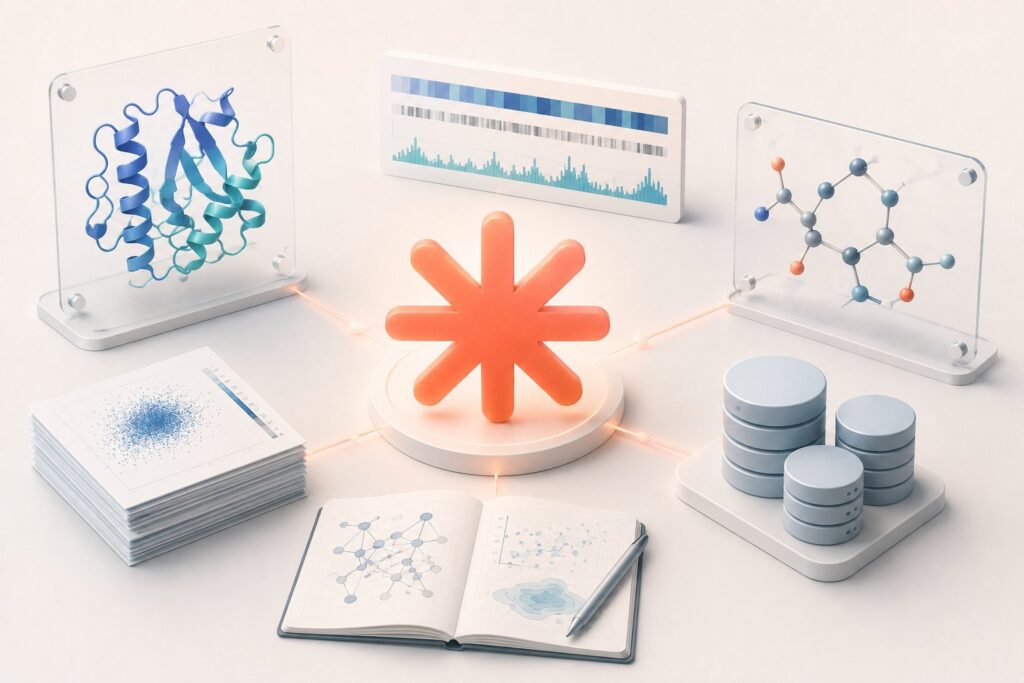
The integration is where the workbench earns its name. Claude Science comes pre-configured with more than 60 scientific databases and connectors spanning the major domains of modern biology: genomics, single-cell, proteomics, structural biology, and cheminformatics. Instead of a researcher manually wiring the model up to the resources they need, those connections are ready out of the box.
It also connects to specialized models. Claude Science uses the skills in NVIDIA’s BioNeMo Agent Toolkit to link natively to the life-sciences models and libraries in BioNeMo, including Evo 2, Boltz-2, and OpenFold3. That matters because general language models are not the right tool for every scientific task; protein structure prediction and genomic modeling have their own specialized models, and Claude Science is designed to orchestrate them rather than pretend to replace them. The Claude model becomes the reasoning and workflow layer that calls the specialized science models when they are the right tool.
What it does
Beyond connecting to data and models, Claude Science provides the practical capabilities a research environment needs:
- Renders scientific artifacts. It can produce and display the outputs scientists work with, including 3D protein structures, genome browser tracks, and chemistry drawings, rather than just text descriptions of them.
- Keeps auditable histories. Outputs come with a record of how they were produced, which is essential for reproducibility and for trusting an AI-assisted result in a scientific context.
- Runs where your work runs. It can run locally on macOS or Linux, or remotely over SSH and on HPC clusters, so it fits into existing research computing setups rather than forcing everything into a cloud app.
These are the unglamorous but decisive features. Reproducibility, real scientific output formats, and fitting into a lab’s existing compute are exactly the things that determine whether a tool gets used in serious research or abandoned after a demo.
What researchers are using it for
Claude Science ran in beta for several months before launch, and the beta use cases show the intended shape of the tool. Researchers used it for single-cell RNA sequencing analysis, CRISPR screen design, protein structure prediction, and cheminformatics, among other tasks. These are real, involved computational-biology workflows, not toy examples, which is the point: the workbench is aimed at the day-to-day analytical work of practicing scientists, particularly in the life sciences and biopharma.
Anthropic has also signaled how seriously it takes the domain by reportedly starting its own drug-discovery programs, which is a notable move for a model company and a sign that it sees science as a first-class application rather than a side market.
Who it’s for and how to get it
Claude Science is aimed at researchers and the pharmaceutical and biotech industry, and it launched in beta available to anyone on the Pro, Max, Team, and Enterprise plans. That is a relatively open beta for a specialized product, which fits the workflow-not-a-new-model strategy: because it runs on the standard Claude models, Anthropic can offer it broadly to existing subscribers rather than gating it behind special model access.
If you are a researcher on one of those plans, the practical path is to try it on a real workflow you already understand, since the value proposition is the integration and reproducibility rather than a capability you could not otherwise reach. If you are evaluating it for a team, weigh how well its database connectors, artifact rendering, and compute options fit your actual pipelines, because that is where a workbench either saves time or does not.
The bottom line: Claude Science is a bet that the missing piece for AI in research is workflow, not intelligence, and it packages the existing Claude models into an environment built for how science actually gets done.
Frequently Asked Questions
What is Claude Science?
Claude Science is Anthropic’s AI workbench for scientists, launched June 30, 2026. It is a customizable app that integrates the tools, more than 60 scientific databases, and workflows researchers use, produces auditable artifacts, and provides flexible access to computing. It puts the existing Claude models at the center of a real research environment rather than being a chatbot or a new model.
Is Claude Science a new AI model?
No. This is the key point. Claude Science is not a new model and not a more capable model for biology. It runs on the existing Claude models, including Claude Opus 4.8, with no special access or gating. What is new is the workbench around the model: the integrations, the scientific output rendering, the auditability, and the compute options.
What databases and models does it connect to?
It comes pre-configured with more than 60 scientific databases and connectors across genomics, single-cell, proteomics, structural biology, and cheminformatics. It also uses NVIDIA’s BioNeMo Agent Toolkit to connect natively to specialized life-sciences models including Evo 2, Boltz-2, and OpenFold3, so the Claude model can call domain-specific models when they are the right tool.
What can Claude Science actually do?
It renders scientific artifacts such as 3D protein structures, genome browser tracks, and chemistry drawings; keeps auditable histories of its outputs for reproducibility; and runs locally on macOS or Linux or remotely over SSH and HPC. In beta, researchers used it for single-cell RNA sequencing analysis, CRISPR screen design, protein structure prediction, and cheminformatics.
Why does “workflow, not a new model” matter?
Because it defines what Claude Science is competing on. Anthropic is betting that the barrier to AI in science is not raw model capability but the friction of connecting a general model to specific data, tools, and reproducibility requirements. The value is in integration and auditability rather than a new set of weights, so you should evaluate it as a research environment, not as a claim about model performance.
Who is it for, and how do I get it?
It is aimed at researchers and the biopharma industry, and it launched in beta to anyone on the Pro, Max, Team, and Enterprise plans. Because it runs on the standard Claude models, Anthropic can offer it broadly to existing subscribers rather than gating it. The best way to evaluate it is to run a real workflow you already understand and see whether the integrations and reproducibility save you time.
How is Claude Science different from just using Claude?
The underlying model is the same. The difference is the environment: pre-built connections to dozens of scientific databases and specialized models, the ability to render real scientific artifacts, auditable output histories, and the option to run on your own machine or compute cluster. Those are the things that make the same model usable inside a serious research workflow rather than a general chat.