The Even Realities G2 is a pair of display smart glasses that takes the opposite approach to most of the category: no camera, no external speakers, and a small monochrome heads-up display that appears only when you want it. Paired with the R1, a ceramic smart ring you use to control the glasses, it is one of the more quietly interesting wearable setups on the market. This piece explains what the G2 and R1 are, what they do, what they cost, and where they fit against the rest of the smart-glasses field.
The short version: the G2 puts a subtle green display in your line of sight for things like AI prompts, live translation, teleprompting, and transcription, and it does so in a normal-looking pair of glasses you can fit with your own prescription. The R1 ring is how you drive that interface without reaching up to touch the frame, and it doubles as a health tracker. Together they are aimed at people who want ambient, glanceable information rather than a camera on their face or a big virtual screen. For the wider category and how these compare to other kinds of eyewear, see our guide to AR glasses.
What the Even Realities G2 is
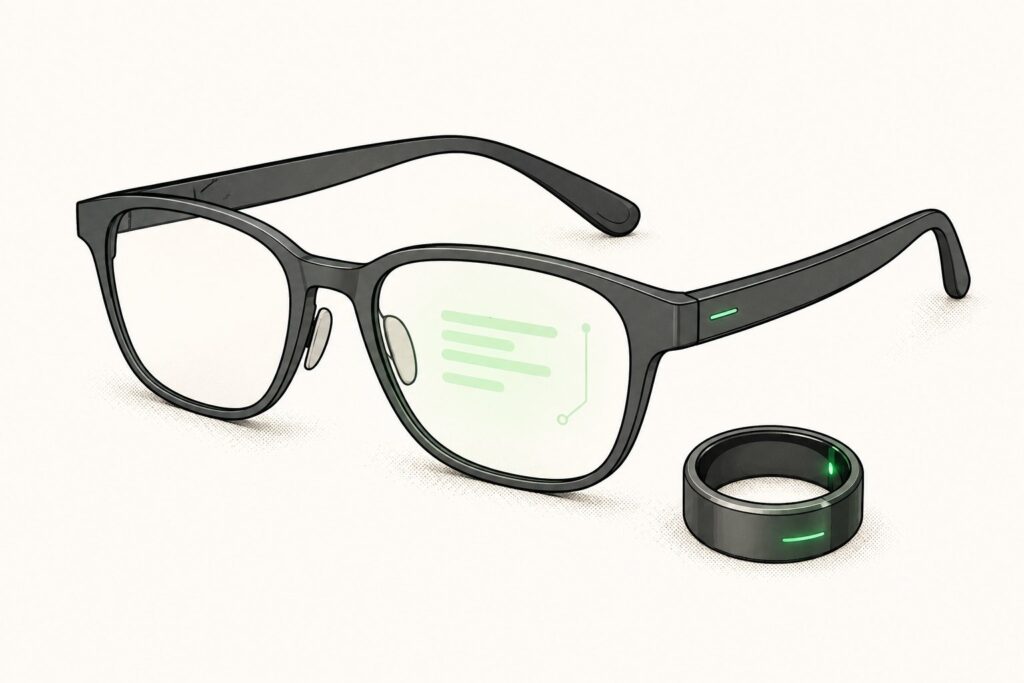
The Even Realities G2 is a set of camera-free display glasses that weigh about 36 grams, close to a normal pair of eyeglasses. Instead of a camera and speakers, the hardware is built around a discreet display and an on-device AI assistant. The design philosophy is deliberately restrained: no camera means nothing pointed at the people around you, and no external speaker means nothing broadcasting your notifications out loud. Even Realities frames this as a privacy-first, low-distraction take on smart glasses, and it is the main reason reviewers describe the G2 as a quiet challenger to camera-first products like Ray-Ban Meta.
The display is the centerpiece. The G2 uses what Even Realities calls HAO 2.0, or Holistic Adaptive Optics, a monochrome green micro-LED system paired with waveguide lenses. Green is used because it is the color the human eye sees most easily, which lets the display stay bright and readable against the real world while drawing very little power. The image is a floating heads-up display that activates on demand rather than sitting in your view all the time, and the newer optical engine is both smaller and noticeably larger in display area than the first-generation G1. The glasses carry an IP67 rating for dust and water resistance, and they support an unusually wide prescription range, from -12 to +12 diopters, so most people can wear them as their everyday glasses.
What you actually see: the display and Even AI
Because the G2 has a real display, it can show text and simple interface elements rather than just play audio. The on-demand screen powers a set of features built around glanceable information:
- Even AI. An on-device style AI assistant that surfaces prompts and answers in your line of sight, without a camera watching the scene.
- Conversate and Translate. Real-time conversational prompts and live translation across dozens of languages, shown as text you can read while you talk.
- Teleprompt. A teleprompter that scrolls your script in the display, useful for presentations or recording.
- Transcribe. Live transcription of what is being said, captured to text.
The through-line is that the G2 is about reading small amounts of the right information at the right moment. It is not trying to be a screen you watch movies on, and it is not trying to capture the world with a camera. That focus is the product’s identity, and it is what makes the display genuinely useful for conversation, translation, and speaking rather than a gimmick.
The R1 ring: how you control the glasses
The R1 is a smart ring that acts as the primary controller for the G2. Rather than tapping the side of the frame every time, you drive the interface with subtle finger gestures: tap, scroll, and long-press. That matters for a device whose whole appeal is being discreet, because reaching up to your glasses in a meeting is exactly the kind of visible fiddling the G2 is trying to avoid.
The ring is built to be worn all day. It is made from zirconia ceramic over a medical-grade stainless steel core, carries an IP68 water-resistance rating, and lasts up to about four days on a charge. It is also a health tracker in its own right, monitoring heart rate, blood oxygen, sleep, heart-rate variability, and steps, which is the same job a fitness ring or smartwatch would do. So the R1 is doing double duty: it is the remote control for the glasses and a standalone wearable that tracks your body.
You can also control the G2 through a touch sensor on the frame itself or through the companion app, so the ring is the preferred input rather than the only one. But the ring is what makes the experience feel seamless, and Even Realities clearly designed the two to be used together.
Battery and everyday wear
Battery life is one of the G2’s standout traits. The glasses are rated for roughly two days of active use on a charge, and the charging case holds around seven more full recharges, which comfortably covers a week of normal wear before you need to plug the case in. That is a different league from camera-equipped smart glasses that often need charging within a day. Combined with the light 36-gram frame, the wide prescription support, and the IP67 rating, the G2 is designed to be the actual glasses you wear all day, not a gadget you put on for a demo.
What it costs and how it is sold
The Even Realities G2 sells for $599 in the United States, with European pricing around £599 or €699. The R1 ring is a separate purchase at $249, or roughly £239 to €269. Even Realities has offered a launch promotion where buyers who get the G2 without a prescription can take 50% off the R1 when they bundle it, which brings the ring closer to an easy add-on than a second major purchase. Prices and promotions change, so it is worth checking the current figures on Even Realities’ own store before you buy, but the shape of it is clear: the glasses are the main cost, and the ring is a meaningful but optional extra.
Where it fits, and who it is for
The G2 sits in a specific corner of the smart-glasses world. It is not a camera-first product like Ray-Ban Meta, which is built around capturing photos and video and talking to an assistant with no real display. And it is not a big-screen media glasses product like the VITURE Beast, which is about projecting a large virtual monitor for watching video or working. The G2 is a third thing: everyday heads-up display glasses that show small, useful bits of text on demand. If you want to understand those other categories and how display glasses differ from camera glasses, our AR glasses guide lays out the landscape.
That makes the audience fairly specific. The G2 and R1 are for people who want ambient information, live translation, or teleprompting in a normal-looking pair of glasses, who value not having a camera on their face, and who are comfortable paying a premium for a restrained, well-built device. If you mainly want to record video or watch a giant virtual screen, this is not the product for you, and that is by design.
The honest limits
A few things are worth being clear-eyed about. The display is monochrome green and built for text and simple prompts, so it will not show rich images or video. There is no camera, which is the point, but it also means no photos, no video, and no visual scene understanding. The setup is not cheap once you add the ring, and the software ecosystem, while genuinely useful, is younger and narrower than what a phone offers. None of these are flaws so much as consequences of the product’s focus, but they define who will be happy with it.
The bottom line: the Even Realities G2 and R1 are a bet that the best smart glasses are the ones you barely notice, showing you a little of the right information and staying out of the way otherwise. If that idea appeals to you, this is one of the most polished attempts at it so far.
Frequently Asked Questions
What is the Even Realities G2?
The Even Realities G2 is a pair of camera-free display smart glasses. It weighs about 36 grams, uses a monochrome green micro-LED heads-up display that appears on demand, and runs features like an AI assistant, live translation, teleprompting, and transcription. It has no camera and no external speakers, and it supports a wide prescription range, so it can serve as your everyday glasses.
What does the R1 ring do?
The R1 is a smart ring that controls the G2 glasses with tap, scroll, and long-press gestures, so you can drive the display without touching the frame. It also works as a health tracker, monitoring heart rate, blood oxygen, sleep, heart-rate variability, and steps. It is made from ceramic over a steel core, is IP68 water resistant, and lasts about four days per charge.
Does the Even Realities G2 have a camera?
No. The G2 deliberately has no camera and no external speakers. That is central to its privacy-first design: nothing is pointed at the people around you and nothing broadcasts your notifications out loud. The trade-off is that it cannot take photos or video or understand a scene visually.
How much do the G2 and R1 cost?
The G2 glasses are $599 in the United States, roughly £599 or €699 in Europe. The R1 ring is $249, roughly £239 to €269. Even Realities has run a launch offer giving 50% off the R1 when it is bundled with a G2 bought without a prescription. Check the current price on Even Realities’ store, since promotions change.
Can I get the G2 with my prescription?
Yes. The G2 supports a wide prescription range from -12 to +12 diopters, which is one of its selling points. That range is wide enough for most people to wear the G2 as their normal daily glasses rather than needing a separate pair.
How long does the battery last?
The G2 glasses are rated for about two days of active use on a charge, and the charging case adds roughly seven more full recharges, so you can go about a week before recharging the case. The R1 ring lasts up to about four days per charge. Both are built for genuine all-day, multi-day wear.
How is the G2 different from Ray-Ban Meta or the VITURE Beast?
Ray-Ban Meta is camera-first with no real display, built for capture and audio. The VITURE Beast is media glasses built to project a large virtual screen for video and work. The Even Realities G2 is neither: it is everyday heads-up display glasses that show small amounts of text on demand, with no camera. Our AR glasses guide explains these categories in more detail.
Who should buy the Even Realities G2?
People who want glanceable information, live translation, or teleprompting in a normal-looking pair of glasses, who prefer not to wear a camera on their face, and who are comfortable paying a premium for a restrained, well-made device. It is not for people who mainly want to record video or watch a large virtual screen.