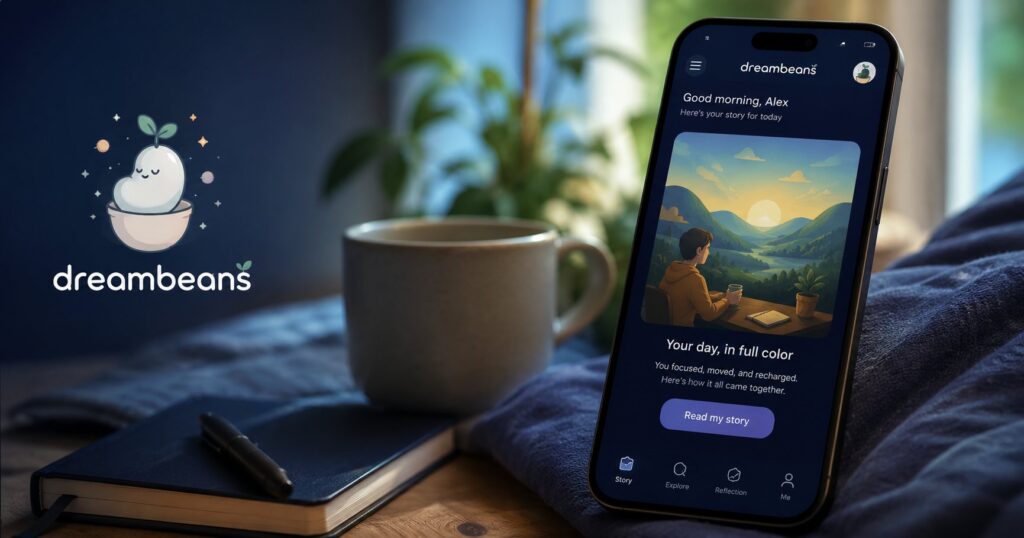
Google Dreambeans is an experimental Google Labs app launched on June 3, 2026 that uses the contents of a user’s Gmail, Google Calendar, Google Photos, YouTube, and Search history to generate 10 to 14 personalized illustrated daily stories every morning. The stories are illustrated by Nano Banana 2, Google’s current-generation image model, and can optionally feature the user’s own face and family. At launch, access was restricted to Google AI Ultra subscribers in the United States who are 18 or older. That gate is now gone: as of late August 2026 Dreambeans is free to any US Google Account. The most interesting design choice is the cap: Dreambeans deliberately stops at 10 to 14 stories per day. No infinite scroll, no algorithmic rabbit hole, no engagement-maximizing recommendation tail. The product is positioned explicitly as an alternative to the bottomless feed model that dominates 2026 mobile attention.
The bigger story Dreambeans is part of is what Google has started calling "Personal Intelligence", the technology layer that uses a user’s own data as the conditioning context for AI outputs. Dreambeans is the first consumer-facing product in that framing, but it’s almost certainly not the last. The Personal Intelligence approach is distinct from general-purpose AI inference (where the same prompt produces roughly the same output regardless of user) in that the output is explicitly grounded in the user’s specific digital footprint. The technical promise is that the AI feels personally relevant in a way generic models can’t match. The privacy implications are that your AI experience becomes a function of your entire Google data ecosystem, which is either a feature or a structural concern depending on how you think about platform centralization.
Update (2026-08-30): Dreambeans is now free. This post was first published on June 15, 2026, when Dreambeans was limited to Google AI Ultra subscribers in the United States. Google expanded eligibility to AI Pro subscribers during August 2026 and then dropped the subscription requirement altogether, and as of August 28, 2026 the app is open to any US Google Account. The sections below reflect the current terms; the launch-time restrictions are kept as history.
This post covers what Dreambeans actually is, the Personal Intelligence framing, how the daily-story generation works, the deliberate anti-feed product philosophy, how access has changed since launch, the Nano Banana 2 image model that powers the visuals, the privacy considerations worth knowing, where Dreambeans fits in Google’s broader AI consumer-product strategy, and what users and marketers should think about as the product expands.
What Dreambeans actually is
Dreambeans is a mobile and web app that generates a daily collection of short illustrated stories tailored to your life. Each morning, the app reads (with your permission) signals from your Google data and produces a curated set of 10 to 14 stories that are meant to spark ideas, surface things you care about, or point you toward content that’s relevant to your recent activity and upcoming plans.
The story formats vary. A trip you’ve been planning becomes an illustrated travelogue of what your destination might feel like. A topic you’ve been searching becomes a explainer with custom illustrations. A photo you took becomes the starting point for a narrative about the moment. A calendar event becomes a preview of what to expect. The illustrations are generated on demand by Nano Banana 2 and can feature your own face (and the faces of people you’ve consented to include) as the protagonists of the stories.
The reading experience is built around the daily quota. You open the app in the morning, work through the day’s stories, and you’re done. There’s no infinite scroll, no algorithm trying to keep you on the app for hours, no engagement-maximizing feedback loop. When you’ve consumed the day’s stories, the app deliberately stops. The next batch arrives the following morning.
For broader context on Google’s AI strategy, our Gemini Spark coverage covers the agentic Gemini experience that pairs with Dreambeans-style personalization, and our Google AI Studio coverage covers the developer-facing AI tooling that runs on the same Gemini foundation.
The "Personal Intelligence" framing
Google is using "Personal Intelligence" as the category label for the underlying technology Dreambeans builds on. The framing matters because it positions a distinct category of AI capability that competing products from OpenAI, Anthropic, and others don’t directly compete with at the same level of integration.
The Personal Intelligence pitch in plain language: general-purpose AI models know a lot about the world but nothing about you specifically. When you ask a generic model a question, it answers based on its training data and the immediate context you provide. Personal Intelligence systems start with your data (your email, your photos, your calendar, your search history, your location) as the primary context and use that to ground every output.
Google’s structural advantage in this category is real. The company holds more user data of more types over longer timespans than essentially any competitor. Gmail has been the dominant email service for over 20 years. Photos has been the default for Android users for over a decade. Search history goes back to a user’s first Google account creation. Maps holds location history that no competitor has at scale. The data inputs Personal Intelligence depends on are inputs Google already has.
The competitive question is whether Personal Intelligence becomes a category that other AI vendors can credibly enter. OpenAI’s ChatGPT memory feature is the closest existing analog, but it’s much smaller in data scope. Apple’s Personal Intelligence (announced in 2024 as part of Apple Intelligence) was the prior use of the same name in the industry and remains a competitor on iPhone, but Apple’s data scope is also smaller than Google’s. Anthropic’s MCP-based personalization is the framework Anthropic and others use, but it requires explicit data integrations that lag what Google’s first-party data provides natively.
If Personal Intelligence becomes a meaningful AI product category, Google has a structural lead. Dreambeans is the first consumer product validating the category for Google.
How the daily-story generation works
The high-level pipeline Google has described:
Signal extraction. Each user’s Dreambeans agent reads their connected Google services (Gmail, Calendar, Photos, YouTube, Search) and extracts signals that might seed stories. A flight confirmation in Gmail signals an upcoming trip. A search for a recipe signals a cooking interest. A YouTube watch session on a topic signals an ongoing interest. A photo from a recent event signals a memory worth revisiting.
Story candidate generation. Gemini (the underlying model) takes the extracted signals and proposes story candidates. The candidate pool is larger than the daily quota; the system needs to choose 10 to 14 from a longer list.
Story selection. The selection step filters and ranks the candidates against the day’s signal mix, the user’s prior engagement patterns, and freshness criteria. The selected set becomes the day’s batch.
Story drafting. Each selected candidate becomes a short narrative drafted by Gemini. The narrative is grounded in the specific signal that triggered it (your flight, your search, your photo) and personalized to what Google knows about you.
Story illustration. Each draft is paired with illustrations generated by Nano Banana 2. When the story includes the user (or family members the user has consented to include), Nano Banana 2 produces images that feature their actual likenesses. Otherwise, the illustrations are stylized representations of the story content.
Delivery. The full set of 10 to 14 stories is delivered to the user’s Dreambeans app each morning. The user can read, skip, share, save, or delete individual stories. The engagement signals feed back into the next day’s story selection.
The pipeline runs once per day on a fixed schedule rather than continuously. That’s the architectural enforcement of the "no infinite scroll" promise.
The anti-feed product philosophy
The 10-to-14-stories-then-stop design is the most distinctive product choice Dreambeans makes, and it’s worth understanding why Google built it that way.
The dominant model for content consumption in 2026 mobile remains the infinite feed: TikTok, Instagram, X, YouTube Shorts, and a dozen smaller products serve content endlessly, with algorithmic ranking optimized to keep users engaged as long as possible. The criticism of that model has built steadily over the past several years: attention fragmentation, mental-health effects on teens, the structural conflict between platform incentives and user well-being. Google’s own products (YouTube most prominently) have been on the receiving end of much of that criticism.
Dreambeans is, deliberately, the opposite design. The daily quota is meant to bound the time a user spends in the app. The fixed-length story format is meant to give each piece of content a definite endpoint rather than a scroll-driven continuation. The morning-batch delivery is meant to give the app a place in the day rather than a perpetual presence on the home screen.
Whether this design choice creates a successful product is an open question. The infinite feed is dominant for a reason: engagement metrics are dramatically higher than bounded-content alternatives. A user who consumes 14 Dreambeans stories and then closes the app is contributing far less to engagement metrics than a user who scrolls TikTok for 90 minutes. If Dreambeans optimizes for user well-being at the cost of engagement, the product economics are different from the products it’s positioned against.
That was likely fine for Google while Dreambeans sat behind a subscription. The product was built on the Google AI Ultra tier rather than on advertising, and subscriber economics reward customer satisfaction and retention rather than time-on-app. Being the "calm" alternative to TikTok and Instagram worked as a value proposition for paying subscribers in a way that an ad-funded version of the same product probably wouldn’t. Now that the subscription is gone, that argument needs a new footing, which is a point the access section returns to.
Nano Banana 2: the image model under the hood
The illustrations that give Dreambeans its visual identity come from Nano Banana 2, Google’s current image generation model. Nano Banana is Google’s family of image models for consumer-product integration (distinct from Imagen, which targets developer use cases). The "2" in Nano Banana 2 indicates this is the second-generation model in the family.
Key capabilities relevant to Dreambeans:
Likeness preservation. Nano Banana 2 can generate images that feature specific people’s faces consistently across multiple illustrations. For Dreambeans, this is what makes the user’s stories actually feature the user (and their family, where consented) as recognizable characters rather than generic stand-ins.
Style consistency. The model produces illustrations that share a consistent visual style across a day’s batch of stories. Each Dreambeans batch reads as a coherent set of illustrations rather than a random collection of varied styles.
Speed. The model is fast enough to generate the illustration set for a day’s stories at delivery time without making the user wait. Dreambeans isn’t a real-time experience (the daily batch is generated overnight in most cases), but the per-illustration generation is fast.
Content safety. Nano Banana 2 includes Google’s standard safety classifiers, which is particularly important for a product that generates images including specific people’s faces. The classifiers refuse to generate inappropriate content involving identified individuals, including the user themselves.
Nano Banana 2 isn’t exclusive to Dreambeans. The model is used across multiple Google products and is also available in some form through Google AI Studio for developer use. Dreambeans is the highest-profile consumer application of the model to date.
Access and pricing
Access is now free in the United States. Any US Google Account can use Dreambeans, with no Google AI subscription required, as 9to5Google reported on August 28, 2026.
The launch state is worth keeping as context, because it moved fast. At release on June 3, 2026, Dreambeans was limited to Google AI Ultra subscribers, Google’s premium AI tier at $19.99 per month in the US, covering Gemini Advanced, Imagen and broader Workspace AI integrations. Google expanded eligibility to the lower-priced AI Pro tier during August 2026, then removed the paid requirement entirely. The product went from Google’s narrowest paid tier to no paid tier in under three months.
The constraints that remain are narrower than the ones that went away. Dreambeans is still US only, still limited to users 18 or older, and still an experimental Google Labs release, which means the feature set and the access terms can change again without notice. Setup is not instant either: the app takes up to a day to build your first set of stories and notifies you when the first collection is ready.
Removing the subscription gate is the most consequential change since launch. The addressable audience went from the slice of US users who pay for Ultra to essentially every US Google Account, which is the difference between a premium experiment and a mass-market one. It also complicates the subscriber-funded economics this post describes above: a product with no subscription behind it has no subscriber retention to optimize for, and the calm, bounded design that made sense as a paid-tier perk now has to justify itself on other terms.
Privacy considerations
A product that reads your email, calendar, photos, search history, and YouTube data to generate AI content has obvious privacy implications. Worth thinking about explicitly:
The data scope is broad. Dreambeans needs access to multiple Google services to function. If you grant access, you’re letting an AI system process the substantial fraction of your digital life that’s in Google’s services. The processing is on Google’s infrastructure (Google has been clear that Dreambeans operates on Google’s servers, not on the device), so the access permission is also a data-residency permission.
The data is used for personalization, not training. Google has said publicly that Dreambeans data isn’t used to train the underlying Gemini or Nano Banana 2 models. That’s a meaningful commitment but it depends on Google honoring it consistently. The privacy policy is the artifact that holds Google accountable; read it before granting access.
Likeness generation has real implications. If you grant Dreambeans permission to feature your face in illustrations, you’re letting Google generate synthetic imagery of you. The illustrations stay in your Dreambeans feed by default, but the generation capability is real and the safeguards depend on Google’s content-safety enforcement. For users who are public figures, victims of stalking or harassment, or otherwise concerned about likeness misuse, the prudent move is to not grant likeness permission.
Family consent matters. Dreambeans can feature family members in stories if you grant permission. The family-member consent question is real: are the family members aware that their likenesses are being generated by Google’s image model? For children specifically, this question is sharper. Google has age gating on the user (18+ for now), but the family members in the stories aren’t subject to the same gating.
The data deletion path. Google has said users can delete Dreambeans data at any time, which removes the stories from the app and removes the user-specific conditioning data from the system. The deletion semantics for the underlying signal extraction (the Gmail, Calendar, Photos data that fed the stories) revert to the standard Google account deletion path. Test the deletion flow before committing to long-term Dreambeans use if data deletion is important to you.
The honest summary: Dreambeans is a fundamentally privacy-invasive product. That doesn’t mean it’s a bad product; it means the privacy tradeoff is real and you should evaluate it explicitly rather than tacitly.
Where Dreambeans fits in Google’s broader AI strategy
Dreambeans is one of several Google 2026 AI products that, taken together, sketch out a clearer strategy than any one of them individually:
Gemini remains the foundational model that powers nearly every Google AI product.
Google Antigravity is the agentic coding platform for developers (covered in our Antigravity coverage).
Gemini Spark is the consumer-facing agentic AI experience (covered in our Spark coverage).
Google AI Studio is the developer-facing tooling for building on Gemini.
Dreambeans is the experimental consumer product validating the Personal Intelligence framing.
The pattern: Google is releasing AI products that target distinct user segments (developers, agentic-AI consumers, personal-AI consumers, AI Studio prototype builders) all building on the same Gemini foundation but with different user-experience patterns and integration depths. Dreambeans is the consumer-product expression of the Personal Intelligence layer in that broader architecture.
The strategic implication: if Personal Intelligence becomes a meaningful AI product category, Dreambeans is the proof point Google needs to expand the framing across more products. Expect future Personal Intelligence products from Google in adjacent categories (calendar AI, photo curation AI, email triage AI) that build on the same data-as-context architecture.
What users and marketers should think about
For users considering Dreambeans:
- Evaluate the privacy tradeoff explicitly. The data access is broad; the value proposition is real but specific. The app is free now, so cost is no longer part of the tradeoff. If the personalization isn’t worth the data access for your specific case, the product isn’t right for you.
- Test the deletion flow before committing. The reversibility of Dreambeans data is important. Grant access, use the product for a week, delete everything, verify the deletion. If the flow doesn’t satisfy you, the long-term commitment isn’t safe.
- Use the family-likeness permission carefully. Granting Dreambeans the ability to generate illustrations of your family members requires their effective consent. Have the conversation explicitly before granting permission on their behalf.
- Watch the daily-quota commitment. The 10-to-14-stories cap is the product’s most distinctive feature. If Google later expands the daily limit or adds infinite-scroll mechanics, the product’s value proposition changes. Monitor the design over time.
For marketers and content strategists:
- The anti-feed pattern is worth understanding even if you don’t use Dreambeans. The bounded-content design is one of the few credible counterpoints to engagement-maximizing recommendation systems. If it succeeds at scale, similar design patterns will likely appear in other premium consumer products.
- Personal Intelligence as a category will affect search and content discovery. If users start consuming personalized AI-generated content as a meaningful share of their daily attention, the traditional search-and-content-marketing funnel changes shape. Plan to evaluate Personal Intelligence products from Google, Apple, OpenAI, and others as they launch.
- AI image generation in consumer apps is now a meaningful pattern. Nano Banana 2 in Dreambeans is consumer-app image generation at scale with likeness preservation. Expect the same technology in adjacent products (consumer photo apps, social products, messaging features) over the next 12 months.
The deeper takeaway is that Dreambeans is significant beyond its specific product features. The Personal Intelligence framing is a category bet Google is making, and the anti-feed product philosophy is a design bet that runs counter to the dominant mobile-attention model. Whether the bets pay off will shape the next phase of consumer AI product strategy across the industry.
Frequently Asked Questions
What is Google Dreambeans?
Google Dreambeans is an experimental Google Labs app launched on June 3, 2026 that generates 10 to 14 personalized illustrated daily stories from a user’s Gmail, Google Calendar, Google Photos, YouTube, and Search history. Stories are illustrated using Nano Banana 2 (Google’s image generation model) and can optionally feature the user’s own face and family. The app is pitched as an anti-infinite-feed alternative that delivers a fixed batch of stories each morning and stops, with no algorithmic engagement-maximization tail.
Who can use Dreambeans?
Anyone with a US Google Account can use Dreambeans, and no subscription is required. The app launched in June 2026 for Google AI Ultra subscribers, expanded to AI Pro subscribers during August 2026, and then dropped the paid requirement altogether, a change 9to5Google reported on August 28, 2026. Dreambeans is still limited to the United States, still restricted to users 18 or older, and still an experimental Labs product, so the terms can change again.
What data does Dreambeans use?
With user permission, Dreambeans reads signals from Gmail, Google Calendar, Google Photos, YouTube, and Google Search history. These signals feed the story-candidate generation pipeline that produces the day’s batch of 10 to 14 stories. Google has stated publicly that Dreambeans data is not used to train the underlying AI models, though the privacy policy is the artifact that holds Google accountable to that claim.
What is “Personal Intelligence”?
Personal Intelligence is Google’s framing for AI capabilities that use a user’s own data (email, calendar, photos, search, location) as the primary context for generating personalized outputs. The category is distinct from general-purpose AI inference (where the same prompt produces roughly the same output regardless of user). Google has structural advantages in this category because it holds more user data of more types over longer timespans than essentially any competitor. Dreambeans is the first consumer product Google has built explicitly on the Personal Intelligence framing.
Can Dreambeans really put my face in the illustrations?
Yes, if you grant the likeness permission. The underlying Nano Banana 2 image model can generate illustrations that feature specific people’s faces consistently. For Dreambeans, this means your stories can include you as a recognizable character in the illustrations. The same capability extends to family members if you grant family-likeness permission. For users concerned about likeness misuse, the prudent move is to not grant likeness permission and accept generic illustrations instead.
Why does Dreambeans cap at 10-14 stories per day?
The cap is deliberate. Google has positioned Dreambeans as an anti-infinite-feed product that delivers a bounded set of daily content and then stops, in contrast to the engagement-maximizing recommendation systems that dominate 2026 mobile attention. The 10-to-14 quota is meant to give the product a defined place in the user’s day rather than a perpetual presence on the home screen. The design choice fit the paid-subscription model Dreambeans launched under, where customer satisfaction and retention matter more than time-on-app metrics; the cap has survived the move to free access so far.
How is Dreambeans different from TikTok or Instagram?
The fundamental difference is the engagement model. TikTok and Instagram are engagement-maximizing platforms with infinite scroll, algorithmic ranking, and time-on-app as a primary metric. Dreambeans is bounded by design: a fixed daily quota, a fixed content format, no infinite tail, no algorithm trying to keep you on the app longer than necessary. The content type also differs (personalized AI-generated stories vs user-generated short-form video). Dreambeans is positioned as the “calm” alternative for users who want AI content without the engagement-maximization patterns that have drawn criticism from public-health and child-development experts.
Should I try Dreambeans?
There is no longer a subscription to weigh, so the only question left is the data tradeoff. Dreambeans is free to any US Google Account, and the experimental phase is the right time to try it if the data access is acceptable for you. The product is genuinely novel and the design choices are worth experiencing directly even if you don’t stick with the product long-term. Expect to wait up to a day for the first set of stories to build. For users who have privacy concerns about Google’s data access already, Dreambeans doesn’t change the calculus meaningfully but it does extend the use of that data into a new product category, so factor that into your overall Google relationship.