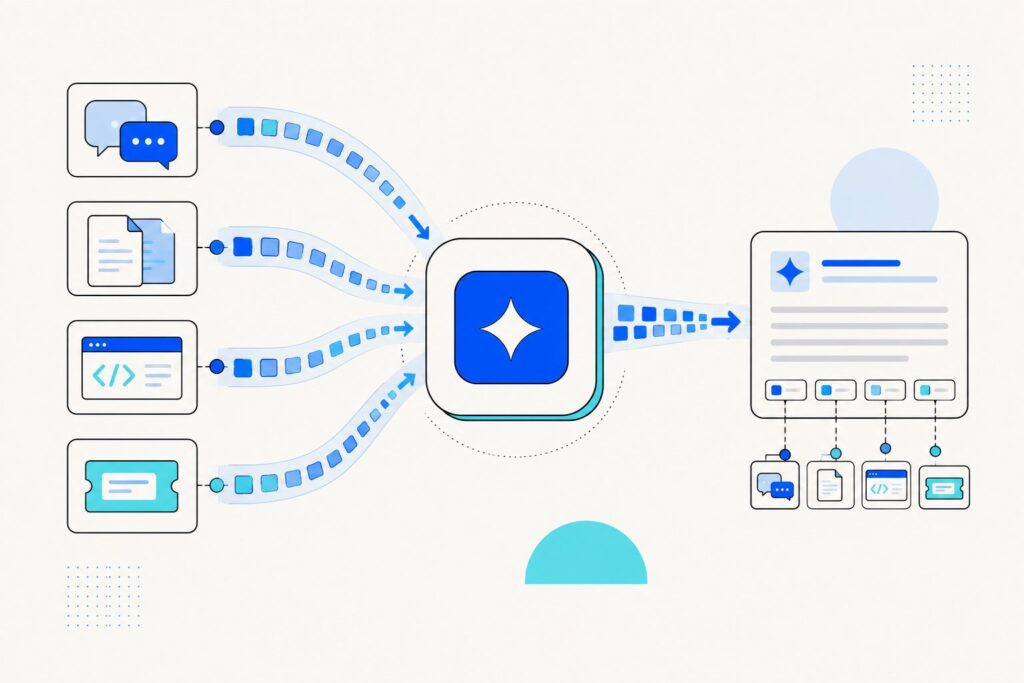
Company knowledge in ChatGPT is a feature that lets ChatGPT answer questions using your organization’s own information, pulled live from the work apps your team already uses. Instead of answering from its general training alone, ChatGPT searches across your connected tools, such as Slack, SharePoint, Google Drive, and GitHub, brings the relevant context together, and gives you an answer specific to your company, with citations back to the original sources. In effect, it turns ChatGPT into a search layer over your internal knowledge, so the things buried in documents, tickets, and chat threads become findable by just asking.
The short version: company knowledge is available on ChatGPT’s Business, Enterprise, and Edu plans, it is powered by a version of GPT-5 trained to look across multiple sources at once, and every answer it produces includes clear citations so you can verify where the information came from. Crucially, it respects your existing permissions, so it can only surface what each user is already allowed to see. This piece explains what company knowledge is, how it works, what it connects to, how citations and permissions work, which plans include it, and its honest limits.
What company knowledge in ChatGPT is
At its core, company knowledge connects ChatGPT to your organization’s apps and lets it use their contents as source material when it answers. Your company’s information lives scattered across many tools: decisions in Slack, documents in Google Drive or SharePoint, code and issues in GitHub, projects in Asana, records in HubSpot or Zendesk. Company knowledge brings that context together inside ChatGPT so a single question can draw on all of it at once, rather than making you search each tool separately.
This is essentially enterprise search powered by a large language model. The pattern of retrieving relevant internal information and feeding it to a model to ground its answer is the same idea behind retrieval-augmented generation, applied across your whole connected workspace. What makes it feel different from a traditional search box is that you ask in plain language, you get a synthesized answer rather than a list of links, and the answer points back to the exact sources it used.
How it works
Using company knowledge is deliberately simple. Inside a ChatGPT conversation on an eligible plan, you choose company knowledge for your question, and ChatGPT searches across the apps your organization has connected, gathers what is relevant, and composes an answer. Behind the scenes it is powered by a version of GPT-5 that OpenAI trained specifically to look across multiple sources and reconcile them into a comprehensive, accurate response, rather than leaning on a single document.
The result is an answer that reads like a colleague who has read everything, summarizing what the company knows about a topic and showing its work. Because it is grounded in your actual sources at query time, it reflects current information in those tools rather than a stale snapshot or the model’s general training.
What it connects to
The value of company knowledge depends entirely on what you connect it to. At launch it supported a broad set of connectors, and OpenAI has kept adding more. The connected sources include:
- Communication and docs: Slack, SharePoint, Google Drive, and Notion, covering the chat threads and documents where most institutional knowledge lives.
- Engineering: GitHub, GitLab Issues, and Azure DevOps, for code, issues, and technical history.
- Business tools: HubSpot, Zendesk, Asana, and ClickUp, covering CRM records, support tickets, and project management.
One naming note worth knowing: OpenAI originally called these integrations "connectors," and in late 2025 folded them under the broader label of "apps" to present a more unified experience. You may see either term, but they refer to the same idea of approved links between ChatGPT and your data sources. Each app is connected through OAuth, the standard secure authorization method, so ChatGPT is granted access explicitly rather than holding your passwords.
Citations, and why they matter
Every company knowledge answer includes clear citations back to the sources it drew from. This is not a cosmetic feature; it is what makes the answers trustworthy enough to act on. When ChatGPT tells you that a policy changed or that a project shipped on a certain date, the citation lets you click through to the original Slack message or document and confirm it. For any serious business use, that verifiability is the difference between a helpful assistant and one you cannot rely on, and it also helps guard against the model stating something confidently that the sources do not actually support.
Permissions, privacy, and admin controls
Because company knowledge reaches into internal systems, its access model is central to how it works. It respects your existing permissions: ChatGPT can only see and use what each individual user is already allowed to access in the connected apps. A user asking a question does not gain visibility into documents or channels they could not open themselves, which keeps existing access boundaries intact.
Administrators get meaningful control on top of that. Enterprise and Edu admins can manage which apps are available across the workspace, create custom roles, and set group-level permissions so people only reach what they should. And on the Business, Enterprise, and Edu plans, your data is not used to train OpenAI’s models by default, which is a key reassurance for organizations connecting sensitive internal information. Taken together, permission-awareness, admin controls, and the training opt-out are what make the feature viable for real company data.
Which plans include it
Company knowledge is a business feature, not something on the free or personal ChatGPT tiers. It is available on ChatGPT Business, Enterprise, and Edu, the plans built for organizations, and OpenAI launched it on October 21, 2025. If you are using a personal ChatGPT account, you will not see it; it is designed for teams whose administrators connect approved data sources and manage access centrally.
Who it is for and what it is good at
Company knowledge is aimed at organizations that have outgrown searching their tools one at a time. It shines when the answer to a question is spread across systems: piecing together the status of a project from Slack, a spec, and a set of GitHub issues; onboarding a new hire who does not yet know where anything lives; or answering a customer question that touches documentation and past support tickets. Anywhere institutional knowledge is real but hard to find, a cited, plain-language answer that spans every connected source saves meaningful time.
The honest framing is that this is enterprise search reimagined around a capable model. Its usefulness scales with how much of your real knowledge is connected and how well your permissions are set up, and it is only as current and correct as the sources behind it. It will not invent knowledge your company never wrote down, it depends on the paid business tiers, and even with citations you should still verify anything important before acting on it. Used with those limits in mind, company knowledge turns ChatGPT into a genuinely useful front door to what your organization already knows.
The bottom line: company knowledge in ChatGPT connects the assistant to your organization’s own apps and answers questions from that internal context, with citations and with respect for existing permissions. It is OpenAI’s move to make ChatGPT the place you ask about your own company, not just the world at large.
Frequently Asked Questions
What is company knowledge in ChatGPT?
Company knowledge is a ChatGPT feature that lets the assistant answer using your organization’s own information, pulled from connected work apps like Slack, SharePoint, Google Drive, and GitHub. It searches across those sources, synthesizes an answer specific to your company, and includes citations back to the originals. It is available on ChatGPT Business, Enterprise, and Edu plans.
Which apps and sources can it use?
At launch it supported connectors including Slack, SharePoint, Google Drive, GitHub, Notion, HubSpot, Zendesk, Azure DevOps, and Asana, with more added over time such as GitLab Issues and ClickUp. Each source connects through OAuth. OpenAI now groups these integrations under the label “apps,” though they were originally called “connectors.”
Which ChatGPT plans have company knowledge?
It is available on ChatGPT Business, Enterprise, and Edu, the plans built for organizations. It launched on October 21, 2025. It is not part of the free or personal ChatGPT tiers, since it depends on administrators connecting approved data sources and managing access for the workspace.
Does company knowledge respect our permissions?
Yes. It only surfaces what each user is already allowed to see in the connected apps, so asking a question never grants access to documents or channels a person could not open themselves. Admins can additionally manage which apps are available, create custom roles, and set group-level permissions across the workspace.
Is our data used to train OpenAI’s models?
By default, no. On the Business, Enterprise, and Edu plans, your data is not used to train OpenAI’s models by default, which is one of the main reasons the feature is considered safe for connecting sensitive internal information. Administrators should still review their organization’s data settings to confirm the configuration.
How is this different from regular ChatGPT search?
Regular ChatGPT answers from its general training and, with web search, from the public internet. Company knowledge instead searches your private, connected business apps and answers from that internal context, with citations to your own sources. It is powered by a version of GPT-5 trained to look across multiple sources at once.
Why do the citations matter?
Citations let you verify every answer against the original source, which is essential for trusting business information. If ChatGPT reports a decision or a status, you can click through to the exact Slack message or document behind it. This verifiability guards against acting on a confident but unsupported answer and is what makes the feature usable for real work.
Is company knowledge the same as an enterprise search tool?
It is a large-language-model take on enterprise search. Rather than returning a list of links, it gives a synthesized, plain-language answer that spans all your connected sources and cites them. The underlying idea of retrieving internal information to ground the model’s answer is the same as retrieval-augmented generation, applied across your whole connected workspace.