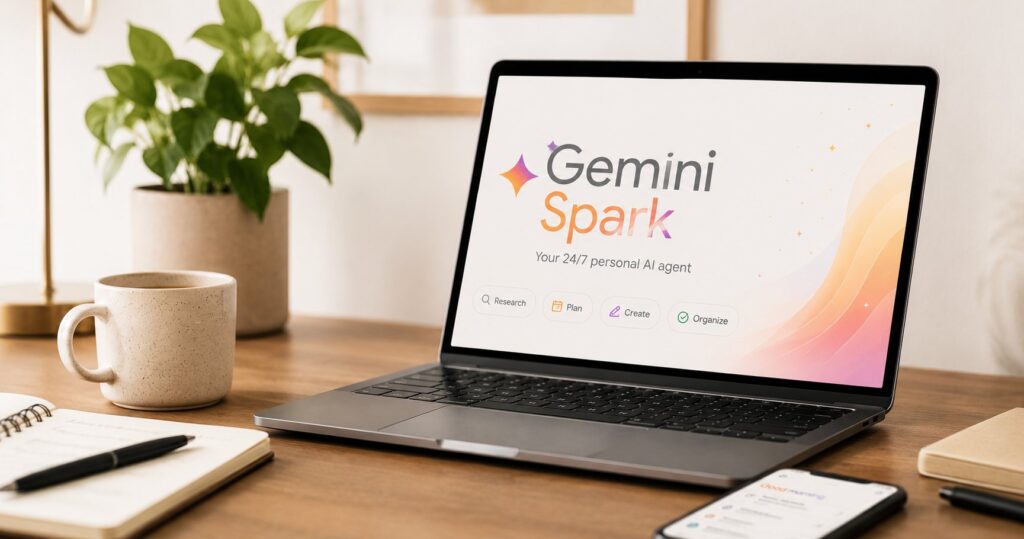
Gemini Spark is Google’s personal AI agent, announced at Google I/O on May 19, 2026. (Some early coverage and casual references call it "Google Spark"; the product’s official name is Gemini Spark.) The pitch is straightforward: a 24/7 assistant that takes action on your behalf, under your direction, with native access to the Gmail, Docs, Drive, and Workspace data you already have at Google. The technical foundation is more interesting: Spark is built on Gemini base models and the same agentic harness that powers Google Antigravity, the agent-first development platform Google launched in late 2025. Spark is, in effect, the consumer-facing application of the agent loop Antigravity built for developers.
This is the 101 entry point for Gemini Spark. We cover what Spark actually is, how the underlying architecture works (and why "runs on its own VM in Google Cloud" matters), what integrations ship out of the box, the safety controls that gate the agent’s authority, where Spark sits relative to Anthropic’s Claude Cowork and OpenAI’s ChatGPT Agent, and how the rollout is staged. This post is foundational rather than tutorial; deeper coverage of specific Spark workflows will follow as more of the product moves from trusted-tester gating to general availability.
What Gemini Spark actually is
Spark is a personal AI agent that runs in the background on Google’s infrastructure, not on your device. Sundar Pichai introduced it at I/O 2026 as "your personal AI agent that helps you navigate your digital life, taking action on your behalf and under your direction." The product framing matters: Spark is positioned as an agent (autonomous, multi-step, long-horizon) rather than an assistant (turn-by-turn, conversational, you-drive-each-step). The distinction is the same one that separates Claude Code from a chat-based coding assistant, or Cursor from a tab-completion plugin.
Three architectural details define the product. First, Spark runs on dedicated virtual machines on Google Cloud, so it can execute long-running tasks (drafting an email, watching your inbox, completing a multi-step workflow) without keeping your laptop open or burning your phone’s battery. Second, every task executes in a fresh, strictly isolated, ephemeral VM, which is the way Google addresses the "agent leaks data between sessions" concern that has shadowed every cross-conversation agent design. Third, the agent loop itself is the Antigravity harness, the same loop Google ships as a developer platform; Spark is the consumer-facing application of that platform.
If you’ve used or read about Google Antigravity already, the easiest way to position Spark is: Antigravity is the agentic developer IDE plus platform; Spark is the agentic personal-life assistant built on top of the same agentic platform.
Why "ephemeral VM in Google Cloud" matters
The single sentence that most defines Spark architecturally is "every task executes in a fresh, strictly isolated, ephemeral VM." That’s the answer to a stack of concerns the consumer-AI category has had for two years.
It addresses background execution. Because the agent runs on Google Cloud, it doesn’t need your laptop or phone to be on. If you ask Spark to monitor your inbox and triage anything from a particular client over the weekend, that’s something Spark can actually do, because the VM it’s running in stays up. The work continues whether you’re online or not.
It addresses data isolation. Each task gets its own VM, and the VM is destroyed when the task completes. This is a real answer to the cross-task data-leakage concern that arises whenever you give an AI agent persistent state. The VM model trades some efficiency for a far better story on what the agent can and cannot retain.
It addresses operational maturity. Spark runs in a fully managed, secure runtime, meaning you don’t manage the underlying infrastructure. For an enterprise customer evaluating consumer-style AI agents for employee use, this is the differentiator that gets the conversation past the legal team. The agent is enterprise-grade on the runtime side even when it’s being used for personal tasks.
It also creates a real cost story. Running long-horizon agents in dedicated cloud VMs is not free, which is why Spark is launching to AI Ultra subscribers rather than to the free tier. The economics shape the product gating.
What Spark connects to out of the box
The integration list is where Spark’s competitive position becomes specific. Spark ships with native, out-of-the-box connections to the data most users already keep at Google.
The core Google Workspace integrations cover Gmail, Google Docs, Google Drive, Sheets, and Slides. Spark can read the contents of your inbox to pull relevant context (recent threads with a specific person, current status of a particular project), read across your Docs and Sheets to assemble drafts, and write back out to those same surfaces. The example Google highlighted at I/O is the status-update email: tell Spark "draft a status update to my boss for the X project," and Spark pulls the facts from your emails, your docs, your sheets, and your slides, then writes the draft for you to review.
The interaction surface goes beyond chat. You can email Spark directly through a dedicated Gmail address, which means delegation is as simple as forwarding a message with instructions. Spark can interact with the web through Chrome when a task requires it. On Android, you can track agent progress through the new Android Halo system surfaced at I/O 2026. The result is a multi-surface agent: chat when you want to, email when that’s faster, and ambient on-device awareness while the work runs in the cloud.
The non-Google story runs on two rails. First, Spark can use existing Gemini Enterprise connectors, which already cover Microsoft SharePoint, Microsoft OneDrive, ServiceNow, and a growing list of enterprise systems. Second, Spark supports the Model Context Protocol (MCP), the open standard for connecting AI agents to external tools and data sources. MCP support means Spark is not locked to Google’s catalog of connectors; if a service exposes an MCP server, Spark can use it.
The safety model: explicit approval for high-risk actions
Letting an agent loose in your inbox and your Drive raises a category of risk that traditional consumer-AI products did not. Spark’s approach uses an explicit-approval gate for anything irreversible or high-stakes.
Spark proactively sends critical updates back to you when it’s working on something. For high-risk actions, like actually sending an email or making a substantive change to a shared document, Spark stops and requires explicit approval before it goes through. The agent can draft, summarize, and propose; the human stays in the loop for anything that crosses a defined line.
This is the same general design pattern that agentic-AI products across vendors have converged on (Anthropic’s Claude Cowork uses a similar approval gate, and so does OpenAI’s ChatGPT Agent). The differences are in where exactly the line gets drawn and how visible the approval prompts are in the host UI. Spark’s first release is explicit about being conservative on the approval side, which is the right starting point given the agent’s reach into Gmail and Drive.
What’s not yet shipping but is on the announced roadmap: the ability to text or email Spark from outside your Google identity, create custom sub-agents, and authorize payments while specifying a budget cap and an allowlist of merchants. Payment authorization with hard guardrails (this much, to these merchants only) is the right way to handle an agentic-payments use case, and it’s notable that Google is announcing it with the guardrails baked in rather than as a free-form capability.
Where Spark fits in the personal-agent landscape
Spark joins a small but rapidly developing field of personal AI agents. The two most direct comparisons are Anthropic’s Claude Cowork (the desktop agent that runs on your machine with deep file-system and application access) and OpenAI’s ChatGPT Agent (the cloud-hosted agent that runs in OpenAI’s environment with browser-based tool use). Spark sits closer architecturally to ChatGPT Agent (cloud-hosted, ephemeral environments) than to Cowork (runs locally on your device).
The differentiator Spark leans on is the data Google already has. If you live in Gmail, Drive, Calendar, and Docs, Spark is plugged into your data on day one with no per-app setup, no OAuth per integration, no copy-paste of relevant context. That’s a real productivity advantage for the Google-resident audience and a non-advantage for users who live primarily in Microsoft 365 or in non-Google productivity stacks (though the Gemini Enterprise connectors cover the most-used Microsoft surfaces and MCP fills in the long tail).
The shared substrate across all three products is interesting too. Spark is built on the Antigravity harness; Claude Cowork is built on Claude Code’s agent loop; ChatGPT Agent is built on OpenAI’s Codex-derived agent stack. Each major lab is shipping a personal-agent product that runs on the same agentic infrastructure their developer products run on, which is the kind of internal-leverage decision that suggests the category is here to stay rather than a one-off product line.
For more background on what AI agents are and how the broader category works, our AI agents pillar covers the foundations, and our AI agent frameworks comparison covers the open-source orchestration alternatives.
Availability and how the rollout is staged
Spark is rolling out cautiously. At I/O 2026, Google said Spark was in testing with trusted testers and that the Beta would come to Google AI Ultra subscribers in the United States the week of May 26, 2026. That gating is consistent with Google’s stated emphasis on safety in the first release: a paid, English-speaking, US-only audience with proven Workspace usage is the right cohort to put a personal agent in front of before scaling.
The pricing context is worth noting. Google’s AI subscription tiers were repriced at I/O 2026. The base AI Pro tier continues; a new AI Ultra at $100 per month gives roughly five times the AI Pro usage limits; and the top-tier AI Ultra was repriced from $250 to $200 per month with twenty times the Pro limits. Spark is initially available on AI Ultra subscriptions, which is the natural fit because the cloud-VM execution model carries real per-task cost.
If you don’t already have AI Ultra and you’re considering it specifically for Spark, the realistic expectation for the first few months is "early access to a maturing product, expect rough edges, expect the feature surface to grow." The capability list Google publicly committed to (custom sub-agents, dedicated Gmail address, payments with budget caps) is the v1.1 roadmap rather than the v1.0 ship list.
What this means for users and teams
For individual users, the practical evaluation is whether the data Spark plugs into matches where you actually live. If your day is Gmail, Docs, Drive, and the standard Workspace tools, Spark removes the per-app connection friction that has held similar agents back, and that’s a meaningful advantage. If you live in Microsoft 365 or in a different productivity stack, Spark’s value depends entirely on the Gemini Enterprise connectors covering what you need, plus MCP filling in the rest.
For teams, the more interesting question is whether Spark becomes a viable lightweight automation layer for small businesses. Google highlighted "small businesses are using Spark; they can watch over their inbox so they never miss a question from a customer" as a real use case in the I/O announcement. That’s a category of work that has historically required either a human (expensive) or a custom integration (complex). If Spark holds up, it lands somewhere between those: less expensive than a person, less effortful than a custom workflow.
For developers, the most useful framing is to look at Spark as the consumer-product proof point for the Antigravity agent loop. Whatever Spark does well or badly in the next six months is informative about what your own agents (built on Antigravity SDK, Managed Agents, or the same patterns) are likely to do well or badly. Spark is the canary for the consumer-grade agentic experience that the rest of the Google AI stack is converging toward.
Frequently Asked Questions
What is Gemini Spark?
Gemini Spark is Google’s 24/7 personal AI agent, announced at Google I/O on May 19, 2026. It’s built on Gemini base models and the agentic harness that powers Google Antigravity, runs in dedicated virtual machines on Google Cloud (so it works in the background without using your device), and integrates natively with Gmail, Google Docs, Drive, and the broader Google Workspace. The product was sometimes referred to casually as “Google Spark” in early coverage; the official name is Gemini Spark.
How is Gemini Spark different from the Gemini app or Gemini Assistant?
The Gemini app and Gemini Assistant are conversational AI products: you ask a question, you get an answer, you ask the next question. Gemini Spark is an autonomous agent: you delegate a multi-step task, and Spark plans it, executes it across your tools (email, docs, web), and reports back when it’s done. The interaction model is “give it the goal” rather than “guide it step by step.” Spark is also designed to run long-horizon tasks in the background on Google Cloud, which the chat-based Gemini products don’t do.
How does Gemini Spark stay secure with my email and documents?
Spark runs in a fully managed, secure runtime on Google Cloud. Every task executes in a fresh, strictly isolated, ephemeral virtual machine, so data doesn’t overlap between tasks or sessions. High-risk actions (such as sending an email or making a substantive change to a document) require explicit approval before Spark will execute them. Spark proactively surfaces critical updates back to you while a task is running so you have visibility into what the agent is doing.
What does Gemini Spark connect to out of the box?
Spark ships with native integrations across Gmail, Google Docs, Google Drive, Sheets, Slides, and the broader Google Workspace. Beyond Google, Spark uses existing Gemini Enterprise connectors (which cover Microsoft SharePoint, Microsoft OneDrive, ServiceNow, and others), and supports the Model Context Protocol (MCP), the open standard for connecting AI agents to external tools and services. You can also email Spark directly through a dedicated Gmail address, and Spark can interact with the web through Chrome when a task requires it.
How do I get access to Gemini Spark?
At launch (May 2026), Spark is in testing with Google’s trusted testers, with Beta access rolling out to Google AI Ultra subscribers in the United States the week of May 26, 2026. AI Ultra subscriptions start at $100 per month (5x the AI Pro usage limits); the top-tier AI Ultra is $200 per month (20x the Pro limits, repriced down from $250 at I/O 2026). Availability outside the US and on lower tiers has not been announced; expect a gradual rollout over the months following the Beta launch.
How does Gemini Spark compare to Claude Cowork and ChatGPT Agent?
All three are personal AI agents built by major AI labs in 2025-2026. Architecturally, Spark and ChatGPT Agent both run in cloud-hosted, ephemeral environments; Claude Cowork runs locally on your device with deeper file-system and application access. The differentiator Spark leans on is native, no-setup integration with Gmail, Docs, Drive, and Workspace, which is a substantial advantage for users whose data lives at Google. For users primarily in Microsoft 365 or in non-Google stacks, the comparison depends on which connectors and MCP integrations each agent offers. Each product is also the consumer-facing application of its lab’s developer agent platform: Spark on Antigravity, Cowork on Claude Code’s agent loop, ChatGPT Agent on OpenAI’s Codex-derived stack.
Is “Google Spark” the same thing as Gemini Spark?
Yes. “Google Spark” is a casual or informal reference; the official product name is Gemini Spark, reflecting that it’s part of Google’s Gemini family. Some early coverage and search queries use both names interchangeably. Throughout this post and across our Gemini Spark coverage we use the official Gemini Spark name.