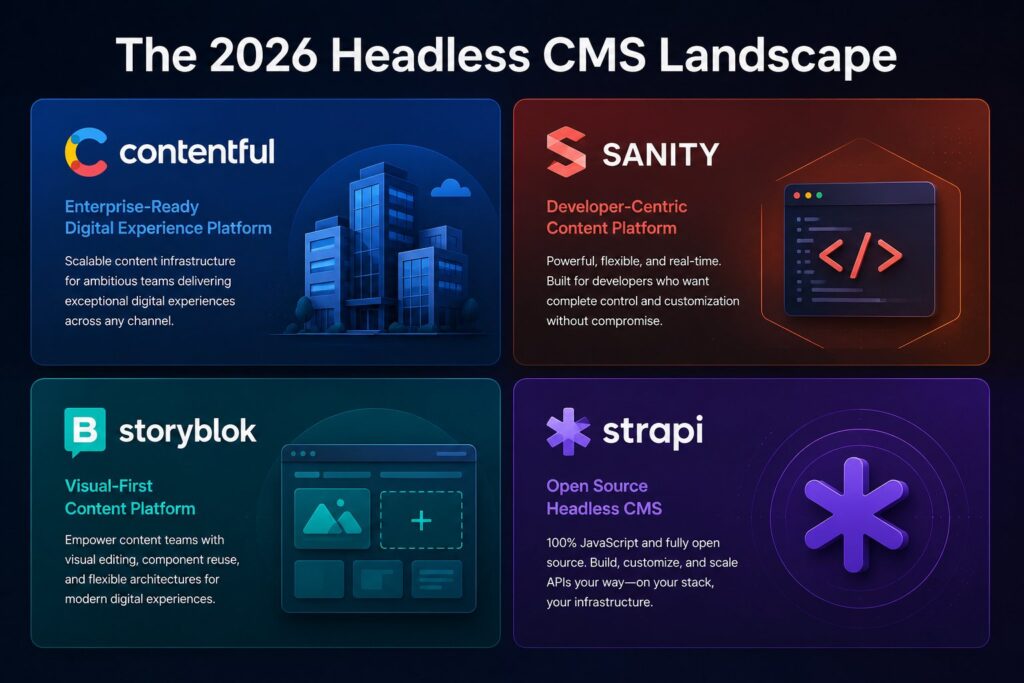
The 2026 headless CMS market has matured to the point where the four most established platforms occupy genuinely distinct positions. Contentful is the enterprise default, mature in governance and broad in framework integration, and as of June 2026 in the middle of a strategic acquisition by Salesforce. Sanity is the developer-focused platform with real-time collaboration and a fully customizable editor interface called Studio. Storyblok is the visual-editing-first headless CMS that gives editors a what-you-see-is-what-you-get experience while keeping content structured underneath. Strapi is the leading open-source self-hostable platform for teams that want full control of the stack. None of these is the "best" in any meaningful general sense. Each is designed for a different team profile, a different operational pattern, and a different relationship between editorial and engineering. The right one for your project is the one that matches your specific constraints, and the wrong question is "which platform wins." The right question is "which platform fits."
This post is an overview rather than a head-to-head. We cover what each of the four established platforms is and the teams that typically choose it, the adjacent platforms worth knowing about (Sitecore XM Cloud, Adobe Experience Manager, headless WordPress, and the smaller specialized options), the dimensions on which teams tend to make selection decisions, and the practical evaluation patterns. For the broader category context, our What Is a Headless CMS? pillar covers the architectural pattern that all of these platforms implement. For the Contentful-specific deep dive (including the Salesforce acquisition), our What Is Contentful? pillar goes further into that platform.
What headless CMS means, briefly
A headless CMS separates content management from content presentation. Editors create and manage content as structured data in the CMS; that content becomes available via APIs (REST, GraphQL, or both) that frontends, mobile apps, AI agents, and downstream systems consume. The "head" (the presentation layer) lives outside the CMS, which is why the pattern is called headless. The architectural benefit is that the same content can power multiple frontends and channels from one source of truth.
The headless category emerged in the mid-2010s as an alternative to coupled CMSs (WordPress, Drupal, Sitecore in classic configurations, Adobe Experience Manager) that bundle content management with the rendered HTML output. Composable content (the broader category that includes headless CMS alongside headless commerce, headless DAM, and other decoupled services) is now the dominant architectural pattern for new enterprise web infrastructure decisions in 2026.
Each of the four platforms covered below implements the headless pattern, with distinct choices about editor experience, developer ergonomics, pricing, and target customer.
Contentful
Contentful is the headless CMS that became the enterprise default in the late 2010s and held that position through the 2020s. Founded in 2013 in Berlin by Sascha Konietzke and Paolo Negri, Contentful built the most mature platform in the category: extensive content modeling, a robust App Framework for editor extensions, multi-environment workflows for dev/staging/production patterns, broad framework integration (Next.js, Nuxt, SvelteKit, Astro, mobile SDKs for iOS and Android), and the kind of enterprise governance posture (SOC 2 Type 2, ISO 27001, HIPAA-eligible, SSO, role-based access control, audit logging) that procurement teams require.
The editor experience in Contentful is form-based. Editors work with structured forms generated from the Content Type definitions, see preview options when the frontend supports it, and use App Framework extensions for custom workflows. The form-based approach is divisive: it’s predictable and constraining (in a good sense, for structured-content discipline), but it’s not what editors transitioning from WordPress visual editing typically expect.
The pricing tiers in 2026 range from Free (evaluation only) through Lite (~$300/month) to Premium (custom pricing typically in the low thousands per month) and Enterprise (typically $10,000+/month for larger customers). Contentful is more expensive than the alternatives in the category at most usage levels; the premium reflects platform maturity, ecosystem depth, and enterprise governance.
On June 1, 2026, Salesforce announced a definitive agreement to acquire Contentful for the Agentforce content-layer strategy. The transaction is expected to close in Q3 of Salesforce’s fiscal 2027 (roughly late 2026 calendar). Existing customers will keep their current implementations and contracts; the strategic direction over the 12-24 months following close is toward deeper Salesforce ecosystem integration.
Teams that typically choose Contentful are enterprises and well-funded scale-ups that need a mature platform with broad framework support, strong governance, and the operational maturity to handle multiple production environments. The form-based editor is acceptable to these teams because they’re investing in structured content discipline anyway.
Sanity
Sanity is the headless CMS most associated with developer customization. Founded in 2015 in Oslo, Sanity built its product around an idea that’s distinctive in the category: the editor interface (called Studio) is itself open source, self-hostable, and infinitely customizable by the customer’s developers. Where Contentful provides a fixed editor experience that extensions can supplement, Sanity provides an editor framework that customers build into the editor experience they want.
The architectural pieces:
The Content Lake is Sanity’s backend datastore that holds the structured content. It’s a SaaS service that customers don’t operate themselves; the storage, indexing, and querying layer is Sanity’s responsibility.
Studio is the editor application that runs on customer infrastructure (typically self-hosted alongside the customer’s frontend codebase) and connects to the Content Lake via API. Studio is built in React, ships as an open-source package, and is meant to be customized by the customer’s developers to match their workflows, branding, and content needs.
GROQ is Sanity’s query language, designed for retrieving content from the Content Lake with the flexibility of a query language and the directness of a configuration file. GROQ is distinctive (no other major headless CMS uses it) and is one of the things developers either love or find peculiar about Sanity.
Real-time collaboration is a flagship feature. Multiple editors can work on the same document simultaneously with live presence indicators and conflict-free merging, similar to Google Docs.
The pricing model is consumption-based: a free tier sufficient for substantial development work, Growth plans starting in the low hundreds per month, and Enterprise plans with custom pricing for larger customers. Pricing scales with API requests, document count, and asset storage.
Teams that typically choose Sanity have strong in-house development capability, want to invest in customizing the editor experience to match specific workflows, and value the flexibility of Studio over a fixed-vendor editor pattern. The "Studio as a customer-built application" model is distinctive and is what makes Sanity feel different from the alternatives.
Storyblok
Storyblok is the headless CMS most associated with visual editing. Founded in 2017 in Linz (Austria), Storyblok built its product around a thesis that distinguishes it in the category: editors should see content the way visitors see it while they edit, even though the content itself stays structured and consumable via API.
The visual editor in Storyblok works by rendering the live frontend in an iframe alongside the editor interface, with the rendered content responsive to the editor’s edits in real time. When an editor types into a headline field, the headline in the rendered page updates. When an editor drags a block to reorder it, the page reorders. When an editor uploads an image, the image appears in the rendered preview. The structured content stays as the source of truth (the API still returns clean JSON), but the editor experience matches what editors familiar with WordPress or other visual platforms expect.
The technical pieces that make this work:
The Visual Editor connects to the customer’s frontend via a small JavaScript bridge that lets the editor communicate with the rendered page. The frontend stack (Next.js, Nuxt, Vue, etc.) doesn’t need to be specifically built for Storyblok; the bridge handles the integration.
Blocks are Storyblok’s content modeling primitive. Editors compose pages by adding, configuring, and arranging blocks (a hero block, a gallery block, a text-and-image block, etc.). Developers define the blocks; editors use them.
Stories are the content units (pages, articles, products) that contain blocks. The terminology reinforces the editorial framing.
The pricing tiers range from Free (evaluation, small projects) through Starter (small commercial), Business (mid-market), and Enterprise. Pricing scales with traffic, custom-component count, and enterprise feature requirements.
Teams that typically choose Storyblok value the visual editing experience and want headless architecture without losing the editorial workflow that visual-first CMSs provide. Marketing-led teams in particular often prefer Storyblok because the editor experience feels familiar.
Strapi
Strapi is the leading open-source headless CMS. Founded in 2015 in Paris, Strapi built around a thesis that’s distinctive in the SaaS-dominated headless category: customers should be able to self-host the platform, modify its source code, and avoid the recurring vendor pricing that SaaS platforms charge.
The architecture:
Strapi is a Node.js application that customers install on their own infrastructure (AWS, GCP, Azure, bare metal, Docker, Kubernetes, anywhere a Node.js app can run). The application provides the admin UI, the content API (REST and GraphQL), the authentication system, and the plugin framework.
Plugins extend the platform. The plugin ecosystem includes integrations with popular tools (email providers, file storage, search engines, AI services) plus customer-built extensions for specific needs.
Customization is at the source level. Customers fork the Strapi codebase, modify it, and ship the modified version. This is genuinely different from the SaaS platforms where customization happens through extension frameworks but the underlying platform code is vendor-controlled.
Self-hosting means full data control. Customer content lives on customer infrastructure. For regulated industries, sovereignty-conscious organizations, or teams that have policy reasons to not use SaaS platforms for content storage, this matters substantially.
Strapi also offers a hosted Strapi Cloud service for customers who want the platform without operating it themselves. Strapi Cloud sits alongside the self-host option rather than replacing it.
Teams that typically choose Strapi have strong DevOps capability, value source-code-level control over their platform, have specific reasons to not use SaaS platforms (regulatory, sovereignty, cost predictability), or want to extensively customize the platform in ways the SaaS alternatives don’t support.
Adjacent platforms worth knowing about
Beyond the four established players, several platforms occupy adjacent positions worth being aware of:
Sitecore XM Cloud is the headless evolution of Sitecore’s enterprise CMS. For organizations already on Sitecore’s broader Digital Experience Platform (DXP), XM Cloud provides the headless content layer that integrates with the rest of the Sitecore stack (personalization, commerce, analytics). Best for large enterprises with existing Sitecore investments.
Adobe Experience Manager (AEM) as a Cloud Service is Adobe’s enterprise headless CMS, deeply integrated with the Adobe Experience Cloud (Analytics, Target, Campaign, Real-Time CDP). Best for large enterprises with existing Adobe investments.
Headless WordPress uses the WordPress core (or WordPress at scale via providers like WP Engine or Pantheon) with the WordPress REST API or the WPGraphQL plugin as the API layer. The frontend is built separately on Next.js, Nuxt, Astro, or similar. This pattern preserves WordPress’s mature editor experience, broad plugin ecosystem, and large talent pool while gaining headless architectural benefits. Best for teams that want the headless pattern with WordPress’s specific advantages.
Builder.io is a visual page-builder-focused platform that overlaps with both headless CMS and visual page builders. Strong for marketing teams that want WYSIWYG-style page building without engineering involvement for every change.
Hygraph (formerly GraphCMS) is a GraphQL-native headless CMS focused on the GraphQL developer experience. Strong for teams that have standardized on GraphQL across their stack.
Payload CMS is an open-source TypeScript-based headless CMS that’s grown rapidly in 2025-2026. Built on Node.js with a strong type-safety story, Payload is positioned for teams that want open-source with a more polished developer experience than Strapi provides.
Ghost is an open-source publishing platform with headless capabilities. Strong for editorial-content-focused teams that want a publishing-specific experience rather than a generic content modeling system.
The adjacent list is genuinely long because the headless CMS category continues to fragment. New platforms launch regularly, and the established players continue evolving. The four-platform overview above covers the established core; the adjacent list covers the genuinely viable alternatives for specific use cases.
How teams typically choose
The selection dimensions teams actually use:
Editor experience. What do the editors who will use the platform daily want? Form-based structured editing (Contentful, Sanity, Strapi)? Visual WYSIWYG editing (Storyblok, Builder.io, headless WordPress)? Real-time collaboration (Sanity)? The editor experience is often the most consequential dimension because the editors are the daily users.
Developer experience. What does the development team want? Mature SDKs and broad framework support (Contentful)? Customizable Studio they’ll invest in shaping (Sanity)? Source-level customization (Strapi, Payload)? GraphQL-native (Hygraph)? The developer experience determines how productive engineering is during the build and over the long maintenance tail.
Hosting model. Does the team want fully managed SaaS (Contentful, Sanity, Storyblok, Hygraph) or self-hosting (Strapi, Payload, sometimes headless WordPress)? The hosting decision interacts with regulatory requirements, cost predictability, and operational capability.
Pricing and total cost of ownership. What’s the platform subscription? What are the overage costs? What’s the engineering cost to integrate and maintain? Cheaper-on-paper platforms often cost more in engineering time; more expensive platforms often save engineering time. The total cost over three to five years is what matters, not the year-one subscription line.
Governance and compliance. What certifications does the team need? SOC 2, ISO 27001, HIPAA, GDPR-compliant data handling, audit logging, role-based access control, SSO. Enterprise procurement processes prioritize these heavily; smaller teams often don’t need them.
Ecosystem maturity. How many integrations, plugins, and extension partners does the platform have? Contentful and Strapi have the largest ecosystems; the others vary by category.
Strategic stack alignment. Does the team already use Salesforce (relevant for Contentful post-acquisition)? Adobe (relevant for AEM)? Sitecore (relevant for XM Cloud)? WordPress (relevant for headless WordPress)? The existing stack often constrains or supports the headless CMS choice.
Future flexibility. How easy is it to migrate away if the team’s needs change? Open-source platforms (Strapi, Payload) and platforms with portable content models reduce switching cost. Heavily vendor-specific platforms increase it.
No single dimension determines the choice. Teams weigh the dimensions according to their specific constraints, and different weights produce different right answers.
What evaluation teams should do
Six practical actions when evaluating headless CMS options:
- Run hands-on trials with actual editors, not just product demos. The editor experience is divisive; what feels natural to the procurement team often feels awkward to editors and vice versa. Spend the time on the hands-on evaluation.
- Model your actual content in each shortlisted platform. The content modeling experience differs meaningfully across platforms. Build your real content model (or a realistic subset) in each finalist and see whether the structure feels natural or forced.
- Verify framework integration depth for your stack. Most headless CMSs work well with most modern frontend frameworks, but the depth of the integration varies. Run a small integration project in each finalist with your actual frontend.
- Model the total cost of ownership over three to five years. Subscription pricing, overage costs, integration engineering time, ongoing maintenance time. Cheaper platforms often have higher engineering costs; more expensive platforms often have lower ones. The honest math matters.
- Talk to reference customers in your size segment. Each platform’s experience varies meaningfully by customer size, content complexity, and team structure. Reference customers similar to your situation give better signal than vendor case studies.
- Plan the exit strategy before committing. What does migration away look like for each platform? Content portability, API stability, custom code portability. Avoiding switching cost is easier when you’ve planned for it from the start.
The deeper takeaway is that the 2026 headless CMS market has matured to where each established platform serves a real niche well. The selection question for any specific team is which platform’s strengths align with that team’s constraints. The platforms aren’t competing on a single axis; they’re occupying different positions on multiple axes simultaneously.
Frequently Asked Questions
Which headless CMS is the best?
There isn’t a single best headless CMS for all teams. The platforms occupy distinct positions: Contentful is the enterprise default with mature governance, Sanity is developer-focused with customizable Studio, Storyblok is visual-editing-first, Strapi is open-source and self-hostable. The right choice depends on your editor experience preferences, developer capability, hosting model preferences, pricing constraints, and strategic stack alignment. The wrong question is “which platform wins”; the right question is “which platform fits my team’s specific situation.”
What does headless CMS mean?
A headless CMS separates content management from content presentation. Editors create and manage content as structured data; that content becomes available via APIs (REST, GraphQL, or both) that frontends, mobile apps, AI agents, and downstream systems consume. The “head” (the presentation layer) lives outside the CMS, which is what makes the pattern headless. The architectural benefit is that the same content can power multiple frontends and channels from one source of truth, rather than being locked to a single presentation.
How do Contentful, Sanity, Storyblok, and Strapi differ?
Each occupies a distinct position. Contentful is the enterprise default with the broadest framework support and mature governance; the editor experience is form-based and structured. Sanity is the developer-focused platform with a customizable Studio interface that customers shape into the editor experience they want; the platform includes real-time collaboration and uses the GROQ query language. Storyblok is the visual-editing-first option that gives editors a what-you-see-is-what-you-get experience while keeping content structured underneath. Strapi is the leading open-source self-hostable option, customizable at the source-code level and runnable on customer infrastructure.
What about Sitecore XM Cloud and Adobe Experience Manager?
Sitecore XM Cloud and Adobe Experience Manager (AEM) as a Cloud Service are enterprise headless CMSs that integrate deeply with the broader Sitecore and Adobe ecosystems respectively. Both are appropriate for large enterprises with existing investments in those ecosystems; both carry enterprise pricing and procurement timelines. For organizations already on Sitecore or Adobe, the integrated stack is often the right answer; for organizations evaluating headless CMS without an existing ecosystem commitment, the dedicated headless platforms (Contentful, Sanity, Storyblok, Strapi) typically fit better.
Can I use WordPress as a headless CMS?
Yes. Headless WordPress uses the WordPress core (or WordPress at scale via providers like WP Engine, Pantheon, or self-hosting) with the WordPress REST API or the WPGraphQL plugin as the API layer, while the frontend is built separately on Next.js, Nuxt, Astro, or similar. This pattern preserves WordPress’s mature editor experience, broad plugin ecosystem, and large talent pool while gaining headless architectural benefits. It’s a credible alternative to dedicated headless CMSs for teams that have specific reasons to prefer WordPress’s strengths.
What’s the difference between headless CMS and composable content?
Composable content is the broader architectural pattern; headless CMS is one piece of it. A composable architecture treats content, commerce, search, personalization, analytics, and other capabilities as decoupled services that compose into the customer experience. Headless CMS is the content piece of that pattern. The other pieces (headless commerce, headless DAM, headless search, headless personalization) follow similar architectural principles. Teams adopting composable architecture typically start with the headless CMS decision and add the other decoupled services over time.
How much does a headless CMS cost?
Pricing varies substantially across the category. Open-source self-hosted options (Strapi, Payload) have no platform subscription but require operational costs for hosting, maintenance, and engineering time. SaaS platforms range from free tiers (limited features, for evaluation) through small-commercial tiers in the low hundreds per month (Lite Contentful at ~$300/mo, Storyblok Starter, Sanity Growth) up to enterprise tiers that can reach $10,000+/month for the largest customers. The total cost includes the platform subscription, the engineering cost to integrate and maintain, the editor training cost, and the ongoing operational cost. For most teams, engineering cost exceeds subscription cost in the total.
How do I evaluate headless CMS options for my team?
Run hands-on trials with actual editors and developers, not just product demos. Model your real content in each shortlisted platform and see how natural the structure feels. Build a small integration project with your frontend stack in each finalist. Model the total cost of ownership over three to five years including engineering time. Talk to reference customers in your size segment. Plan the exit strategy before committing. The evaluation takes time but the consequences of choosing wrong are large; the time invested in evaluation usually pays back many times over in the production years that follow.