
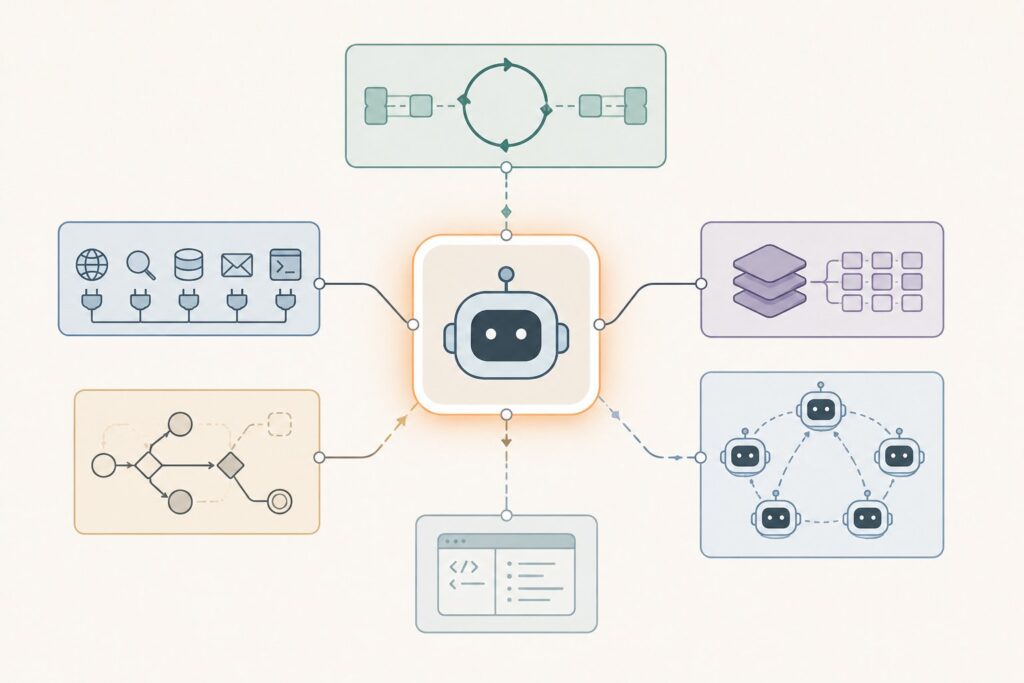
An AI agent development framework is a toolkit that handles the recurring machinery of building an AI agent so you do not have to build it yourself. When you move past a single prompt-and-response call to a language model and start building something that can plan a task, call tools, remember what it has done, and work across multiple steps or multiple agents, you run into the same set of problems every time: how to structure the control flow, how to let the model use tools, how to give it memory, how to manage state, and how to see what it did when something goes wrong. An agent development framework provides that plumbing as a library, so you can focus on your application’s logic rather than rebuilding the foundations.
The short version: these frameworks exist because building a reliable agent directly against a raw model API means writing a lot of orchestration, tool-calling, memory, and error-handling code that is largely the same across projects. A framework packages that work, adds structure and observability, and gives you patterns for the hard parts like multi-agent coordination. But they are not free: they add abstraction, a learning curve, and sometimes lock-in, and for simple cases they can be more overhead than help. This guide covers what an agent development framework actually is, the core components every one provides, the main categories, the major frameworks in 2026, how to choose among them, and the honest question of whether you need one at all. For the wider view, our practitioner’s guide to AI agents covers what agents are, and our 2026 agent framework landscape surveys the specific tools.
What an AI agent development framework is
Start from the problem it solves. A bare language model call takes some input and returns some text. An agent is different: it is a system that uses a model to decide what to do, takes actions like calling tools or APIs, observes the results, and loops until a goal is met. Building that loop reliably is real engineering. You need to manage the back-and-forth between the model and the tools, handle the model asking for a tool that fails, keep track of what has happened so far, decide when the task is done, and recover gracefully when the model goes off the rails.
An agent development framework gives you that loop and its supporting machinery as reusable components. Instead of hand-writing the orchestration that routes between the model and your tools, you configure it. Instead of inventing your own way to store what the agent remembers, you use the framework’s memory abstractions. Instead of building your own tracing to debug a run, you get observability out of the box. The framework encodes patterns that the field has converged on, so you start from a working foundation rather than a blank file.
That is the core value and the core tradeoff in one sentence: a framework trades some control and some added abstraction for a large amount of plumbing you would otherwise write and maintain yourself.
The core components every framework provides
Frameworks differ in emphasis, but almost all of them provide the same handful of building blocks. Knowing these components is the key to comparing frameworks, because every framework is really a set of opinions about how to implement them.
Orchestration and control flow. This is the heart of an agent: the logic that decides what happens next. Some frameworks model this as a loop where the model repeatedly chooses a tool until it is done; others model it as an explicit graph of steps and transitions that you define, which gives you more control over branching, retries, and cycles. How a framework handles orchestration is usually its defining characteristic.
Tool and function calling. Agents act by calling tools: functions, APIs, databases, search, code execution. A framework standardizes how you define a tool, how the model is told the tool exists, how the model’s request to use it is parsed and executed, and how the result is fed back into the loop. Good tool handling also covers validation and error handling when a tool call fails.
Memory. Agents need to remember. Short-term memory holds the current conversation or task context; long-term memory persists facts, past interactions, or retrieved knowledge across sessions, often backed by a vector database for semantic recall. Frameworks provide abstractions so you are not manually stuffing everything into the prompt.
State management. Beyond memory, an agent has state: where it is in a multi-step task, what it has tried, intermediate results. Frameworks that model agents as graphs or state machines make this explicit, which matters a great deal for long-running or resumable tasks.
Multi-agent coordination. Many real systems use several specialized agents that hand work to each other: a researcher, a writer, a reviewer. Frameworks provide patterns for this, whether as roles on a team, a supervisor that delegates to workers, or a conversation among agents. Coordinating multiple agents reliably is one of the hardest parts of the space, and it is where frameworks earn their keep.
Evaluation and observability. When an agent does something unexpected, you need to see the full trace of what the model decided and why. Frameworks increasingly ship tracing, logging, and evaluation hooks, because debugging a non-deterministic multi-step system without them is painful.
Guardrails. Finally, most frameworks offer some way to constrain behavior: input and output validation, permission boundaries on tools, and checks that keep the agent within safe limits. This matters more the more autonomy you grant.
The patterns frameworks implement
Underneath the components, frameworks encode a handful of well-known agent patterns, and recognizing them helps you read what a framework is really offering.
- The reason-and-act loop (ReAct). The most basic agent pattern: the model reasons about what to do, takes an action such as a tool call, observes the result, and repeats until the task is done. Almost every framework supports this as its default loop.
- Plan-and-execute. The agent first drafts a plan of steps, then executes them, sometimes revising the plan as it goes. This suits complex tasks where thinking ahead beats reacting one step at a time, and frameworks that model explicit state make it cleaner to implement.
- Reflection and self-critique. The agent reviews its own output, critiques it, and revises, which improves quality on tasks like writing or coding. Frameworks provide hooks to add a review step without hand-wiring it.
- Supervisor and hierarchical delegation. A coordinating agent breaks work into subtasks, hands them to specialized worker agents, then assembles the results. This is the backbone of most serious multi-agent systems, and how a framework models delegation is a defining trait.
- Tool-augmented retrieval. The agent pulls relevant knowledge from a vector store or search before acting, grounding its decisions in real data. This is where agent frameworks meet retrieval-augmented generation.
A framework is largely a set of decisions about which of these patterns it makes easy, and how. When you evaluate one, ask which patterns your problem actually needs and how naturally the framework expresses them.
The main categories
Frameworks sort along a few axes, and placing a framework on these axes tells you most of what you need to know.
Code-first versus low-code. Code-first frameworks are libraries you program against, giving maximum control and fitting into a developer workflow. Low-code and visual tools let you assemble agents through a UI, trading control for speed and accessibility. Most of the serious developer frameworks are code-first.
Single-agent versus multi-agent. Some frameworks are optimized for building one capable agent with tools; others are built from the ground up for orchestrating teams of agents. Many do both, but with a clear bias toward one.
Lightweight versus batteries-included. A lightweight framework gives you a thin, flexible core and gets out of your way; a batteries-included framework provides memory, tools, integrations, and patterns pre-assembled. Lightweight favors control and simplicity; batteries-included favors speed to a working system.
Model-agnostic versus vendor-integrated. Some frameworks work with any model provider, which protects you from lock-in and lets you switch models; others are tied to a specific vendor’s models and platform, which can mean tighter integration at the cost of flexibility.
The major frameworks in 2026
The landscape is crowded, and the right choice depends on your axes above. A brief, agnostic orientation to the most common code-first options, each covered in depth in our frameworks comparison:
- LangGraph models agents as explicit stateful graphs, which suits complex, controllable, long-running workflows where you want to define branching and cycles precisely.
- CrewAI centers on a role-based team abstraction, where you define agents as members of a crew with roles and let them collaborate, which suits multi-agent workflows you can describe as a team.
- AutoGen focuses on conversational multi-agent systems, where agents talk to each other to solve a task, and it is strong for research and experimentation with agent collaboration.
- The OpenAI Agents SDK is a lightweight, code-first way to build agents with tools and handoffs, favoring simplicity and tight integration with OpenAI’s models.
- Google’s Agent Development Kit (ADK) is Google’s open-source framework for building and deploying agents, oriented toward its own model and cloud ecosystem.
Beyond these, data-centric frameworks like LlamaIndex emphasize retrieval and knowledge, and a steady stream of newer entrants compete on ergonomics and type safety. The point is not that one wins, but that each encodes a different opinion about orchestration and multi-agent work.
How to choose one
Choosing well is mostly a matter of matching the framework’s opinions to your needs. A practical set of questions:
How complex is your control flow? If your agent is a straightforward tool-using loop, a lightweight framework is plenty. If you need branching, cycles, human-in-the-loop steps, and resumable long-running tasks, a graph-based framework that makes state explicit will save you pain.
One agent or many? If you are building a single capable agent, optimize for clean tool handling and observability. If you genuinely need multiple specialized agents coordinating, choose a framework whose multi-agent model matches how you think about the problem, whether that is a team, a supervisor, or a conversation.
How much do you value control versus speed? Lightweight and code-first favors control and fits engineers who want to understand every step. Batteries-included and low-code favors getting to a working system fast. Be honest about which your team actually needs.
Do you need model flexibility? If you want to switch model providers or avoid lock-in, prioritize a model-agnostic framework. If you are committed to one vendor’s ecosystem and want the tightest integration, a vendor-integrated option can be the better fit.
What are your observability and production requirements? For anything going to production, weight tracing, evaluation, and reliability heavily. A framework that is delightful in a demo but opaque when an agent misbehaves will cost you later.
How mature and well-supported is it? Agent frameworks move fast, and some are more stable and better documented than others. For production work, maturity, community, and the pace of breaking changes matter as much as features.
Do you even need a framework?
It is worth asking honestly, because the answer is sometimes no. If your use case is a single agent that calls a few tools in a simple loop, modern model APIs already support tool calling directly, and you can build it with a small amount of your own code and full control over every step. In that case a framework can be more abstraction and learning curve than it is worth, and rolling your own keeps the system simple and transparent.
The case for a framework gets stronger as complexity rises: multiple agents, long-running or resumable tasks, sophisticated memory, the need for solid observability, or a team that benefits from shared patterns. The case against is real too: abstraction can hide behavior you need to understand, frameworks churn quickly, and some lock you into a vendor. A reasonable default is to start with the least framework you can, and adopt one when you feel yourself rebuilding orchestration, memory, and tracing by hand. For teams weighing where the agent will actually run, our hardware for AI agents guide covers the infrastructure side of the same decision.
What teams building agents should do
A short, practical playbook. Define the agent’s job narrowly before choosing tooling, because the shape of the task determines which framework fits. Prototype the simplest version first, often with direct API tool calling, to learn what your agent actually needs before committing to a framework’s abstractions. When you do adopt a framework, weight observability and control over feature lists, because debugging non-deterministic systems is where projects stall. Keep an abstraction boundary between your application logic and the framework so you can switch if the framework churns or a better one emerges. And treat autonomy as a dial: add tools and independence incrementally, with guardrails, rather than granting a new agent broad power on day one.
The frameworks are improving quickly, and the sensible posture is to use them where they save real work while staying close enough to the underlying model behavior that you are never surprised by what your agent does.
Frequently Asked Questions
What is an AI agent development framework?
It is a toolkit or library that handles the recurring machinery of building an AI agent: orchestration and control flow, tool and function calling, memory, state management, multi-agent coordination, and evaluation. It lets you build agents on top of a language model without rebuilding that plumbing from scratch, encoding patterns the field has converged on so you start from a working foundation.
How is it different from just calling a language model API?
A raw API call takes input and returns text. An agent uses the model to decide what to do, calls tools, observes results, and loops until a goal is met. Building that loop reliably, with memory, state, error handling, and observability, is real engineering. A framework provides that loop and its supporting components as reusable parts rather than code you write and maintain yourself.
What are the core components of an agent framework?
Orchestration and control flow (deciding what happens next), tool and function calling, memory (short-term context and long-term persistence), state management, multi-agent coordination, evaluation and observability, and guardrails. Frameworks differ mainly in how they implement these components, especially orchestration and multi-agent coordination.
What are the major AI agent development frameworks in 2026?
Common code-first options include LangGraph (stateful graphs for complex control flow), CrewAI (role-based agent teams), AutoGen (conversational multi-agent systems), the OpenAI Agents SDK (lightweight, OpenAI-integrated), and Google’s Agent Development Kit. Data-centric frameworks like LlamaIndex emphasize retrieval. Each encodes a different opinion about orchestration and multi-agent work, so the right one depends on your needs.
How do I choose an AI agent framework?
Match the framework to your problem: how complex your control flow is (simple loop versus branching and long-running tasks), whether you need one agent or many, how much you value control versus speed, whether you need model flexibility or want a single vendor’s ecosystem, and how much observability and production reliability you require. For production, weight maturity, documentation, and tracing heavily.
Do I actually need a framework to build an agent?
Not always. If your agent is a single tool-using loop, modern model APIs support tool calling directly, and a small amount of your own code gives you full control with less abstraction. Frameworks pay off as complexity rises: multiple agents, long-running or resumable tasks, sophisticated memory, or strong observability needs. A good default is to start minimal and adopt a framework when you find yourself rebuilding orchestration and tracing by hand.
What is the difference between single-agent and multi-agent frameworks?
Single-agent frameworks optimize for building one capable agent with tools and clean observability. Multi-agent frameworks are built to orchestrate several specialized agents that hand work to each other, whether as a team with roles, a supervisor delegating to workers, or a conversation among agents. Many frameworks do both but lean one way; coordinating multiple agents reliably is one of the harder problems in the space.
What is the risk of adopting an agent framework?
Three main ones. Abstraction can hide model behavior you need to understand for debugging. Frameworks churn quickly, so today’s choice may look dated in months. And some tie you to a specific vendor’s models or platform. Mitigate these by keeping an abstraction boundary between your application logic and the framework, favoring observability and control, and adopting the least framework that solves your problem.