Security

How to Secure Project NOMAD on a Shared Network
To secure Project NOMAD on a shared network, you control who can reach it, because the software has no login of its…

Local AI refers to running AI models on customer hardware (laptops, workstations, on-premise servers, edge devices) rather than via cloud APIs. The pattern eliminates per-request subscription costs, keeps data fully on customer infrastructure, supports air-gapped and regulated environments, and enables customization that cloud APIs don't permit. Articles cover the local AI landscape, the runtime tools, the open-weight models that run locally, and the operational guides for teams adopting local inference.
To secure Project NOMAD on a shared network, you control who can reach it, because the software has no login of its…

Project NOMAD hardware can be as modest as a dual-core PC with 4 GB of RAM. The content you load decides how…

Project NOMAD is a free, open-source server that puts Wikipedia, Khan Academy courses, offline maps and an optional local AI assistant on…

Muse Spark Open is an open-weight model Meta released on October 15, 2026, with 816 billion total parameters, 42 billion active per…

Google AI Edge Foresight is a Mac app that transcribes meetings, writes notes and answers questions without sending audio or notes to…

An AI appliance is a dedicated box you buy once, plug in, and run AI models on, sold against the subscription you…

Apple announced the m6 mac mini on August 25, 2026, alongside an M5 Pro configuration of the same machine. Orders opened the…

Local ai agent security has a founding assumption that almost nobody states out loud, and CVE-2026-65105 is what happens when it fails.…

Llama is Meta’s family of open-weight large language models, first released in February 2023 and now in its fourth generation with Llama…
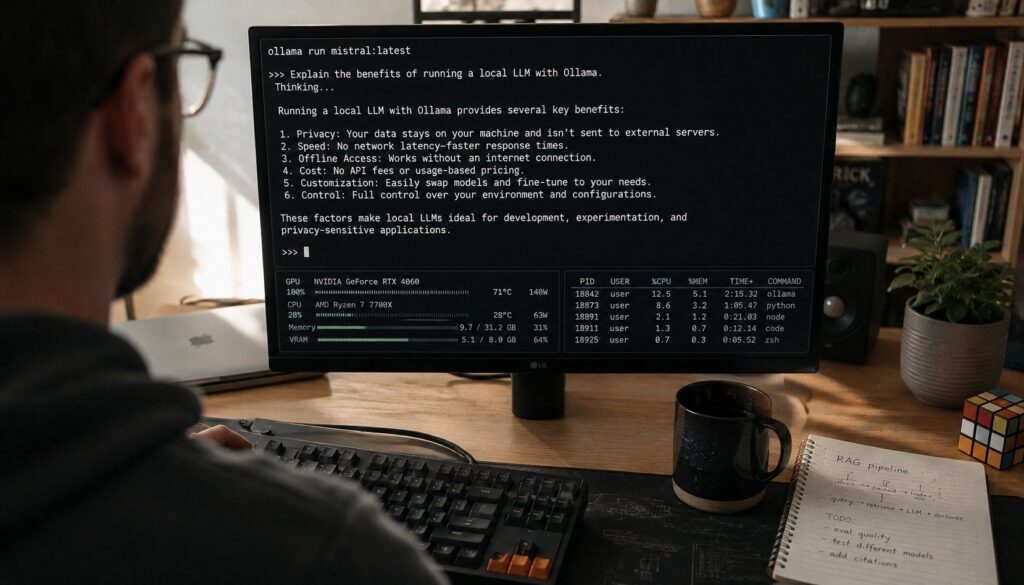
Ollama is the open-source command-line and HTTP-API tool that became the most-adopted local LLM runtime through 2024 and 2026 by abstracting away…