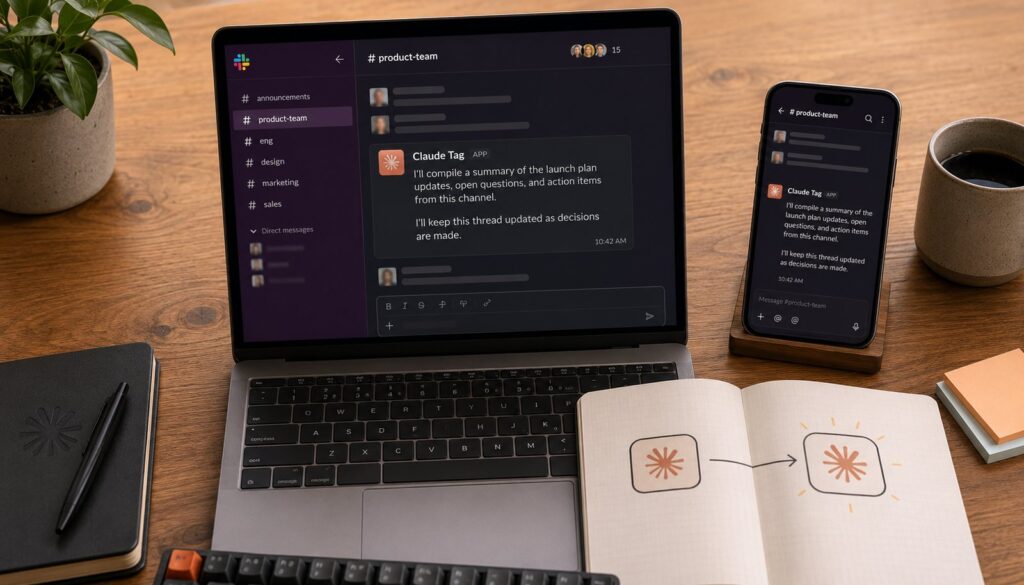
Anthropic launched a new product on Monday, June 23, 2026, that is structurally different from the AI products that have dominated the workplace through 2024 and 2025. The product is called Claude Tag. It is a Slack integration, but framing it as a Slack integration undersells what it is and what Anthropic is trying to do with it. Claude Tag is positioned as a persistent AI teammate that lives inside a Slack channel with the people who work in that channel, learns the channel’s context over time, can be invoked by anyone in the channel through the standard @-mention pattern, and can take on tasks that run autonomously over hours or days. The framing in Anthropic’s own messaging is that Claude Tag replaces the Slack app concept entirely with a coworker who happens to communicate through Slack rather than being a chatbot users open and message.
This piece walks through what Claude Tag actually is, the architectural choices that distinguish it from prior AI-in-Slack integrations including Anthropic’s own earlier Claude-for-Slack app, the specific behaviors that the launch documentation describes, the dogfooding story Anthropic has shared about its own internal use, the customer profile and pricing situation, the practical workflows that fit the product’s design, and the honest limits and concerns worth understanding before deploying it in your organization. The launch is two days old as of this writing, so the customer-side experience is just beginning to develop; we will update as the production deployment patterns emerge.
The short version is that Claude Tag is a genuinely new product category rather than an incremental Claude feature. The shift from "Claude is a chatbot you open" to "Claude is a coworker who lives in your channel" is the kind of pattern change that, if it works, changes how AI integrates into team workflows. The architectural choices that support the new pattern (persistent memory, multiplayer shared context, ambient mode, async scheduling, deep tool connections) are individually sensible and collectively coherent. The launch availability is restricted to Claude Enterprise and Claude Team customers in beta, which means Claude Tag is positioned as an enterprise rollout rather than a broad consumer product. Whether the pattern scales to the broader market depends on how the enterprise beta unfolds through the second half of 2026.
What Claude Tag is
Claude Tag is a Slack-native integration from Anthropic that installs into a Slack workspace and is added to specific channels by the workspace administrators. Once installed in a channel, Claude Tag becomes a participant in that channel with its own presence indicator, its own profile, and the ability to be addressed by any channel member through the standard @Claude mention pattern.
The underlying model is Claude Opus 4.8, Anthropic’s current flagship. The choice of Opus rather than a smaller tier is intentional. Claude Tag is positioned as a workload that benefits from the highest capability available, and Anthropic has built the pricing model around the assumption that the Opus-tier cost is justified for the use cases the product targets.
The mechanics that distinguish Claude Tag from the prior generation of AI-in-Slack integrations:
Tag-as-delegation. When any channel member @-mentions Claude with a task description, Claude treats the mention as a delegation request. Claude breaks the task into stages, executes the stages using whatever tools and data sources it has been connected to, and replies in-thread with the work product and a description of what was done. The pattern is conversational at the surface but the underlying flow is more like assigning work to a junior team member than like chatting with a bot.
Multiplayer / shared context. One Claude per channel, visible to everyone in the channel. When one team member starts a conversation with Claude and another team member picks up where the first left off, Claude has the full context of both interactions. The shared context is fundamentally different from one-user-per-Claude-session patterns, where each user’s conversation is private to them and the AI has no awareness of what other users have said.
Persistent memory. Claude Tag builds a persistent memory of the channel’s context over time. The memory includes information from the channel’s history (what kinds of things the team works on, what conventions they use, what tools they rely on), preferences expressed by team members (how they want certain kinds of work done), and ongoing context for in-progress work (the state of a multi-step task that spans multiple sessions). The memory is per-channel rather than per-user.
Ambient mode (opt-in). When ambient mode is enabled, Claude monitors the channel passively and proactively surfaces information it judges relevant: flagging stale threads that may have been forgotten, surfacing related context when a topic comes up that connects to prior work, suggesting follow-ups on commitments that were made earlier. Ambient mode is the most behaviorally distinctive feature and is explicitly opt-in because the right level of AI intervention varies substantially by team and channel.
Async + scheduling. Claude Tag can schedule its own follow-up work. A task that takes hours or days to complete (a research project, a multi-day data analysis, a project tracker) can be assigned with the expectation that Claude will check back periodically and report progress. The async pattern is the right fit for the kind of work that doesn’t fit in a single chat session.
Tool, data, and codebase connections. Claude Tag connects to organizational tools (the broader Slack workspace, calendars, docs, ticketing systems), data sources (databases, data warehouses, analytics platforms), and codebases (GitHub repositories, internal source-code systems). The connections are configured at the workspace level and inherit Slack’s permission model so that Claude can access only what the configuring administrators have granted.
How this differs from the prior Claude-for-Slack app
Anthropic has had a Claude integration in Slack for some time. The prior integration was a more conventional bot pattern: users could @-mention Claude to get an answer to a question, similar to how they would query any other Slack bot. The Claude-for-Slack app was a chat surface that happened to live in Slack rather than a coworker pattern.
Claude Tag is positioned as the replacement for the prior app rather than a parallel product. Anthropic’s framing in the launch materials is that the original Claude-for-Slack app pattern was limited by what a chatbot could be. The Claude Tag pattern is what they actually wanted to build but could only build now that Claude Opus 4.8’s persistent memory, ambient reasoning, and async-task capabilities are reliable enough to support it.
The practical consequence is that organizations currently using the older Claude-for-Slack app will be migrated to Claude Tag over the coming months. The migration timeline and the exact handling of in-flight conversations have not been fully published, but the direction is that the old app is end-of-lifed in favor of the new one.
The architectural distinction worth understanding
The fundamental shift Claude Tag represents is from the "chatbot" architectural pattern to the "agent" pattern, applied specifically to a channel-based collaboration surface.
In the chatbot pattern, each user has their own session with an AI. The AI’s job is to respond to direct messages with helpful answers. The AI has no awareness of other users’ interactions, no persistent memory across sessions (beyond whatever the platform provides), and no ability to take action between messages. The model is "user types, AI responds."
In the agent pattern, the AI is an autonomous entity that exists between messages. It has persistent memory, it can take action without being prompted (within whatever permissions it has been granted), and it can be shared by multiple users who interact with the same underlying agent. The model is closer to "user delegates task, agent works on it, agent reports back."
The agent pattern has been the direction of AI development across many vendors through 2025 and 2026. What Claude Tag does that is specifically interesting is map the agent pattern onto Slack’s native concept of a channel. The channel is already the unit of team collaboration in Slack. Putting an agent in the channel makes the agent a team member rather than a per-user assistant.
The closest competitive product is Microsoft Agent 365, which Anthropic does not directly mention in the launch materials but which is the obvious comparison point. Agent 365 maps a similar agent pattern onto the Microsoft Teams collaboration surface. The fact that both Anthropic and Microsoft are landing on the same architectural pattern (agent-in-channel) on different team-collaboration platforms (Slack and Teams respectively) is the strongest signal that this is the direction the workplace AI category is heading.
The dogfooding story
Anthropic shared one specific internal-usage statistic in the launch materials that has attracted attention: approximately 65 percent of the code written by Anthropic’s product team is now generated by their internal version of Claude Tag. The number is high enough to be remarkable and is consistent with Anthropic’s general pattern of using its own products at scale internally before launching them externally.
The number deserves some interpretation. "Generated by" is doing some work in the framing. The 65 percent is not 65 percent of code with no human involvement; it is code that was initially produced by Claude Tag and then reviewed, modified, and committed by human engineers. The human role is supervision, review, and the judgment about whether the generated code is right for the situation. The AI’s role is the initial drafting that the human work builds on.
Anthropic has also said the internal usage has spread beyond engineering into other functions. Specifically called out in the launch: chasing product metrics, working through support tickets, and conducting bug root-cause analysis. The implication is that the Claude Tag pattern works for a broader range of knowledge work than the engineering-focused initial framing might suggest.
The dogfooding story matters because it represents a meaningful credibility signal for the product. Anthropic is staking a public claim about their own production-use scale, which they would not do if the internal usage were modest. The number is the kind of thing competitors will scrutinize and that external customers will use as a benchmark for what they should expect their own adoption to look like.
Availability and pricing
Claude Tag is in beta as of the June 23 launch, available specifically to Claude Enterprise and Claude Team customers. The beta is not open to Claude Pro consumers or to API-only customers. The restriction means Claude Tag is positioned as an enterprise rollout from the start, with the pricing model embedded in the broader Enterprise and Team plan economics rather than as a separate per-seat charge.
For organizations on Claude Enterprise, Claude Tag is included in the plan with the existing per-seat pricing. The Claude Tag usage counts against the workspace’s Opus token allocation; high-volume Claude Tag use will push token consumption higher, which may require upgrading the Enterprise plan tier or negotiating additional capacity.
For organizations on Claude Team, Claude Tag is similarly included with the existing per-seat pricing and shares the workspace’s Opus token allocation. The Team plan’s capacity is smaller than Enterprise, which means Claude Tag use at scale will be more constrained on Team than on Enterprise.
Anthropic has not published a specific Claude Tag standalone pricing or a Pro-tier path. The expectation in the customer conversations following the launch is that Claude Tag will eventually be available more broadly but the beta period will run through enterprise-only customers first to refine the product based on production feedback.
The integration installs through Slack’s standard workspace-admin flow. A workspace admin authorizes the Claude Tag app, configures which channels Claude Tag is allowed to be added to, and grants access to whatever organizational tools and data sources the workspace wants Claude Tag to use. Once installed at the workspace level, individual channel admins can add Claude Tag to specific channels.
Workflows that fit the Claude Tag pattern
The workloads that match Claude Tag’s architectural strengths:
Engineering team coordination. A development team channel with Claude Tag installed can use Claude for code review (the team @-mentions Claude with a pull-request link, Claude reviews the code and posts comments back in the thread), for incident response (Claude assists with the debugging conversation, has the context of the team’s prior incidents, can pull data from monitoring tools), and for the kinds of recurring engineering tasks that fit the delegation pattern.
Product and ops chasing metrics. Product managers and operations team members can delegate periodic data-pulling work to Claude Tag. The Anthropic dogfooding example mentions chasing product metrics specifically; the pattern is "Claude, check our weekly active user count and flag anything unusual," with Claude going off to pull the data, analyze it, and report back in the channel.
Support workflow assistance. Support team channels can have Claude Tag in the loop to assist with ticket triage, draft response templates, surface related historical tickets, and flag tickets that need escalation. The persistent memory means Claude learns the team’s specific conventions over time.
Bug investigation and root-cause analysis. When a bug is being investigated in a channel, Claude Tag can pull logs, query telemetry, search the codebase for related changes, and synthesize hypotheses. The combination of tool access and persistent context makes Claude Tag meaningfully more useful than a standalone Claude chat session for this kind of work.
Multi-stakeholder project coordination. Cross-functional project channels (where engineering, product, design, and operations team members all participate) benefit from Claude Tag’s shared-context model. When a designer asks a question Claude already discussed with engineering, Claude has the engineering context. The shared-context property is the specific thing that makes cross-functional collaboration easier with Claude Tag than with per-user chat surfaces.
The workflows that do not fit as well:
Individual deep work that does not need team context. A solo engineer working on a focused implementation may be better served by Claude Code (the IDE-integrated agentic coding tool) than by Claude Tag. The team-context advantages of Claude Tag are not relevant when the work is individual.
Highly confidential one-on-one conversations. Anything an individual would want to discuss privately with Claude is not the right fit for the shared-channel model. The private DM pattern with Claude through other surfaces is still appropriate for those cases.
Tasks that need very tight latency. The async-task model means Claude Tag’s natural rhythm is "respond in seconds for simple things, hours or days for complex things." Real-time tight-latency interactions (live coding paired programming, interactive design feedback) are not the design center.
Concerns and limitations
A few specific concerns worth flagging:
The "always-on" pattern has surveillance implications. Claude Tag in ambient mode is continuously monitoring the channel. The monitoring is in service of the team, and the data handling follows Anthropic’s standard enterprise privacy commitments, but the pattern is genuinely different from on-demand-only AI use. Teams adopting Claude Tag should explicitly discuss what is and is not appropriate to discuss in Claude-Tag-enabled channels, particularly when the channel has cross-functional or contractor membership.
The shared-context property is also a shared-context risk. Information one team member shares with Claude becomes visible to anyone else in the channel who interacts with Claude. The pattern is by design, but it requires the team to think about what context they want shared. For highly sensitive work, the right pattern is a private channel with restricted membership rather than disabling Claude Tag.
The persistent memory is opaque. Claude Tag remembers context but the specific contents of its memory are not directly inspectable by team members. The pattern is the standard pattern for LLM-based memory systems but it means that team members cannot easily audit what Claude knows about them or about the team. This is an active area of work in the AI assistant category broadly and Claude Tag’s implementation will likely evolve.
The token economics matter at scale. Claude Tag use consumes Opus tokens, and Opus is the most expensive tier. A heavily-used Claude Tag workspace can run up substantial token costs that the team may not have budgeted for. The recommended pattern is to monitor token consumption per channel early in the deployment and to set expectations about what kinds of work are appropriate for delegation to Claude Tag.
The bug-fixing and code-generation pattern still requires human review. The 65-percent-of-code Anthropic dogfooding stat is real but it is not "AI writes code, ships to production." It is "AI drafts code, human reviews, human ships." Teams that interpret the dogfooding stat as meaning they can skip code review will get themselves into trouble. The pattern is augmentation, not replacement.
How to think about adopting it
For organizations considering Claude Tag adoption, the practical approach that has emerged in the early customer conversations:
Start with one channel where the team is high-trust, AI-curious, and willing to spend a few weeks figuring out what works. The first channel will produce learning that informs broader rollout; rushing the initial deployment to many channels at once produces too many variables to debug.
Configure tool connections deliberately. The temptation is to grant Claude Tag access to everything the workspace can see, but the principle of least privilege applies. Start with the minimum tool surface that supports the channel’s specific use case and expand from there as the team establishes patterns.
Decide explicitly about ambient mode. The default should probably be off until the team has a clear sense of when ambient surfacing is helpful and when it is noise. Ambient mode is the feature most likely to feel like AI overreach if enabled without team discussion.
Treat the persistent memory as something the team can shape over time. Anthropic has indicated mechanisms for the team to correct Claude’s memory when it gets something wrong; using those mechanisms early in the deployment establishes the pattern of treating Claude as a teammate who can be corrected rather than as an opaque system.
Plan for the token economics. Claude Tag adoption at scale will increase Opus token consumption substantially. Either negotiate the token capacity into the Enterprise plan from the start or set up monitoring that flags when consumption is trending toward plan limits.
Frequently asked questions
Is Claude Tag available on Microsoft Teams?
Not yet. Claude Tag is specifically a Slack integration as of the launch. Microsoft Teams equivalents would presumably come later if Anthropic chooses to expand. Microsoft’s own Agent 365 covers the equivalent pattern on Teams.
Can I use Claude Tag on my Pro plan?
No. Claude Tag is restricted to Enterprise and Team plans in the beta. The standalone pricing path for individual users has not been announced.
Will Claude Tag eventually replace the prior Claude-for-Slack app?
Yes, per Anthropic’s launch communication. The older app is being end-of-lifed in favor of Claude Tag. Specific migration timing has not been published.
Does Claude Tag’s memory share across channels in the same workspace?
No. The memory is per-channel by design. Each channel’s Claude Tag has its own context and memory.
Can I see what Claude Tag has remembered about my team?
The persistent memory is not directly inspectable in the launch version. Anthropic has indicated work on memory inspection and correction tooling but it has not shipped.
What tools can Claude Tag connect to?
The launch supports connections to the broader Slack workspace, calendars, docs, ticketing systems, databases, data warehouses, analytics platforms, and code repositories. The specific connector ecosystem is similar to what Claude in the broader product surface supports.
Is Claude Tag covered by Anthropic’s enterprise privacy commitments?
Yes. Customer data processed through Claude Tag is covered by Anthropic’s standard enterprise data-handling commitments, which include not using customer data for model training without explicit opt-in.
How does Claude Tag handle channels with external members (guests, contractors)?
The same as the rest of Slack: external members see Claude Tag’s presence and can interact with it within whatever channel permissions they have. Teams should be explicit about what is appropriate to discuss in channels with external membership.
Will the 65 percent code generation figure apply to my organization?
Probably not at launch. Anthropic’s internal use reflects months of refinement of patterns and team training. New customer organizations should expect to see lower initial adoption and to grow into the pattern over time.
What happens to in-flight Claude Tag tasks if I uninstall the app?
Open async tasks are canceled. There is no migration path for in-flight work; teams uninstalling should plan to complete or hand off open work first.
This piece is a same-week followup to the June 23 launch. We will update with additional detail as production usage patterns emerge through the beta.