
Update, July 26, 2026: the current Opus generation is now Claude Opus 5, released July 24, 2026, which replaced Opus 4.8 at the same $5 and $25 per million token pricing while adding a larger context window and a five-level effort control. The tier framework below is unchanged; only the Opus model name has moved.
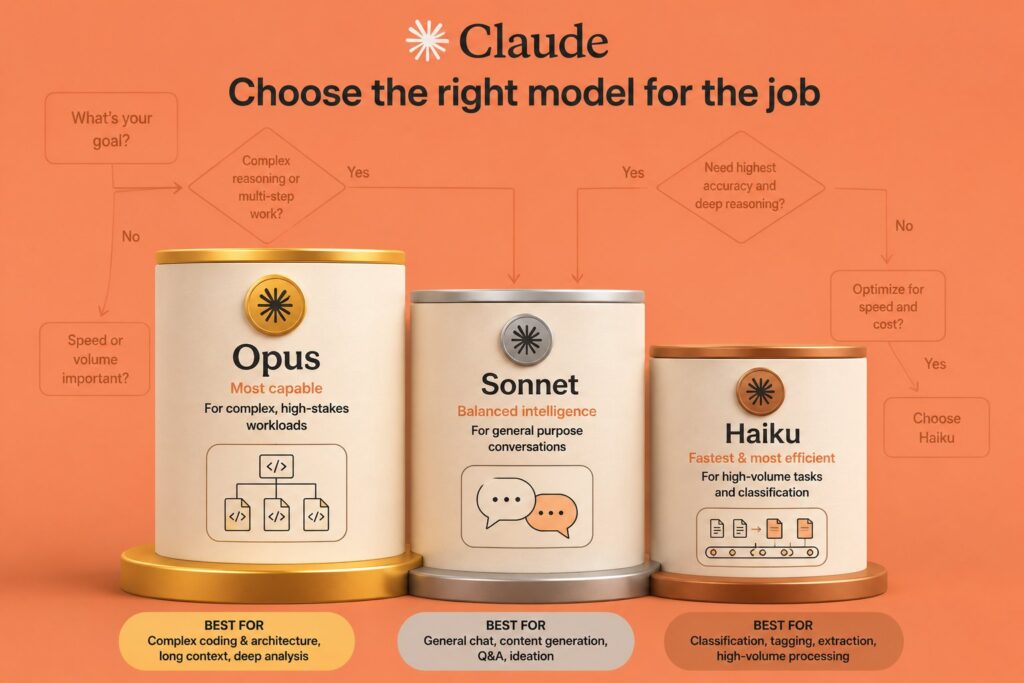
Claude Opus, Sonnet, and Haiku are the three tiers of Anthropic’s Claude model family, designed to serve different workload profiles at different price points. Opus is the flagship with the highest capability for complex reasoning, long-horizon coding, analytical depth, and high-stakes professional workflows. Sonnet is the middle tier with strong general-purpose capability at meaningfully lower cost. Haiku is the fastest, most cost-effective tier for high-volume workloads, classification, simple summarization, and latency-sensitive applications. The right tier for any specific workload depends on the capability-versus-cost-versus-latency tradeoff that workload actually faces, and the wrong question is "which is best" while the right question is "which fits the workload’s specific constraints." This post covers the decision framework, the capability differences that matter operationally, the pricing dynamics, and the practical patterns teams use to pick the right Claude tier in mid-2026.
For broader context on the Claude lineup, our Claude Opus 4.8 pillar covers the current Opus generation in detail, and our Claude Code vs OpenAI Codex comparison covers the coding-tool landscape where the Claude tier choice has substantial operational implications.
What the three tiers actually are
The Claude family in mid-2026:
Opus is Anthropic’s flagship reasoning model. The current generation is Claude Opus 5, which succeeded Opus 4.8 on July 24, 2026 at the same price. Opus is designed for the hardest tasks: complex multi-step reasoning, long-horizon agentic workflows, professional analytical work in legal/financial/medical/research domains, complex coding tasks that benefit from deep architectural thinking, and any workload where the capability ceiling matters more than the per-token cost. Opus is the most expensive tier and the slowest to respond per token, though throughput has improved meaningfully through the 4.x generation.
Sonnet is the mid-tier general-purpose model. Sonnet’s positioning has historically been "Opus capability at meaningfully lower cost for most workloads." For the majority of production AI workloads where the marginal capability of Opus isn’t needed, Sonnet provides strong general-purpose performance at substantially lower per-token cost and meaningfully better latency. Many teams default to Sonnet for production workloads and only reach for Opus when specific tasks demand it.
Haiku is the fastest, most cost-effective tier. Haiku is designed for high-volume workloads where speed and cost matter more than peak capability: text classification, simple summarization, extraction tasks, real-time latency-sensitive applications, and large-batch processing where total cost is the dominant constraint. Haiku is genuinely capable for the workloads it targets and dramatically more cost-effective than Opus or Sonnet for those use cases.
The naming convention reflects the positioning: Opus (the longest, most expansive musical work), Sonnet (the structured medium-length poetic form), Haiku (the short, elegant minimal-form poem). The pattern signals capability tier intuitively.
The decision framework
The decision framework asks four questions per workload:
What’s the capability requirement? Some workloads have a real capability ceiling that only Opus can clear: complex coding tasks that require deep architectural reasoning, multi-step analytical work where errors compound, professional workflows in regulated domains where accuracy demands the best available model. Other workloads have substantial capability headroom; Sonnet or Haiku handle them fine. Be honest about whether the workload actually needs Opus capability or whether it just feels safer to use Opus.
What’s the cost constraint? Per-token cost matters more for high-volume workloads. A workload running a few hundred requests per day faces different cost economics than a workload running millions per day. For high-volume use cases, the Haiku-vs-Sonnet-vs-Opus cost differences compound substantially.
What’s the latency requirement? Real-time interactive applications (chat interfaces, autocomplete, live transcription) face hard latency budgets that Haiku and Sonnet often clear while Opus may not. Batch workloads that run asynchronously face no real-time latency constraint and can use Opus comfortably.
What’s the risk tolerance for the workload? High-stakes outputs (legal contracts, medical recommendations, financial advice, security analysis) benefit from Opus’s lower error rates even when the cost is meaningfully higher. Low-stakes outputs (content classification, simple summaries, internal note tagging) can tolerate the higher error rates of cheaper tiers in exchange for the cost savings.
The four questions together produce the right tier choice for most workloads. The pattern that emerges most often: Opus for the hardest 10-20 percent of workloads, Sonnet for the majority of production work, Haiku for high-volume cost-sensitive workloads.
When Opus is the right choice
Opus is the right choice when the workload meets any of these criteria:
Long-horizon coding tasks. Complex refactors, large-codebase migrations, multi-file architectural changes, debugging cross-cutting issues. Opus’s depth advantage matters substantially for these tasks; cheaper tiers produce more bugs and require more rework.
Professional analytical work. Legal contract analysis, financial modeling, medical literature review, scientific research. The accuracy and reasoning depth matter; the per-task cost is small relative to the value of getting the analysis right.
Multi-step reasoning where errors compound. Workflows where each step’s output feeds into the next step’s input. Errors in step 1 produce worse errors in step 5. Opus’s lower error rate per step prevents the cascade.
High-stakes single-shot outputs. When the output goes directly to a customer, a regulator, a public document, or a critical business decision, the capability premium is worth the cost premium.
Agentic workflows. AI agents that run for hours or days, making many decisions and coordinating multiple steps. Opus’s reasoning depth and instruction-following accuracy matter substantially for agent reliability.
Complex creative work. Long-form writing with specific structural requirements, complex strategic analysis, sophisticated content generation that needs nuance and coherence.
For these workloads, the cost difference between Opus and Sonnet is often small relative to the value of getting the work done well. The wrong economy is using Sonnet for an Opus-shaped task and absorbing higher error rates that produce worse outcomes.
When Sonnet is the right default
Sonnet is the right default for most production workloads. The pattern:
General-purpose chat and assistance. Most chat interactions, customer support augmentation, internal Q&A, and similar conversational use cases. Sonnet handles these well; Opus is overkill.
Standard coding assistance. Single-function generation, code review, refactoring within a single file, debugging straightforward issues. Sonnet’s coding capability is strong enough that the Opus premium often isn’t worth it for these tasks.
Most content generation. Blog posts, marketing copy, email drafting, social media content. Sonnet generates well-organized substantive content; Opus advantages are mostly in edge cases.
Analytical work with limited capability ceiling. Data summarization, basic financial analysis, standard report generation. Sonnet handles these workloads competently.
Most agentic workflows that aren’t long-horizon. Single-step or few-step agents (call this API, summarize this document, classify this input) work well on Sonnet.
The teams that get this right often have an explicit "Sonnet by default, Opus when justified" policy that prevents the easy mistake of defaulting to Opus for everything.
When Haiku is the right choice
Haiku is the right choice when the workload meets these criteria:
High-volume classification. Text classification, sentiment analysis, content tagging, entity extraction at volume. Haiku is dramatically more cost-effective than Sonnet for these tasks and the capability is genuinely sufficient.
Simple summarization. Short-document summarization where structural complexity is low. Haiku handles this well at a fraction of Sonnet’s cost.
Real-time latency-sensitive applications. Chat autocomplete, real-time suggestion systems, in-line UI assistance. Haiku’s lower latency matters substantially and the capability is sufficient for most real-time use cases.
Large-batch processing. Pipelines that process millions of items per day. Per-token cost differences scale with volume; Haiku produces meaningful cost savings at this scale.
Extraction tasks with structured outputs. Pulling specific fields from documents, normalizing data formats, applying simple transformations. Haiku handles these reliably at scale.
Reranking and filtering pipelines. Multi-stage retrieval where Haiku does initial filtering and a more capable model handles the final selection. The two-stage pattern is dramatically more cost-effective than running everything through Sonnet or Opus.
For high-volume use cases, Haiku adoption is often the single highest-impact cost optimization available without meaningfully degrading output quality.
Pricing dynamics
The pricing pattern across the three tiers (representative as of mid-2026, with actual pricing varying by specific model version):
Opus is priced at roughly $5 per million input tokens and $25 per million output tokens at standard rates. Caching, batching, and other optimizations can reduce effective costs meaningfully. For high-volume workloads, Anthropic offers committed-use discounts.
Sonnet is priced at $2 per million input tokens and $10 per million output tokens as of Sonnet 5. Anthropic canceled the increase to $3 and $15 that had been scheduled for September 1, 2026, and made the launch rate standard on August 10, 2026. The discount versus Opus is substantial across most production workloads.
Haiku is priced at roughly $0.80 per million input tokens and $4 per million output tokens. The roughly 6x discount versus Opus and 4x discount versus Sonnet is meaningful at high volume.
The pricing dynamics reward thoughtful tier selection. A workload running 100 million tokens per month costs about $250 on Sonnet and about $420 on Opus, while the same workload costs about $80 on Haiku. The cost differences compound at scale.
For workloads where the capability ceiling allows it, moving from Opus to Sonnet or Sonnet to Haiku can substantially improve unit economics without sacrificing output quality.
The two-stage pattern
A common production pattern that uses tier selection well: two-stage processing with cheaper tiers for initial work and more capable tiers for final selection.
Pattern 1: Filter with Haiku, select with Sonnet. Use Haiku to filter a large input set down to a candidate pool. Use Sonnet to make final selection from the candidates. Dramatic cost savings versus running everything through Sonnet directly.
Pattern 2: Generate with Sonnet, verify with Opus. Use Sonnet for initial content generation. Use Opus to verify and refine. Combines Sonnet’s cost advantages for the generation work with Opus’s accuracy advantages for the verification step.
Pattern 3: Extract with Haiku, reason with Opus. Use Haiku for structured extraction from raw inputs. Use Opus for the downstream reasoning that uses the extracted data. The extraction is high-volume and capability-light; the reasoning is low-volume and capability-heavy.
Pattern 4: Tier escalation based on confidence. Try Haiku first. If the output confidence is low (via self-evaluation or downstream checks), escalate to Sonnet. If Sonnet’s confidence is also low, escalate to Opus. The pattern uses Opus only when actually needed, dramatically reducing average cost while preserving the capability ceiling for hard cases.
The two-stage patterns produce substantially better cost economics than uniform single-tier deployment. For most production AI workloads at meaningful scale, evaluating these patterns is worth real engineering effort.
What teams should do
Six concrete actions:
- Audit current Claude tier usage. Which workloads use which tier? Many teams default to Opus everywhere out of caution; the audit often reveals substantial cost savings available without quality loss.
- Categorize workloads by capability requirement. Some workloads need Opus; others don’t. Be honest about which is which based on actual output quality requirements rather than instinctive preferences.
- Evaluate two-stage patterns. Cheaper tiers for initial work plus more capable tiers for final selection can substantially improve cost economics. The engineering effort is often worth the savings.
- Set explicit tier-selection policies. “Sonnet by default, Opus when justified by specific workload characteristics” is a reasonable default. Document the decision criteria so the team applies them consistently.
- Monitor cost per workload over time. Tier selection isn’t a one-time decision; workloads evolve and the right tier may shift. Recurring review catches drift.
- Test on real workloads before committing. Don’t trust benchmarks for the tier decision; run your actual workloads through different tiers and compare output quality. The tier that benchmarks well for general use may not be the tier that fits your specific workload best.
The deeper takeaway is that Claude tier selection is a real operational discipline that affects both unit economics and output quality. Teams that pick deliberately produce better outcomes than teams that default to the most expensive tier out of caution or default to the cheapest tier out of cost focus. The right mix usually has Opus for the hardest 10-20 percent of workloads, Sonnet for the majority, and Haiku for high-volume workloads where the cost economics dominate.
Frequently Asked Questions
Which Claude tier should I use?
The right tier depends on workload characteristics. Opus is the right choice for complex reasoning, long-horizon coding, professional analytical work in regulated domains, multi-step reasoning where errors compound, high-stakes single-shot outputs, and agentic workflows. Sonnet is the right default for general-purpose chat, standard coding assistance, most content generation, and most analytical workloads that don’t need peak capability. Haiku is the right choice for high-volume classification, simple summarization, real-time latency-sensitive applications, large-batch processing, and structured extraction tasks.
How much does each tier cost?
Representative pricing as of mid-2026 (actual pricing varies by specific model version). Opus is roughly $5 per million input tokens and $25 per million output tokens. Sonnet 5 is $2 per million input tokens and $10 per million output tokens, after Anthropic canceled the September 1, 2026 increase to $3 and $15. Haiku is roughly $0.80 per million input tokens and $4 per million output tokens (about 6x cheaper than Opus). For high-volume workloads, the cost differences compound substantially.
Can I use multiple tiers in the same workflow?
Yes, and many production workflows do this for cost optimization. Common two-stage patterns include filtering with Haiku and selecting with Sonnet, generating with Sonnet and verifying with Opus, extracting with Haiku and reasoning with Opus, or tier escalation based on confidence scores (try Haiku first, escalate to Sonnet or Opus if confidence is low). The two-stage patterns often produce substantially better cost economics than uniform single-tier deployment.
Is Haiku actually capable enough for production?
Yes, for the workloads it targets. Haiku is genuinely capable for text classification, sentiment analysis, entity extraction, simple summarization, real-time latency-sensitive applications, and structured extraction tasks. The capability gap relative to Opus and Sonnet is real for complex reasoning, long-horizon coding, and high-stakes analytical work, but for the workloads Haiku targets, the capability is sufficient and the cost advantages are dramatic.
What’s the difference between Opus generations?
Opus generations (Opus 3, 4.6, 4.7, 4.8 as of mid-2026) represent incremental capability and efficiency improvements within the same Opus tier. The newer Opus generations typically have better reasoning, lower error rates, faster throughput, and sometimes lower pricing. For most workloads, using the current Opus generation is appropriate; older generations remain available for backward compatibility but typically don’t offer cost advantages relative to current generations.
Should I always use the cheapest tier that works?
Usually yes, but not always. For workloads where the cost is small relative to the value of getting the work done well (high-stakes outputs, irreversible decisions, professional analytical work), the capability premium of Opus is often worth the cost premium even when Sonnet might technically work. For workloads where cost is the dominant constraint (high-volume processing, real-time applications), picking the cheapest tier that meets the capability requirement is the right pattern.
How do I know if my workload needs Opus capability?
Test both tiers on representative workload samples and compare output quality. Run the same inputs through Opus and Sonnet, examine the outputs, and judge whether the Opus advantage is worth the cost premium for the specific workload. Subjective evaluation by domain experts is often more useful than benchmarks for this question because benchmarks may not match your workload’s specific characteristics. For workloads where the difference is meaningful, Opus is the right choice; for workloads where the difference is marginal, Sonnet is the right default.
Does Anthropic offer enterprise pricing?
Yes. For high-volume workloads, Anthropic offers committed-use discounts that reduce per-token costs in exchange for usage commitments. Enterprise pricing also includes additional governance features (audit logging, data residency options, contractual terms appropriate for regulated industries) that aren’t part of the standard pay-as-you-go pricing. For organizations with substantial Claude usage, evaluating the enterprise tier is worth the procurement effort.