
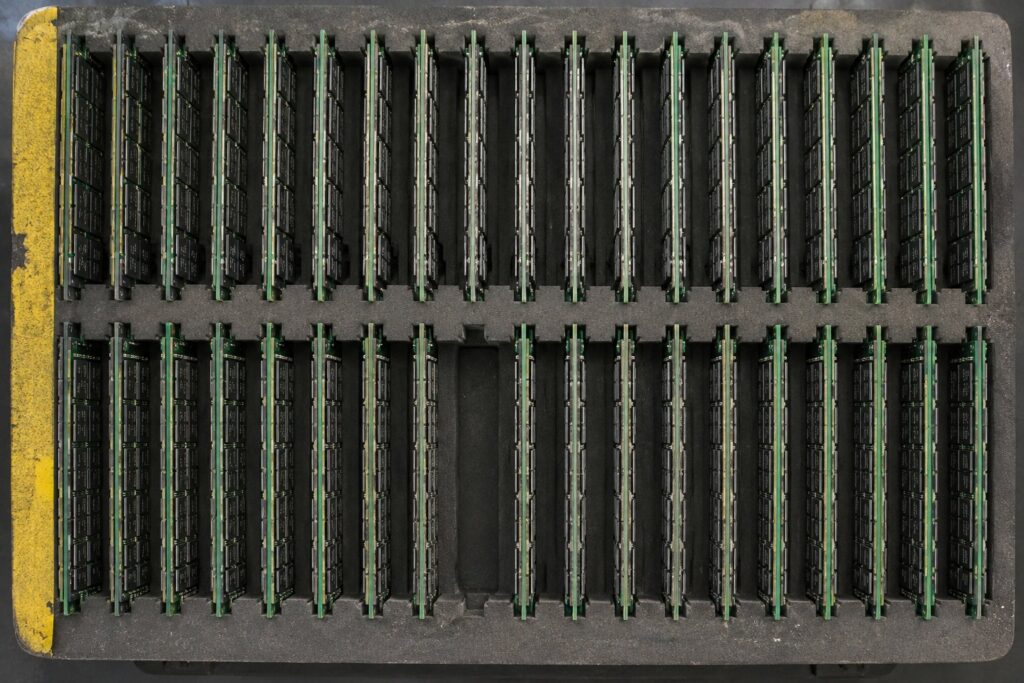
If you have quoted a server refresh, a workstation upgrade, or even a laptop fleet in the last few months, the memory line has moved in a way that is difficult to explain to a finance team. Server memory prices are not drifting up with inflation. They have re-based.
This is an AI story, but not the one usually told about it. No model is involved, nothing was announced at a keynote, and the mechanism is a supply chain rather than a capability. It is also the AI story most likely to show up in an ordinary IT budget this year.
The number that started this
TrendForce reported that first quarter 2026 DRAM industry revenue hit $97 billion, up 81 percent quarter over quarter. That growth did not come from shipping more chips. It came from price: contract prices for conventional DRAM rose approximately 93 to 98 percent quarter over quarter.
Conventional DRAM, not the specialized memory that sits on AI accelerators. The ordinary kind, in ordinary servers and desktops, roughly doubling in contract price in three months.
The three suppliers that matter all posted the corresponding results in the same quarter.
| Supplier | 1Q26 revenue | Market share | QoQ growth |
|---|---|---|---|
| Samsung | $37.32 billion | 38.5% | 93.4% |
| SK hynix | $27.98 billion | 28.8% | 62.5% |
| Micron | $21.75 billion | 22.4% | 81.6% |
Why the usual explanation is only half right
The explanation in general circulation goes like this: the memory makers moved their capacity to high bandwidth memory for AI accelerators, HBM eats far more wafer per gigabyte than DDR5, so ordinary memory got scarce. Tom’s Hardware puts that ratio at roughly three times the wafer capacity per gigabyte, which is the figure most coverage repeats.
That mechanism is real. It is also not the whole picture, and the part that gets left out changes what you should expect next.
TrendForce attributes the 2026 pricing momentum to something broader: a shift in AI deployment priorities from training-focused systems toward inference, which expanded memory procurement across multiple DRAM categories rather than only specialized server memory. Inference runs in more places, on more varied hardware, than training does. It pulls on standard DDR5 as well as HBM.
There is a further wrinkle that inverts the simple story. In December 2025 TrendForce noted that "as the profitability of conventional DRAM improves, some suppliers are shifting capacity toward DDR5, creating more room for HBM3e price increases." Capacity has been moving toward conventional memory, not only away from it, because conventional memory became lucrative in its own right.
The long-term agreements that decide who pays
This is the part almost nobody writes about, and it is the part that determines whether the increase lands on your purchase order or somebody else’s.
TrendForce reports that several US-based cloud service providers have signed multi-year long-term agreements that restrict suppliers from raising prices for those clients. The consequence is stated directly: those provisions shift price pressure toward non-LTA buyers beginning in the third quarter of 2026.
Read that plainly. The largest buyers of memory in the world negotiated protection from the increase. Suppliers still need to hit their numbers. The difference is recovered from buyers who did not have the volume or the foresight to lock in multi-year terms, which is to say: everyone else.
The same report forecasts server DRAM contract prices rising 13 to 18 percent quarter over quarter in 3Q26. That is the headline forecast, and non-LTA buyers should expect to sit at the upper end of it rather than the average. Any published average for server memory prices is blending two populations with very different deals, and you are almost certainly in the one paying more.
What this looks like on a purchase order
Memory is a larger share of a modern server bill of materials than most budget models assume, and it is the component with the least substitutability. You can specify a cheaper CPU, fewer cores, a smaller boot drive. A workload that needs 512 GB of RAM needs 512 GB of RAM.
Three practical effects follow:
Configurations quoted more than 60 days ago are stale. In a market moving at these rates, an old quote is not a negotiating position, it is a fiction. Re-quote before committing.
The memory line stops tracking the rest of the build. Historic ratios between CPU, memory, and storage cost no longer hold, so budget templates built on those ratios will under-forecast.
Consumer and workstation hardware is affected too. The same DDR5 supply feeds laptops and desktops. Fleet refreshes specified on last year’s pricing will come in high, and specifying less memory to hit a number has a longer tail of consequences than usual, because those machines will be in service through the whole squeeze.
When it eases, and what the forecasts actually say
Not soon, and the detail is worse than the headline.
TrendForce projects server DRAM prices continuing to rise from the second half of 2026 through the second half of 2027. It anticipates a server DRAM shortage in 2027. Total RDIMM bit supply is expected to grow only 15 to 20 percent year over year, which lags projected CPU shipment growth. CPU supply is expected to improve progressively from the second half of 2026 through 2027, which makes the mismatch sharper rather than softer: more servers can be built than there is memory to fill them.
That is the structural point. The constraint is not going to be relieved by the thing that is improving.
What to do about it now
The recommendations are unglamorous and they are the ones that actually work.
Buy memory earlier in the project than you would have. If a build is funded and specified, the memory is the component to secure first. This inverts the usual sequencing, where memory is a late line item because it was always available.
Ask your reseller directly whether they hold allocation. Distribution allocation is doing real work in this market. A reseller with committed supply is worth more than a lower quote from one without, because a quote you cannot fill is not a price.
Specify for the service life, not the budget cycle. Under-specifying memory to hit this year’s number means buying more of it in 2027, in the middle of a forecast shortage. This is the one case where paying the elevated price now is likely to be the cheaper decision.
Look hard at what actually needs to be new. Memory upgrades to existing servers face the same pricing, but avoiding a whole-platform refresh can still net out favorably. Run the comparison rather than assuming.
If you are sizing for local inference, size honestly. Our guides to hardware for AI agents and the cost of self-hosting a large model both assume memory pricing that has since moved. Re-run those numbers before committing to a self-hosting plan on the strength of an older estimate.
Where server memory prices fit in the wider AI buildout
The through-line is that AI infrastructure spending has started to show up in places that have nothing to do with AI. A company running no models at all, with no plans to, is paying more for its file server because of demand created by companies that do.
That is a different kind of story from the ones this beat usually produces, and it is worth holding onto as a lens. Our AI accelerator landscape piece noted that packaging, memory, and power are the real constraints on AI compute rather than the processors themselves. Server memory prices are that constraint arriving on an invoice, several steps downstream, at an organization that never bought an accelerator. Our explainer on what compute actually means covers why those inputs bind before the silicon does.
The practical posture is to treat memory as a scarce, price-volatile input for the next several quarters, plan procurement around availability rather than list price, and stop assuming the memory line will behave like the rest of the build.
Frequently Asked Questions
Why are server memory prices rising so fast?
AI demand expanded memory procurement across every DRAM category, not just the specialized high bandwidth memory used on accelerators. TrendForce attributes the 2026 surge partly to AI deployment shifting from training toward inference, which pulls on conventional DDR5 as well as HBM. Contract prices for conventional DRAM rose roughly 93 to 98 percent quarter over quarter in 1Q26.
Is it just that capacity moved from DDR5 to HBM?
That is the common explanation and it is incomplete. HBM does consume more wafer capacity per gigabyte, reported at roughly three times. But TrendForce also observed suppliers shifting capacity toward DDR5 as conventional DRAM profitability improved. Demand rose across categories rather than simply being diverted between them.
Why is my price increase worse than the reported average?
Several large US cloud providers signed multi-year agreements that restrict suppliers from raising their prices. TrendForce reports those provisions shift price pressure onto buyers without such agreements from the third quarter of 2026 onward. Reported averages blend both groups, so buyers outside long-term agreements should expect the top of any forecast range.
How much further are prices expected to rise?
TrendForce forecast server DRAM contract prices rising 13 to 18 percent quarter over quarter in 3Q26, with increases continuing from the second half of 2026 through the second half of 2027.
When will memory prices come back down?
No forecast reviewed here predicts relief before late 2027, and TrendForce anticipates a server DRAM shortage during 2027. RDIMM bit supply is projected to grow only 15 to 20 percent year over year, behind CPU shipment growth, so the memory constraint tightens even as processor supply improves.
Should I buy now or wait?
On current forecasts, waiting costs more. Prices are projected to keep rising through 2027 and a shortage is anticipated, so deferring a funded purchase means buying later at a higher price with worse availability. Secure memory early in the project rather than treating it as a late line item.
Does this affect laptops and desktops too?
Yes. The same DDR5 supply serves consumer and workstation hardware, so fleet refresh budgets built on last year’s pricing will come in high. Reducing specified memory to hit a number is risky given that those machines will remain in service through the forecast squeeze.
Are the retail price figures circulating online reliable?
Treat them with care. Figures such as a 64 GB kit at several times its previous price come from retail trackers and vary enormously by individual product. The contract-price and supplier-revenue data from market analysts is more stable and better suited to budgeting, which is why this piece uses it.