
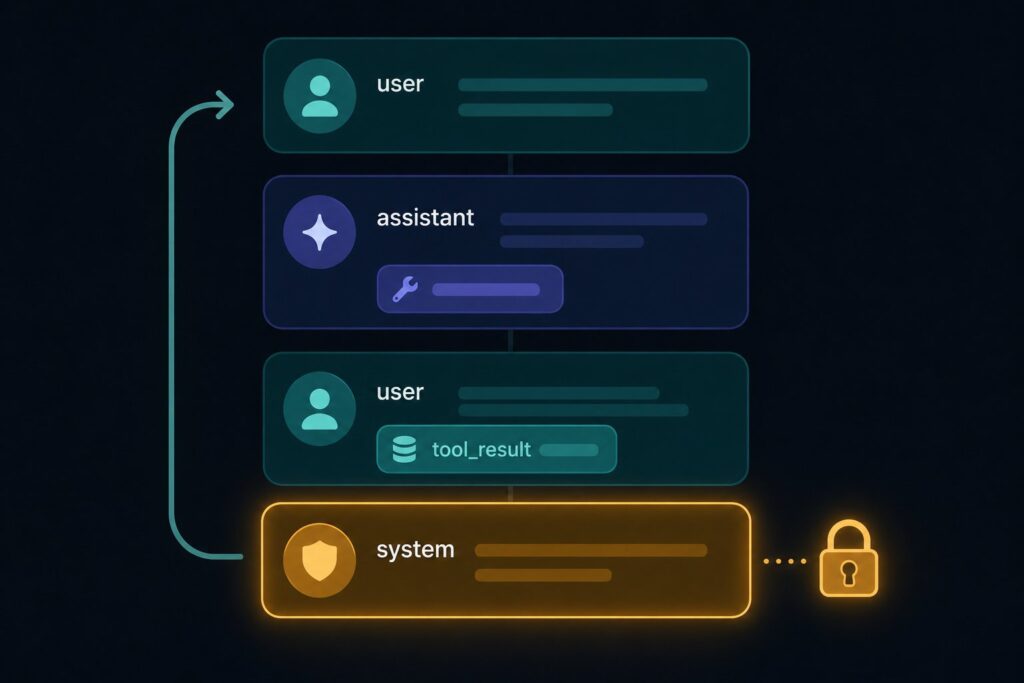
The Claude Messages API gives you exactly one place for standing instructions: a single top-level system field that sits ahead of the whole conversation. That works fine until you are deep in a long agentic session and realize the model needs a new rule partway through. Mid-conversation system messages are the pattern that fills this gap, and getting them right matters for any production harness that has to steer Claude while it is already working.
One system prompt, a conversation that keeps changing
The Messages API has a deliberately simple shape. You send a model, a messages array, an optional top-level system string, and parameters like max_tokens. The messages array has to alternate: a user turn, then an assistant turn, then user again, starting with user. Two user turns in a row, or a conversation that opens with an assistant turn, returns a 400 error. Each message carries a content field that can be a plain string or an array of content blocks (text, images, tool_use, tool_result), which is how tool calling threads through the same structure.
The system field is separate from all of this. It is not a message with a role inside the array. It is one top-level parameter that describes who the model is and how it should behave for the entire exchange. That single-slot design is clean, but it assumes you know everything you want to say before the first token is generated. Real agent runs are not like that. You discover new constraints as the work unfolds.
Where mid-conversation guidance actually helps
Consider a coding agent that has been running for forty turns. Halfway through, your policy engine decides that every SQL suggestion from here on must be a parameterized query. Or a user types a follow-up ("also update the changelog") while the model is still executing tools for the previous request. Or your application observes something the model should treat as fact: files changed on disk, the remaining token budget dropped below a threshold, or a tool the model was relying on just went offline.
None of these fit neatly into the original system prompt, because they did not exist when the conversation started. You have three broad options for getting that guidance in front of the model, and they are not equal.
- Edit the top-level system field. Technically possible, but it changes the very beginning of the prompt. Every request after that misses the prompt cache for the system prompt and every turn behind it, which on a long session is an expensive way to add one sentence.
- Put the instruction in an ordinary user turn. Claude does follow instructions that arrive in user messages, so this works. The catch is priority: a user turn is treated as coming from the end user, not from you, the operator. If the end user later asks for the opposite, the two carry similar weight.
- Send it as a mid-conversation system message. On models that support it, you append a message with
"role": "system"to the end of the array. It keeps operator-level priority, and because it sits after the cached prefix, it does not invalidate the cache.
The constraint, and the feature that addresses it
Here is the version-dependent part, so treat it precisely. As of 2026, Anthropic documents a first-class feature for exactly this: mid-conversation system messages, where you add a {"role": "system"} entry inside the messages array rather than editing the top-level field. Per Anthropic’s documentation it is available on Claude Opus 4.8 only, and on the Claude API, Claude Platform on AWS, and Microsoft Foundry, but not on Amazon Bedrock or Google Cloud. No beta header is required. If you are targeting an older model or one of the unsupported platforms, this exact mechanism is not available to you, and you fall back to the delimited-user-turn pattern described below.
The reason the feature exists comes down to caching. Prompt caching hashes the request prefix in a fixed order: tools, then system, then messages. A cache hit requires that prefix to match a recent request byte for byte up to the breakpoint. Because the top-level system field sits near the start of that hash, any edit to it, even appending a single sentence, produces a new hash and misses the cache for everything after. Appending a system message at the end of the history leaves the earlier turns untouched, so the cached prefix still matches and only the new message is processed as fresh input.
Placement is constrained. A system message cannot be the first entry in messages (use the top-level field for that). It must immediately follow a user turn, including a user turn that carries tool_result blocks, or an assistant turn that ends in server tool use, and it must either end the array or be followed by an assistant turn. The one position that is explicitly disallowed is between a tool_use block and the tool_result that answers it. Consecutive system messages are also rejected, so merge instructions into one message rather than stacking two.
The agent-loop pattern
The most useful placement is right after tool results come back, before the model takes its next turn. That is where an agent loop can fold in new context without restarting the current request. A user message delivers the tool_result blocks, and the system message follows it:
[
  { "role": "user", "content": "Run the test suite and fix any failures." },
  { "role": "assistant", "content": [
    { "type": "tool_use", "id": "toolu_01", "name": "run_tests", "input": {} }
  ]},
  { "role": "user", "content": [
    { "type": "tool_result", "tool_use_id": "toolu_01", "content": "12 passed, 0 failed" }
  ]},
  { "role": "system", "content": "New input arrived from the user: also update the changelog before finishing." }
]
If you have built or studied agentic systems, this loop will feel familiar. It is the same read-act-observe cycle covered in our explainer on what AI agents are, and the same orchestration surface that an AI agent development framework manages for you. The mid-conversation system message is the steering signal you inject between the observe and act phases.
Best practices for injected instructions
A few habits keep this reliable in production.
Phrase the content as context, not as a command that overrides the user. State what changed ("the remaining token budget is now 8,000 tokens", "the auto-approve setting was turned off") and let the model act on it. Claude is trained to resist instructions that appear to work against the end user, and that protection applies to the system role too, so language like "ignore what the user said" tends to be less effective than simply stating the new fact.
Keep untrusted content out of system messages entirely. This is the single most important rule. The model treats system content as operator instructions and follows it, which means raw tool output, retrieved documents, or fetched web pages must never be pasted into a system message. Doing so hands that text operator-level authority and turns an indirect prompt injection into a privileged one. Keep third-party data in tool_result blocks where the model already treats it as untrusted. The same principle underlies safe tool design in protocols like the one covered in our guide to the Model Context Protocol, where the boundary between instructions and data is the whole ballgame.
When you do relay end-user input through a system message, delimit it clearly so the model can tell your framing from the payload. A short, explicit wrapper ("The user sent the following message while you were working:") is enough to separate operator narration from the quoted text.
Do not edit or delete a system message you already sent. Rewriting an earlier message invalidates the cache from that point forward, which defeats the purpose. If the instruction needs to evolve, append a new system message. Later system messages take precedence over earlier ones, so the newest guidance wins without any surgery on history.
For older models or unsupported platforms, the fallback is a user turn that carries clearly delimited, system-style guidance. It loses the operator-level priority of a true system message, so lean harder on unambiguous delimiters and keep the injected block short and factual. It is a workable pattern, just a weaker one, and worth flagging in your own harness so nobody assumes it carries the same weight.
Frequently Asked Questions
Can I put a system role message anywhere in the Claude messages array?
No. A system message cannot be first, cannot sit between a tool_use block and its matching tool_result, and cannot directly follow another system message. It has to come after a user turn (including one carrying tool results) or an assistant turn ending in server tool use, and either end the array or precede an assistant turn.
Which Claude models support mid-conversation system messages?
As documented in 2026, the feature is available on Claude Opus 4.8 only, and on the Claude API, Claude Platform on AWS, and Microsoft Foundry. It is not offered on Amazon Bedrock or Google Cloud. On other models you fall back to placing delimited guidance in a user turn.
Why not just edit the top-level system field instead?
Editing the top-level system field changes the start of the cached prefix, so the request misses the prompt cache for the system prompt and every turn after it. On a long session that is a large, avoidable cost. Appending a system message at the end leaves the cached prefix intact.
Is a mid-conversation system message different from a user message?
Functionally the model follows instructions from both, but priority differs. A user message is treated as coming from the end user, while a system message is treated as coming from you, the operator. When the two conflict, system instructions take precedence.
Can I relay a user’s follow-up through a system message during an agent loop?
Yes, and it is a recommended pattern. Place the system message after the user turn that delivers the tool results, phrased as context (“new input arrived from the user: X”), so the model folds the request into its current work instead of treating it as a fresh turn to switch to.
Should I ever put tool output or retrieved documents in a system message?
No. System content is treated as trusted operator instructions, so placing untrusted external text there grants it operator-level authority and creates a prompt-injection risk. Keep that data in tool_result blocks and apply standard jailbreak and injection mitigations.
How does this interact with prompt caching?
They are designed to work together. Enable caching with a cache_control breakpoint on the stable prefix, then append the system message after that breakpoint. Because it comes after the cached region, the prefix hash is unchanged and the cache still hits. On the next turn the system message itself becomes part of the cacheable history.
What if I need to change an instruction I already injected?
Do not rewrite the earlier message, since that invalidates the cache from that point onward. Append a new system message instead. Later system messages take precedence over earlier ones, so the newest instruction governs the turns that follow it.