The OpenAI speaker is shaping up to be the company’s first flagship consumer device, and according to reporting it is not what most people expected. Rather than a phone or a pair of glasses, OpenAI is said to be building a screenless, movable smart speaker designed to feel less like a gadget and more like a companion that lives in your home. Nothing here is official yet. What we know comes from reporting, chiefly a July 14, 2026 Bloomberg account that other outlets have since corroborated, and OpenAI has not publicly detailed the product. With that caveat front and center, here is what has been reported and how to read it.
The short version: a portable speaker with no screen, a camera and sensors, a rechargeable battery so it can move between rooms, and small motorized parts that move on their own to give it a sense of presence. It is being built with Jony Ive’s team, it runs an advanced version of ChatGPT’s voice mode, and it is expected to be unveiled in 2026 and to ship in 2027 at a price around $200 to $300. This piece walks through the reported features, the design thinking behind them, the legal cloud over the project, and where it sits in OpenAI’s broader hardware plans.
What OpenAI is reportedly building
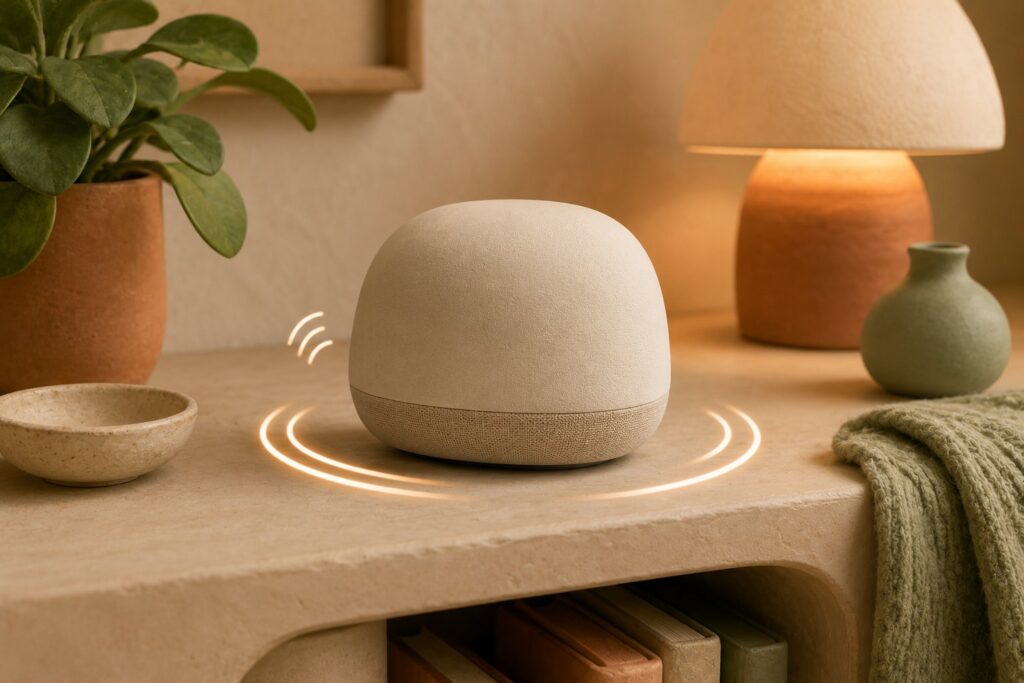
The device is described as a home AI companion in the shape of a small, portable speaker. The defining choice is what it leaves out: there is no screen. Instead of pulling you toward a display, it is meant to be something you talk to and that talks back, positioned as an ambient presence rather than another rectangle to stare at.
The other defining choice is that it moves. Reporting describes mechanical elements that can move on their own, and a rechargeable battery that lets the device be carried or reposition itself around a room. The internal pitch, as reported, is a humanlike companion that feels alive rather than an appliance waiting for commands. That framing is doing a lot of work, and it is worth treating as an aspiration rather than a description of a finished product.
The features being reported
Across the reporting, a consistent set of capabilities shows up:
- Screenless, voice-first interaction powered by an advanced version of ChatGPT’s voice mode, so the primary interface is conversation.
- A camera and onboard sensors that help the device perceive its surroundings and respond with context.
- A rechargeable battery so it is portable and can move between rooms rather than staying tethered in one spot.
- Motorized, self-moving parts meant to express personality and suggest the device is present and attentive.
- Home-assistant functions: controlling smart-home appliances, playing media, answering questions, and handling messages, backed by the full range of ChatGPT’s capabilities.
The voice layer is the part with the clearest lineage. It is reported to build on the same real-time, conversational direction as ChatGPT’s live voice mode, which is where OpenAI has been developing natural, low-latency spoken interaction. The camera and sensors are what would let a home device move from answering questions to noticing context, which is also where most of the privacy questions will land.
Why screenless, and why it moves
The screenless choice is a philosophy, not an oversight. The reported design leans on the idea that a companion device should not compete for your visual attention the way a phone does. Removing the screen forces the interaction to be spoken and ambient, which fits the "presence in the room" goal and reflects a long-running design view, associated with Jony Ive, that we should be looking at screens less, not more.
The self-moving parts serve the same goal. A device that turns toward you or shifts as you move reads as attentive in a way a static speaker does not. The intent is to cross from appliance to companion. It is a genuinely ambitious interaction bet, and also the part most deserving of skepticism, because "feels alive" is easy to say in a briefing and hard to deliver without landing in a novelty drawer. Until people use one, the companion framing is a marketing promise, not a proven experience.
The Jony Ive and io backstory
This device is the first concrete product from OpenAI’s expensive move into hardware design. OpenAI acquired Jony Ive’s hardware startup, io, in a deal reported at roughly $6.5 billion, and paired with Ive’s LoveFrom design studio to build AI-first devices. The team reportedly includes many former Apple engineers who worked on products like the iPhone and Mac, which is both the project’s biggest asset and the source of its biggest legal risk.
That pedigree is why expectations are high. It is also why the product is being designed around a strong point of view rather than a spec sheet, with the "companion" concept driving the hardware choices rather than the other way around.
The Apple lawsuit hanging over it
The project does not arrive cleanly. On July 10, 2026, Apple sued OpenAI over alleged trade-secret theft, with reporting centering on OpenAI’s chief hardware officer Tang Tan, a former head of iPhone product design and an io co-founder. Apple’s claim, as reported, is that a campaign was run to obtain confidential information about Apple’s future products. OpenAI disputes the framing.
For readers, the takeaway is not to adjudicate the suit. It is that OpenAI’s first flagship device is being built under active litigation by the most experienced consumer-hardware company in the world, which adds real uncertainty to the timeline and the design on top of the usual risks of a first-generation product.
Not OpenAI’s first hardware, but its first flagship
A quick clarification, because the "first device" language gets muddled. OpenAI’s first piece of commercial hardware was actually a niche accessory, the Codex Micro macropad, a small controller for its coding agent. The screenless speaker is different in kind: it is the first mainstream consumer device, the one meant to put ChatGPT into the home as a product in its own right.
It is also just one of several. Reporting describes an OpenAI hardware division working on roughly five products, including a portable device positioned to replace a phone, a wearable pendant, and home robotics. The speaker is the first to surface in detail, and it fits a broader pattern we have tracked in the physical AI device landscape, where the interface for AI is moving off the screen and into ambient, sensor-rich objects.
Timeline, price, and how to read this
On the numbers, reporting points to an unveiling in 2026 and a ship date in 2027, with February 2027 cited as the earliest, at a price around $200 to $300. Those figures put it in the range of a premium smart speaker rather than a phone-tier purchase, which matters for how many homes might actually try it.
The honest way to hold all of this is as credible, well-sourced reporting about a product that is still in development and not officially announced. Details can change, ship dates in first-generation hardware slip, and the "feels alive" promise is unproven until it is in living rooms. Treat the specifics as provisional, watch for an official reveal, and weigh the companion pitch against how these ambient devices actually behave once the demo ends. What is clear is the direction: OpenAI wants ChatGPT to have a body in your home, and this speaker is its first real attempt.
Frequently Asked Questions
What is the OpenAI speaker?
It is a reported screenless, portable smart speaker that OpenAI is building as a home AI companion. According to reporting, it has a camera, sensors, a rechargeable battery, and motorized parts that move on their own, and it runs an advanced version of ChatGPT’s voice mode. OpenAI has not officially announced it, so all details come from reporting rather than the company.
Does the OpenAI speaker have a screen?
No. The defining design choice is that it is screenless. The interaction is meant to be voice-first and ambient, so you talk to it and it responds, rather than looking at a display. The reported thinking is that a companion device should not compete for your visual attention the way a phone does.
When will it launch and how much will it cost?
Reporting points to an unveiling in 2026 and a ship date in 2027, with February 2027 cited as the earliest, at a price around $200 to $300. These are reported figures, not official ones, and first-generation hardware timelines often move.
Who is designing the OpenAI speaker?
It is being built with Jony Ive’s team after OpenAI acquired his hardware startup io in a deal reported at about $6.5 billion, alongside his LoveFrom design studio. The team reportedly includes many former Apple engineers who worked on products like the iPhone and Mac.
Why is Apple involved in a lawsuit over it?
On July 10, 2026, Apple sued OpenAI alleging trade-secret theft, with reporting focused on OpenAI’s chief hardware officer Tang Tan, a former Apple iPhone design lead and io co-founder. Apple alleges an effort to obtain confidential information about its future products. OpenAI disputes the characterization, and the case is unresolved.
Is this OpenAI’s first hardware device?
It is OpenAI’s first flagship consumer device, but not its first hardware overall. That was the Codex Micro, a niche macropad for controlling its coding agent. The speaker is the first mainstream product, and reporting says it is one of about five hardware projects, including a phone-replacement device, a wearable pendant, and home robotics.
What can the OpenAI speaker do?
Based on reporting, it is meant to control smart-home appliances, play media, answer questions, handle messages, and tap the full range of ChatGPT’s capabilities through conversation. Its camera and sensors are intended to give it awareness of its surroundings, though that is also where the main privacy questions sit.