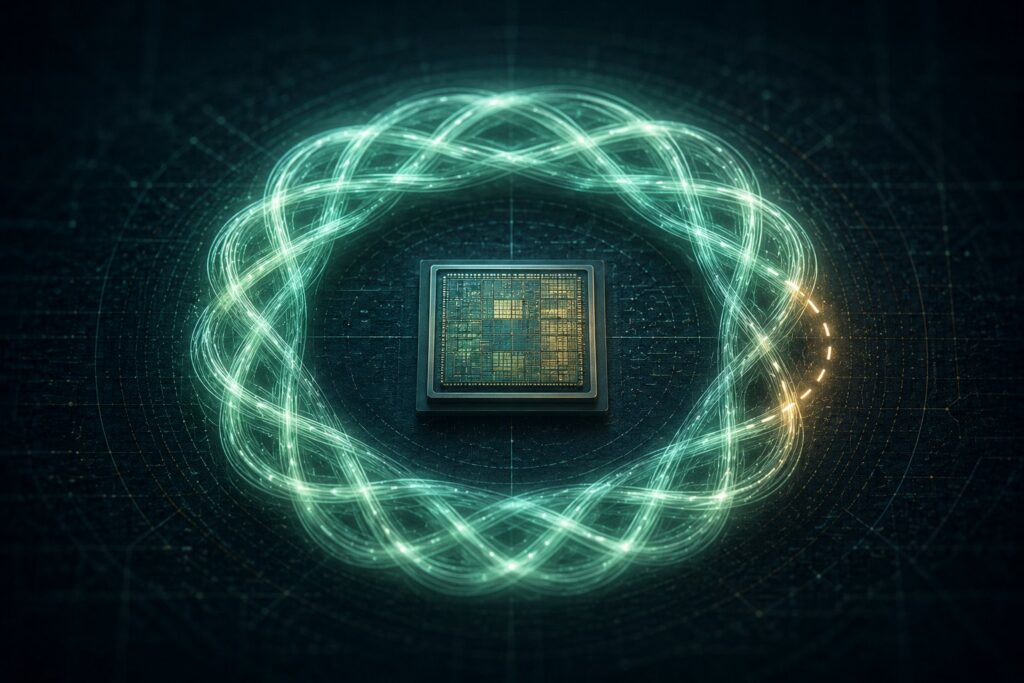
Majorana 2 is Microsoft’s second-generation topological quantum chip, unveiled at its Build conference on June 2, 2026. Microsoft says the new design improves qubit reliability roughly a thousandfold over its predecessor and lets it cut its roadmap to a practical quantum computer in half, now aiming for 2029. It is a genuinely notable engineering claim. It also arrives with a caveat that has followed Microsoft’s quantum program for years: much of the physics underneath is still contested by outside scientists. This post explains what Majorana 2 actually is, what changed from the first chip, the role AI played in building it, and why the reaction has been a mix of real interest and real skepticism.
The honest framing up front: Majorana 2 is a meaningful step on the metrics Microsoft can measure and publish, and an unproven one on the deeper question of whether its qubits work the exotic way the company says they do. Both things are true at once, and any useful read of the announcement has to hold them together.
What Microsoft announced
Majorana 2 is the follow-up to Majorana 1, the topological chip Microsoft introduced in early 2025. The headline numbers from the June announcement:
- A roughly 1,000x reliability improvement over the prior generation, which Microsoft frames as its central advance.
- A mean qubit lifetime near 20 seconds, with some instances lasting as long as a minute, compared with 1 to 12 milliseconds for Majorana 1.
- 12 qubits, up from the eight that the first chip reached.
- A new materials stack: lead replaces aluminum as the superconductor, and the semiconductor region moves to a combination of indium arsenide and indium arsenide antimonide, changes Microsoft says more than doubled the protective “topological gap.”
- Fast, small operation: roughly one-microsecond operations and a qubit size around one-hundredth of a millimeter.
Two things stand out from that list. The reliability jump is large and specific, and it comes mostly from materials science rather than a wholly new architecture. And the qubit count is still tiny: 12 qubits is a research device, not a machine that runs useful workloads. The story here is about coherence and stability, not scale.
What topological qubits are trying to solve
To understand why Microsoft cares so much about reliability, it helps to know what makes its approach different. Most quantum computers, including those from IBM and Google, use qubits that are extremely fragile: they lose their quantum state in microseconds and require enormous overhead in error correction, where many physical qubits are combined to produce one stable "logical" qubit.
Microsoft’s bet is topological qubits, which aim to build error resistance into the hardware itself by encoding information in a more robust physical property rather than a delicate local state. If it works, the payoff is fewer physical qubits per logical qubit and a shorter path to a machine that scales. That is the whole reason a jump from millisecond to twenty-second qubit lifetimes matters: stability at the hardware level is the entire premise of the topological approach, so a large reliability gain is exactly the kind of result the strategy needs to show.
The 1,000x reliability leap, in context
Going from qubit lifetimes measured in single-digit milliseconds to lifetimes measured in tens of seconds is a dramatic change on paper, and it is the number Microsoft leads with. Longer coherence means more time to run operations before the qubit decoheres, which is a real and useful property.
The context that keeps it grounded is scale and independence. Twelve qubits cannot run a meaningful algorithm, so this is a demonstration of a better building block, not a working computer. And as with any vendor result, the figures come from Microsoft’s own measurements. They are worth taking seriously and worth treating as provisional until independent groups can reproduce them, the same standard we apply to model benchmarks and chip claims across the industry, including the frontier silicon work at IBM’s sub-1nm research.
The AI angle: a chip designed with agentic AI
The detail most relevant to where technology is heading is how Microsoft got here. The company credits its new materials stack in part to Microsoft Discovery, its agentic-AI platform for scientific research, which uses a coordinated set of AI agents to synthesize data, propose hypotheses, and run simulations across the research loop. In other words, agentic AI helped search the materials space that led to swapping aluminum for lead and redesigning the semiconductor region.
This is the part of the announcement with the broadest implications, and it connects to a theme we have covered directly: value is shifting toward applying AI to real work, including hard R&D. Whether or not the topological claims hold, a frontier materials result accelerated by AI agents is a concrete example of the "agentic science" pitch moving from slideware to a shipped chip. It is also a reminder that the most consequential AI stories are increasingly not about chatbots at all.
The catch: the underlying physics is still contested
Here is the part a careful reader needs. Microsoft’s topological approach depends on a phenomenon called Majorana zero modes, exotic quasiparticles that the whole design assumes it can create and control. The problem is that outside physicists have not been convinced there is definitive public evidence these devices actually exhibit those modes, and that skepticism did not start with the new chip.
Majorana 1 drew scrutiny in 2025 over exactly this question, and reporting on Majorana 2 notes that the debate carried straight into the second generation. Some coverage was blunt about it: Scientific American described the upgraded chip as one that "fizzles with physicists," and specialist outlets framed the release as advances reported amid an unresolved dispute over the topological claims. The reliability numbers can be real while the deeper interpretation of what is happening inside the device remains open. Both can hold at once, and Microsoft’s critics are not disputing that the engineering improved so much as whether it demonstrates the physics the company says it does.
For a general reader, the takeaway is not to adjudicate the physics. It is to notice that a major vendor is making strong claims in a domain where independent verification is genuinely hard, and to weight the announcement accordingly.
The 2029 timeline, and how to read it
Microsoft paired the chip with an accelerated roadmap: it says it has cut its timeline roughly in half and now targets a scalable, practical quantum computer by 2029. That is a striking date, and it is also a vendor projection about an unsolved engineering problem, which is the kind of claim that has slipped before across the whole quantum field.
The reasonable way to hold it is as a statement of ambition and direction, not a delivery commitment. A 2029 target tells you where Microsoft believes its approach is heading and how confident it wants the market to be. It does not tell you a useful quantum computer will exist in 2029. Roadmaps in emerging hardware compress and stretch, and topological quantum computing in particular still has to clear the verification questions above before scale becomes the main obstacle.
What Majorana 2 means for a business right now
The practical answer is short: nothing you need to act on this quarter. Quantum computing is not about to change your infrastructure, your security posture, or your software stack in the near term, and Majorana 2, a 12-qubit research device, does not move that timeline for buyers. Anyone selling you an urgent quantum decision today is ahead of the technology.
What is worth internalizing is the shape of the story. The most durable signal in this announcement is not the qubit lifetime; it is that AI agents materially helped design a frontier chip, which is a live example of AI compressing hard research cycles. Keep an eye on the independent verification of the topological claims, treat the 2029 date as direction rather than schedule, and file Majorana 2 as a real engineering result wrapped in an unresolved scientific question. That combination, promising and unproven, is the accurate way to hold it.
Frequently Asked Questions
What is Microsoft Majorana 2?
Majorana 2 is Microsoft’s second-generation topological quantum chip, announced at Build on June 2, 2026. It scales to 12 qubits and claims a roughly 1,000-fold improvement in qubit reliability over Majorana 1, with a mean qubit lifetime near 20 seconds. It is a research device, not a commercial quantum computer.
How is Majorana 2 different from Majorana 1?
It scales from 8 to 12 qubits and, more importantly, claims a large reliability gain: qubit lifetimes move from 1 to 12 milliseconds to around 20 seconds. The change comes mainly from a new materials stack, with lead replacing aluminum as the superconductor and a redesigned indium-arsenide semiconductor region that Microsoft says more than doubled the protective topological gap.
What are topological qubits, and why do they matter?
Topological qubits aim to build error resistance into the hardware by encoding information in a robust physical property rather than a fragile local state. If the approach works, it needs fewer physical qubits per stable logical qubit than mainstream designs, which is why Microsoft is chasing large reliability gains rather than raw qubit counts.
Did AI help design Majorana 2?
Microsoft credits its agentic-AI research platform, Microsoft Discovery, with helping develop the new materials stack. The platform uses coordinated AI agents to synthesize data, generate hypotheses, and run simulations, and Microsoft says it contributed to the materials changes behind the reliability improvement.
Why are some physicists skeptical of Majorana 2?
Microsoft’s approach relies on Majorana zero modes, exotic quasiparticles that the design assumes it can create and control. Outside physicists say there is not yet definitive public evidence the devices exhibit those modes. That debate began with Majorana 1 in 2025 and continued with the second chip. The reliability numbers can be genuine while the deeper physical interpretation stays contested.
When will Microsoft have a practical quantum computer?
Microsoft says it has cut its timeline roughly in half and now targets a scalable, practical quantum computer by 2029. Treat that as a statement of ambition rather than a delivery date. It is a vendor projection about an unsolved engineering problem, and quantum timelines across the industry have shifted before.
Should my business do anything about Majorana 2 now?
No. Quantum computing is not about to change your infrastructure, security, or software in the near term, and a 12-qubit research chip does not alter that. The more useful signal for most organizations is that AI agents helped design a frontier chip, an example of AI accelerating hard research, rather than anything requiring a quantum decision today.