
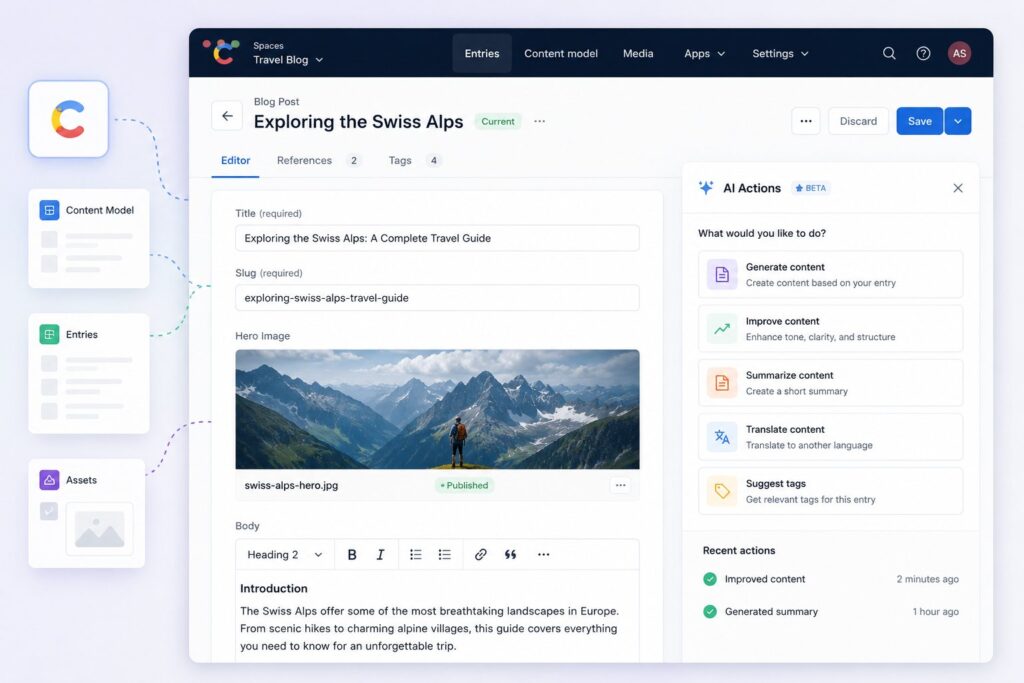
Contentful AI Actions is the AI integration layer inside Contentful that lets editors trigger AI-powered workflows directly from the entry editor interface. The feature has been evolving steadily through 2025-2026, with the most recent major update on May 19, 2026 adding two consequential capabilities: assignment and filtering configurations (admins can control which content types and fields specific AI Actions appear on, configure default variable values, and reduce repetitive editor work) and Azure OpenAI as an additional Bring Your Own Model (BYOM) connector alongside the previously-supported OpenAI, AWS Bedrock, and Google Gemini. The May 2026 update fits a clear pattern: Contentful is positioning AI Actions as the foundational content-AI integration layer that enterprise customers can deploy on the AI vendor of their choice, without being forced into Contentful’s bundled model decisions. That positioning is more strategically important than ever after Salesforce’s June 1, 2026 announcement of a definitive agreement to acquire Contentful for the Agentforce AI agent strategy. We covered the broader platform in our What Is Contentful? pillar last week; this post covers the AI Actions layer specifically.
The reason AI Actions matter beyond the feature-set itself: AI inside a CMS is becoming table stakes for enterprise content infrastructure decisions. Editors want to draft content with AI assistance, translate it with AI, optimize it for SEO with AI, generate variations for personalization with AI, and check it against brand guidelines with AI, all from inside the CMS they already use. Without an integrated AI layer, those workflows live in separate tools (ChatGPT, Claude, Jasper, Writer, Copy.ai) with manual paste-back patterns that are slow and lossy. AI Actions is Contentful’s answer to the integrated-AI editor experience, and the BYOM architecture is the answer to the procurement and governance constraints that enterprise customers face when picking an AI model layer. This post covers what AI Actions actually is, the BYOM model support and what it enables, the May 2026 assignment-and-filtering updates, the practical use cases for editors, the security and governance posture, where the Salesforce acquisition will likely take the feature, and what teams using Contentful should be doing today.
What AI Actions actually is
AI Actions is a Contentful feature that exposes AI-powered workflows directly in the entry editor. The architecture: an admin defines an AI Action with a prompt template, a target model, target content types and fields, and configuration variables. Editors then see the AI Action available on entries of the configured content types, click to invoke it, and see the AI’s output applied to the entry (either as a draft for editor review or, in supervised configurations, directly to the field).
The practical user experience: an editor working on an article entry sees an "Improve headline" button. Clicking it sends the current headline (and possibly other context like the article body) to the configured AI model with the admin-defined prompt template. The model returns an improved headline. The editor reviews the suggestion, accepts it, edits it further, or rejects it. The whole interaction happens inside Contentful without context-switching to another tool.
The AI Action capability surface as of mid-2026:
Content generation. Generate draft body copy, headlines, meta descriptions, alt text, social media variants, and similar derivative content from existing content or prompts.
Content transformation. Translate content between languages, summarize long content into short variants, reformat content for different channels, simplify technical content for general audiences.
Content validation. Check content against brand voice guidelines, check for inclusive language, validate factual claims against source material, score content against SEO targets.
Content enrichment. Suggest tags, identify entities, extract metadata, generate structured data attributes, propose related content references.
Editorial workflow assistance. Suggest review comments, draft response messages to reviewers, summarize review threads, draft change-log entries.
The capability surface is genuinely useful for the editorial workflows it covers, and the integration into the editor surface removes the friction that plagues separate-tool AI workflows.
The Bring Your Own Model architecture
The most important architectural decision Contentful made with AI Actions is BYOM: customers run the AI Actions on a model they choose and pay for separately, rather than the platform’s bundled model. The supported BYOM connectors as of mid-2026:
OpenAI. Direct integration with OpenAI’s API. Customers use their own OpenAI API key, run AI Actions against GPT-4, GPT-4 Turbo, GPT-5, GPT-5.5, or whichever current OpenAI model they prefer. Costs flow through the customer’s OpenAI account.
AWS Bedrock. For customers running AI on AWS infrastructure (often for governance, compliance, or existing cloud relationship reasons), Bedrock provides access to Anthropic Claude models, Mistral models, Amazon’s own Titan and Nova models, and others.
Google Gemini. For customers on Google Cloud, Gemini integration provides access to the Gemini family directly.
Azure OpenAI. Added on May 19, 2026. For customers running OpenAI models through Microsoft Azure (which provides additional governance and compliance assurances over direct OpenAI integration), Azure OpenAI is the path.
The architectural significance of BYOM:
Vendor independence. Customers aren’t locked into Contentful’s choice of AI vendor. If your organization has standardized on Azure OpenAI for governance reasons, AI Actions runs on that. If you’ve standardized on AWS Bedrock for cost reasons, AI Actions runs on that.
Cost transparency. AI costs flow through the customer’s existing AI vendor account, not bundled into Contentful’s pricing. Cost visibility and control stay with the customer.
Existing governance posture extends. Whatever AI governance and data-handling policies your organization has established with your AI vendor (data residency, no-training commitments, audit logging, access controls) apply to your AI Actions usage automatically. No new governance framework needed.
Model lifecycle independence. As frontier models evolve (and they evolve fast), customers can change the underlying model without changing the AI Actions configuration. New OpenAI model? Update the model selection. New Claude release? Switch the Bedrock target. The platform abstracts the model choice.
The BYOM architecture is what makes AI Actions credible for enterprise procurement. Without it, every customer would face an AI vendor lock-in decision tied to their CMS lock-in decision. With it, the two decisions decouple.
What changed on May 19, 2026
The May 19, 2026 update was a meaningful capability expansion in two areas:
Azure OpenAI BYOM support. Before May 19, customers wanting Microsoft-stack AI for AI Actions had to use OpenAI directly. The Azure OpenAI option adds the governance and data-handling assurances Microsoft customers expect (compliance certifications, data residency options, additional access controls) while still running OpenAI’s models underneath. For Microsoft-Azure-shop enterprises, this removed a meaningful adoption blocker.
Assignment and filtering configurations. Admins can now configure which content types and fields specific AI Actions appear on. The administrative benefit is real: a 50-person editorial team using 30 AI Actions across 15 content types previously saw every AI Action on every content type, which created interface clutter and editor confusion. With assignment and filtering, "Improve headline" appears only on Article content types (not on Product content types where it doesn’t apply); "Translate" appears only on the localized content types; and so on.
Default variable values. Admins can also configure default values for AI Action variables. If an action takes a "target language" variable, the admin can set a default appropriate to the editor’s context. This reduces repetitive editor work and produces better default behavior for less-experienced editors.
The cumulative effect: AI Actions in mid-2026 are substantially more configurable than they were three months earlier, and the configuration surface targets the operational frustrations that emerged from real enterprise deployments. The pattern reads as Contentful responding to customer feedback from production users rather than building speculatively, which is generally a positive signal about the feature’s maturity.
Practical use cases for editors
The editor-facing use cases that have emerged from production AI Actions deployments:
Headline optimization. Editors draft a headline; AI Actions suggest variants optimized for SEO, click-through rate, or brand voice. Editors pick the best variant or use it as inspiration for their final headline.
Meta description drafting. AI Actions reads the article body and generates a 120-156 character meta description that includes the focus keyphrase. Editors review and adjust.
Multi-language translation. AI Actions translates content between the languages the brand supports, with company-specific terminology and brand voice preserved through prompt engineering and reference documents.
Brand voice checking. AI Actions reads content and scores it against brand voice guidelines (tone, style, terminology). Catches drift before content publishes.
Social media derivative generation. AI Actions takes a long-form article and generates Twitter, LinkedIn, Facebook, and Instagram variants. Editors review and customize.
Alt text generation. AI Actions reads an image (via the model’s vision capabilities) and generates descriptive alt text. Substantially faster than manual alt-text writing while preserving accessibility quality.
SEO field population. AI Actions reads the article and populates the SEO title, meta description, and Open Graph fields automatically. Editors review.
Entity extraction and tag suggestion. AI Actions identifies entities (people, organizations, topics) in content and suggests appropriate tags from a controlled vocabulary.
Content summarization. AI Actions generates short and long summaries for content that needs to be syndicated or excerpted across multiple channels.
Each of these use cases is real and saves real editor time when configured well. The configuration discipline matters: a poorly-tuned AI Action that generates low-quality output is worse than no AI Action because it teaches editors to ignore the suggestions, which then degrades adoption of the well-tuned actions.
Security and governance
AI Actions inherit the security and governance posture of the underlying AI vendor plus Contentful’s platform-level controls. The practical implications:
Data flow. When an AI Action runs, the relevant Contentful content (typically the field being acted on plus configured context) is sent to the chosen AI vendor’s API. The vendor processes the data per the customer’s contractual arrangement with that vendor (which is the customer’s responsibility to verify).
No-training commitments. OpenAI, Azure OpenAI, AWS Bedrock, and Google Gemini all offer enterprise-tier API access with no-training commitments (the customer’s content isn’t used to train the underlying models). For organizations with content confidentiality requirements, ensure the AI Actions BYOM connector uses an enterprise-tier API key with no-training assurances rather than a consumer-tier key.
Audit logging. Contentful logs AI Action invocations at the platform level (which AI Action was triggered, by which user, on which entry, when). The AI vendor side may also log requests per the customer’s vendor-level configuration. For compliance use cases, ensure both audit logging surfaces are configured and monitored.
Access controls. Contentful’s role-based access control extends to AI Actions: admins can configure which roles can invoke which AI Actions. For organizations with workflow separation requirements (editors can suggest, only senior editors can apply), this maps to the access control system.
Prompt and content review. The AI Action prompt template is administered, not editor-controlled. Editors can’t change the underlying prompt; they can only invoke the action with the configured prompt. This is the right design for compliance and brand consistency but constrains the flexibility editors have to customize AI outputs.
Content retention. The AI vendor’s retention policy applies to AI Action requests. For most enterprise BYOM configurations, this is 30 days or less of retained traffic for safety and abuse monitoring. For high-confidentiality content, verify the retention configuration with your AI vendor.
The summary: AI Actions has a defensible enterprise security and governance posture when configured correctly. The configuration discipline is the customer’s responsibility, not Contentful’s.
The Salesforce Agentforce dimension
The June 1, 2026 Salesforce announcement of the definitive agreement to acquire Contentful changes the strategic context for AI Actions. The likely trajectory:
Agentforce integration. Salesforce’s Agentforce AI agent platform needs structured, brand-approved content to assemble customer experiences on the fly. Contentful’s content layer is the natural source for that content. Expect tighter integration between AI Actions, Agentforce agents, and the broader Salesforce data graph over the 12-18 months following acquisition close.
Salesforce-managed BYOM expansion. Salesforce has its own AI model strategy (Einstein, Agentforce) and partnerships with OpenAI, Anthropic, and others. Expect Salesforce-flavored BYOM options to emerge that simplify the procurement story for customers already on Salesforce.
Editor experience consolidation. Salesforce’s Marketing Cloud has editor experiences that overlap with Contentful’s. The integration of those product surfaces will likely happen in phases over the post-close years.
Pricing realignment. Bundled offerings that include Contentful, Agentforce, and other Salesforce products are highly likely. Standalone Contentful pricing will continue to exist for non-Salesforce customers, but Salesforce-shop customers will likely see bundled options that reshape the economics.
Competitive positioning shift. Sanity, Storyblok, Strapi, and other independent headless CMSs gain a positioning advantage as the non-Salesforce alternatives. Some customers will use that positioning to justify staying independent of the Salesforce ecosystem.
For current AI Actions users, none of this is immediate. The acquisition is expected to close in Q3 of Salesforce’s fiscal 2027 (roughly late 2026 calendar), and the integration roadmap will play out over the years following. For evaluation decisions today, the acquisition is a meaningful strategic factor but not a deal-breaker.
What teams using Contentful should do
Six concrete actions:
- Audit your current AI Action configuration against the May 19, 2026 assignment and filtering capabilities. If your team is using AI Actions broadly and editors complain about interface clutter, the new filtering options likely solve real adoption friction.
- Evaluate Azure OpenAI as a BYOM target if your organization runs on Azure. The governance assurances that Azure adds over direct OpenAI integration are often the difference between a viable and a blocked enterprise procurement.
- Document your AI vendor governance posture for AI Actions. Which models can be used? What’s the data-handling commitment? What’s the audit logging configuration? What’s the retention policy? Get answers in writing before scaling AI Actions usage.
- Build a prompt library for your AI Actions. The configured prompts are the highest-leverage tuning surface for output quality. Document working prompts, version them, A/B test variations, and share patterns across the team.
- Set up cost monitoring. AI vendor costs scale with usage. A successful AI Actions rollout that drives substantial editor adoption can produce surprising vendor bills if not monitored. Build cost dashboards and budget alerts from day one.
- Plan for the Salesforce acquisition trajectory. If your organization is a Salesforce shop, lean into the integration story; the Agentforce-Contentful integration roadmap is the strategic direction. If your organization has explicit reasons to avoid Salesforce dependencies, evaluate the alternative headless CMS platforms (Sanity, Storyblok, Strapi) before committing to substantial AI Actions investment.
The deeper takeaway is that Contentful AI Actions has matured from a 2024 feature announcement into a defensible enterprise AI integration layer in mid-2026. The May 19 update closes important configuration gaps. The BYOM architecture solves the vendor independence problem. The Salesforce acquisition reframes the strategic direction without disrupting the current capability. For Contentful customers, AI Actions is now a feature worth investing in deliberately rather than a feature to dabble with.
Frequently Asked Questions
What are Contentful AI Actions?
AI Actions is the Contentful feature that lets editors trigger AI-powered workflows directly from the entry editor interface. Admins define AI Actions with a prompt template, a target AI model, target content types and fields, and configuration variables. Editors invoke the actions on entries and see AI outputs applied as draft suggestions for review. The feature supports a Bring Your Own Model architecture allowing customers to run actions on OpenAI, Azure OpenAI, AWS Bedrock, or Google Gemini models of their choice.
What models does AI Actions support?
As of mid-2026, AI Actions supports four BYOM connectors: OpenAI (direct integration with OpenAI API), Azure OpenAI (added May 19, 2026, for Microsoft Azure customers), AWS Bedrock (for Anthropic Claude, Mistral, Amazon Titan/Nova, and other Bedrock-hosted models), and Google Gemini (for the Gemini family). Customers use their own API keys and credentials, so AI costs and data handling flow through the customer’s existing vendor relationship rather than Contentful’s billing.
What changed in the May 2026 update?
Two main capabilities: assignment and filtering configurations let admins control which content types and fields specific AI Actions appear on, configure default variable values, and reduce editor interface clutter; and Azure OpenAI was added as a BYOM connector alongside the previously supported OpenAI, AWS Bedrock, and Google Gemini. The cumulative effect is substantially more configurable AI Actions deployments and a meaningful enterprise adoption unlock for Microsoft Azure customers.
What can editors actually do with AI Actions?
The practical use cases include headline optimization, meta description drafting, multi-language translation with brand voice preservation, brand voice checking against guidelines, social media derivative generation, alt text generation from images, SEO field population, entity extraction and tag suggestion, and content summarization for syndication. Each use case is configured by an admin as an AI Action with the appropriate prompt template, model selection, and content type targeting; editors invoke the actions on relevant entries.
Is AI Actions secure for confidential content?
The security posture depends on the underlying AI vendor configuration. AI Actions sends content to the customer’s chosen AI vendor (OpenAI, Azure OpenAI, AWS Bedrock, or Gemini); the vendor’s data-handling policies apply. For confidential content, ensure the BYOM connector uses an enterprise-tier API with no-training commitments and appropriate retention policies. Contentful’s platform-level audit logging captures which actions were invoked by which users; the AI vendor logs the request side per its configuration. Configure both audit surfaces and monitor them for compliance use cases.
How does AI Actions fit with the Salesforce acquisition?
The June 1, 2026 Salesforce announcement of a definitive agreement to acquire Contentful frames AI Actions as part of the broader Agentforce content-layer strategy. Salesforce’s Agentforce AI agent platform needs structured, brand-approved content to assemble customer experiences on the fly; Contentful provides that content layer; AI Actions provides the AI integration surface for editors. Expect tighter integration between AI Actions, Agentforce agents, and Salesforce’s broader Customer 360 data graph over the 12-18 months following the acquisition close (expected Q3 of Salesforce’s fiscal 2027, roughly late 2026 calendar).
What does AI Actions cost?
AI Actions is included in Contentful Premium and Enterprise tiers without additional per-action charges; the platform-level cost is rolled into the standard Contentful subscription. The AI vendor costs (the per-token charges from OpenAI, Azure OpenAI, AWS Bedrock, or Gemini) flow through the customer’s vendor relationship and are separate from Contentful’s billing. The total cost depends on AI Action invocation volume, the chosen model’s pricing, and the average prompt and response sizes. Build cost monitoring from day one if AI Actions adoption is expected to scale.
Should I use AI Actions or a separate AI tool?
For workflows that fit inside the Contentful editor experience, AI Actions has substantial workflow advantages: no context-switching, structured integration with content fields, configurable governance, and admin-controlled prompts. For workflows that span multiple tools or require capabilities outside the AI Actions surface, separate tools (Jasper, Writer, Claude.ai, ChatGPT) remain appropriate. Most teams end up using both: AI Actions for the routine content tasks that integrate cleanly with Contentful, separate AI tools for exploratory work, research, and tasks outside the editor’s scope.