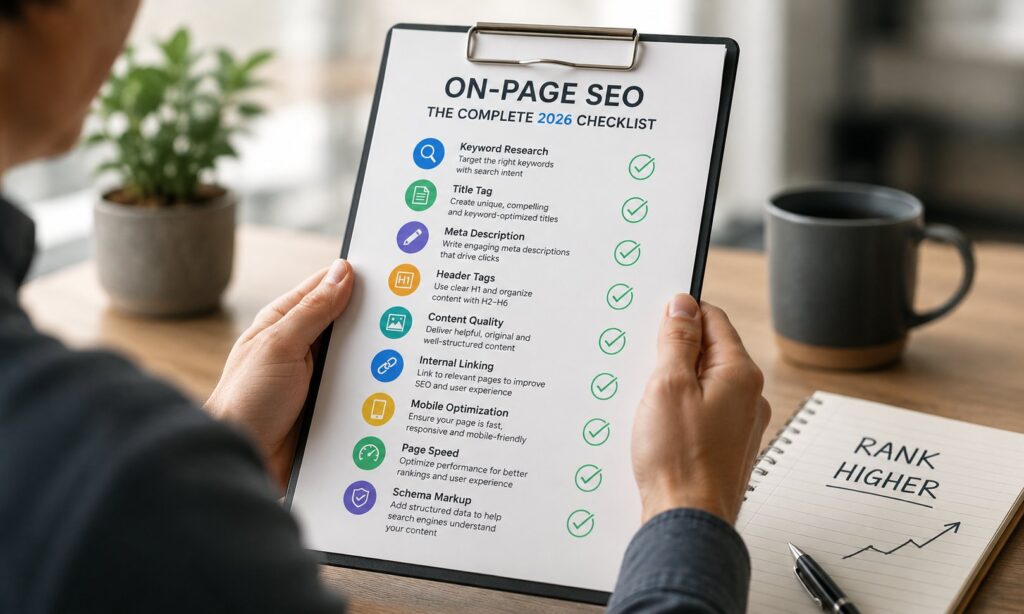
On-page SEO is the practice of optimizing the elements within each webpage to rank well in search engines. Where technical SEO sets the foundation (whether search engines can crawl and render your site at all) and off-page SEO covers your reputation across the web (who links to you, who mentions you, what authority signals your brand has accumulated), on-page SEO is what’s inside the individual pages: the title tags, the meta descriptions, the heading hierarchy, the keyword placement, the internal linking, the image optimization, and the content depth that satisfies the underlying search intent. The good news is that on-page SEO is the part of search optimization that’s most directly under your control. You can ship the changes today and see ranking effects within days. The harder news is that there’s a finite list of things to get right, doing them halfway is worse than not doing them at all, and the standards keep evolving as Google’s algorithms get better at recognizing pattern abuse.
The 2026 state of on-page SEO emphasizes content depth and E-E-A-T (Experience, Expertise, Authoritativeness, Trustworthiness) signals more than the keyword-density heuristics that dominated the field a decade ago. Google’s understanding of language has grown to where a page covering a topic comprehensively will outrank a page that repeats the focus keyphrase 18 times in the body. AI Overviews citations correlate with content that demonstrates real expertise on the underlying topic, not content that’s been mechanically optimized for the query. The practical implication: on-page SEO in 2026 is more about whether your content actually answers the searcher’s question well than about whether you’ve hit the right keyword distribution. This post walks through the on-page elements that still matter, the keyword and content patterns that work in 2026, and the practical checklist for shipping pages that rank.
This post pairs with our technical SEO foundations guide on the infrastructure side and our SEO vs GEO bridge piece on the AI-search side. The three together cover the practical SEO surface for content publishers in 2026.
Title tags
The title tag is the most important on-page element. It’s what shows in the browser tab, what appears as the clickable headline in search results, and what Google weights heavily as a relevance signal for the query.
The 2026 patterns:
Length: 50-60 characters. Anything longer gets truncated in search results. The truncation point varies by device and query, but staying under 60 characters keeps the full title visible.
Focus keyphrase at the start. Put your primary keyphrase as early in the title as possible. Search results display the front of the title most prominently, and Google weights early-position keywords more strongly than late-position ones.
Pipe or colon separator for branding. Format: "Primary keyphrase: Secondary descriptor | Brand". The pipe separator is conventional for adding the brand to the title. The colon separator is conventional for adding a descriptive subtitle. Use whichever fits the page’s structure.
Avoid keyword stuffing. A title with the focus keyphrase repeated twice or three times reads as manipulative and gets penalized. One placement, naturally integrated, is the right amount.
Make it click-worthy. The title is also a marketing decision. Two titles that contain the same keyphrase can have very different click-through rates depending on whether they make the searcher want to click. Numbers, year markers, and clear value propositions improve CTR.
Examples of good 2026 titles:
- "Technical SEO in 2026: The Foundations That Move Rankings | Digital Matters"
- "What Is Vercel? An Introduction to the Frontend Cloud Platform | DM"
- "Drupal 10 End of Life: What to Plan Before December 2026"
The diagnostic: open Google Search Console, navigate to Performance, sort by impressions, and look at the queries your pages rank for. For each top-performing page, ask whether the title accurately reflects the query the page is ranking for. Mismatches are rewriting opportunities.
Meta descriptions
The meta description is the snippet that appears under the title in search results. It’s not a direct ranking factor (Google has confirmed this multiple times), but it’s a CTR factor that indirectly affects rankings: pages that get clicked more from the same position climb in the rankings over time because Google interprets the higher CTR as a relevance signal.
The 2026 patterns:
Length: 120-156 characters. Anything longer gets truncated. Anything shorter wastes the opportunity to make the case for clicking.
Include the focus keyphrase. Google bolds the matched query terms in the meta description, which makes the result more eye-catching and improves CTR.
Lead with the value proposition. What does the user get from clicking? Answer that in the first 8-10 words.
Avoid duplicate meta descriptions. Google flags duplicate metas in Search Console; they signal lazy SEO and depress confidence in the page-specific relevance.
Match the page content. A meta description that promises content the page doesn’t deliver is a bounce-rate problem and indirectly a ranking problem.
For pages where you don’t write a meta description, Google generates one from the page content. The auto-generated version is usually acceptable but rarely optimal. For high-value pages, write the meta description deliberately.
The diagnostic: in Search Console, find pages with high impressions but low CTR (say, 1-2% when the position would suggest 5-10%). Those are usually meta description problems. Rewrite the meta, ship the change, monitor CTR for the next 14 days.
Header hierarchy
The heading structure of your page tells search engines (and AI Overviews) how the content is organized. The conventions:
One H1 per page. The H1 should match or closely mirror the title tag. Multiple H1s confuse the document-structure signal; one H1 is the rule.
H2s for major sections. Each major section of the body gets an H2 that describes what the section covers. The H2 wording is a strong relevance signal for the topics within the section.
H3s for subsections within H2s. Use H3s sparingly; they’re for genuine subsections, not stylistic emphasis.
H4-H6 for deeper nesting. Rarely needed except for highly structured content (technical documentation, deep how-tos). Most blog posts and articles never need anything beyond H3.
Don’t skip levels. An H4 nested directly under an H2 (with no H3 between) confuses the structure. Always cascade through the levels.
The 2026 emphasis: descriptive H2s with semantic meaning. An H2 like "What Vercel actually is" tells Google what the section covers; an H2 like "Section 2" tells Google nothing. The descriptive pattern also wins in AI Overviews because the AI uses heading structure to extract answerable chunks.
The diagnostic: in your CMS, look at the headings outline for any important page. Are the H2s descriptive? Does the H1 match the title? Are there orphan H3s skipping H2 levels? Fix the structural issues.
Keyword placement
Keyword placement matters less than it did a decade ago, but it still matters. The 2026 distribution:
Focus keyphrase in the title tag. Mandatory; near the start.
Focus keyphrase in the first sentence of the page body. Specifically the first 100 characters; Google weights early-body content heavily.
Focus keyphrase in at least one H2. Helps Google understand that the page is really about the keyphrase rather than just mentioning it once.
Focus keyphrase in the meta description. For the bolding effect in search results.
Focus keyphrase in the SEO title (if different from the page title). When using SEO tools like Yoast that allow a separate SEO title, include the focus keyphrase there too.
Focus keyphrase in the URL slug. A URL containing the keyphrase is a small relevance signal and a click-through factor (users see the URL in search results).
Focus keyphrase in the image alt text for the featured image. Helps with image search ranking and reinforces the page topic.
Natural integration throughout the body. Mention the keyphrase a few times in the body where it fits naturally. Don’t force it. Don’t repeat it 15 times.
Related terms throughout the body. Modern Google understands semantic relationships. If your focus keyphrase is "technical SEO," related terms like "Core Web Vitals," "robots.txt," "structured data," "indexation" reinforce the topical signal. Cover the topic comprehensively and the related-term coverage happens naturally.
The diagnostic: pick a page that’s underperforming for its target keyphrase. Check the placement checklist above. Fix any missing placements. Ship and monitor.
Content depth and E-E-A-T
E-E-A-T (Experience, Expertise, Authoritativeness, Trustworthiness) is Google’s quality framework for evaluating content. Originally E-A-T, the "Experience" dimension was added in late 2022 to recognize that first-hand experience with a topic produces better content than secondhand summarization. The framework shapes both how Google’s quality raters score pages and how the ranking algorithms learn what high-quality content looks like.
The practical implications for content:
Demonstrate first-hand experience. When you’re writing about a product, a service, a methodology, show that you’ve actually used it. Specifics that come from hands-on experience read differently than specifics that come from summarizing others’ coverage.
Cite your expertise. Author bylines with credentials, "About the author" sections, links to professional profiles, and disclosures of relevant background all reinforce the expertise signal. For content in YMYL ("Your Money, Your Life") topics (medical, financial, legal), demonstrated expertise is more important than for general content.
Show authoritativeness. Internal linking from other pages on your site that have established authority, external mentions of your work, citations of your content by other reputable sources, all contribute to the authoritativeness signal. Some of this is on-page (linking patterns); some is off-page (who else mentions you).
Build trustworthiness. Accurate information, clear corrections when you get something wrong, transparent disclosures about conflicts of interest, secure HTTPS, clear contact information, a privacy policy. The trust signals are mostly site-level rather than page-level but they affect every page.
Depth over breadth on important topics. Pages that cover a topic comprehensively (the right depth for the searcher’s intent) outrank pages that cover it superficially. The right depth is often longer than instinct suggests: 1,500-3,000 words for substantive informational content, 3,000-5,000 words for pillar content that’s expected to rank against established competition.
The diagnostic: pick your most important pages. For each, ask whether the content demonstrably reflects first-hand experience, whether the author’s expertise is clear, whether the page demonstrates authoritativeness through internal and external signals, and whether the content depth matches the searcher’s intent. Improvements on any axis lift the page’s E-E-A-T profile.
Internal linking
Internal linking is partly technical SEO (the architecture decisions about depth and orphan pages) and partly on-page SEO (the contextual links within each page’s body). The on-page patterns:
3-5 contextual internal links per long-form post. Links from the body of one page to related pages on your site distribute authority and signal topical clustering.
Descriptive anchor text. "Our technical SEO guide" is better than "this article" or "click here." The anchor text tells Google what the linked page covers, which becomes a ranking signal for the linked page.
Link to genuinely relevant pages. Don’t force internal links for the sake of internal linking. Links from contextually related content carry more weight than links from unrelated content.
Link from high-authority pages to high-priority pages. Your most-trafficked pages have accumulated authority that flows through their internal links. Direct that flow toward the pages you want to rank.
Vary the anchor text. If every page on your site links to a specific page with the same anchor text, the pattern reads as manipulation. Vary the wording while keeping it descriptive.
The diagnostic: pick a page you want to rank for a specific keyphrase. Run a Screaming Frog or Sitebulb crawl. Count the internal links pointing at the page. If it’s fewer than 3-5, find related pages that should link to it and add the links.
Image SEO
Images are SEO assets that get under-optimized on most sites. The 2026 patterns:
Descriptive filenames. Save images with descriptive filenames (technical-seo-core-web-vitals.jpg) rather than camera defaults (IMG_4837.JPG). The filename is a small relevance signal.
Alt text on every image. Required for accessibility, weighted as a relevance signal by Google, and used as the source for many AI Overviews citations of image content. Write descriptive alt text that explains what the image shows in context.
Modern formats. WebP and AVIF compress images more efficiently than JPEG and PNG. Use them where browser support allows. For DM, we use JPEG at quality 85 with the optimize=True flag, which is a good middle ground.
Lazy loading for below-the-fold images. The loading="lazy" HTML attribute defers below-the-fold image loading until the user scrolls toward them. Improves Core Web Vitals (LCP) and reduces unnecessary bandwidth.
Image dimensions specified. Always include width and height attributes. Prevents Cumulative Layout Shift as images load and is a Core Web Vitals requirement.
Compressed appropriately. A 4MB hero image kills Core Web Vitals. Compress to the smallest size that still looks good (typically 100-300KB for hero images, 30-100KB for body images).
Open Graph and Twitter Card images. For social sharing, set explicit og:image and twitter:image meta tags. Affects how your content displays when shared on social platforms.
The diagnostic: use Lighthouse or PageSpeed Insights on a representative page. Look for image-related warnings: missing alt text, oversized images, missing dimensions, lazy-loading opportunities. Fix the template; ship across all images.
URL structure
URL structure is small as a ranking signal but worth getting right because it affects click-through rates and is hard to change after the fact.
Short URLs over long. /technical-seo-2026/ is better than /2026/06/15/the-complete-guide-to-technical-seo-in-2026-with-all-the-tips/.
Keywords in the URL. Include the focus keyphrase. Avoid stuffing.
Hyphens between words. technical-seo not technical_seo or technicalseo.
Lowercase only. Mixed case URLs cause edge cases on case-sensitive systems and look unprofessional.
No stop words you don’t need. "How to optimize" can become "optimize" in the URL slug; the meaning is clear without the connector words.
Match the slug to the canonical title. If the page title is "Technical SEO in 2026," the slug should be technical-seo-2026 (or close variants).
Avoid URL parameters in canonical URLs when possible. Parameters are fine for filters and pagination, but the canonical URL for a content page should be a clean path.
What teams should do this quarter
Six concrete actions:
- Audit your title tags on the top 20 traffic pages. Are they 50-60 characters with the focus keyphrase at the start? Rewrite the misses; ship the changes; monitor CTR.
- Audit meta descriptions on the same top 20 pages. Are they 120-156 characters with the focus keyphrase and a compelling reason to click? Rewrite the misses.
- Audit the heading structure on your most important pages. Is there one H1 matching the title? Are the H2s descriptive? Fix structural issues.
- Add or update internal linking on pages you want to rank. Identify 3-5 contextually related pages and add the links with descriptive anchor text.
- Audit image SEO on your blog template. Alt text on every image, modern formats, lazy loading, dimensions specified, reasonable compression. Fix the template; the fixes apply to every image rendered through it.
- Schedule the E-E-A-T review. Pick five high-stakes pages where ranking matters most. For each, ask whether the page demonstrates first-hand experience, expertise, authoritativeness, and trustworthiness. Update the pages where the signals are weak.
The deeper takeaway is that on-page SEO in 2026 rewards depth and quality over volume. The checklist items above are the structural foundation; the multiplier on top of them is whether the content actually serves the searcher’s intent well. Pages that combine good technical hygiene with substantive content depth and demonstrated expertise consistently outrank pages that have one without the other.
Frequently Asked Questions
What’s the most important on-page SEO element?
The title tag, by a meaningful margin. It’s what Google weights most heavily as a relevance signal for the query, what users see most prominently in search results, and what determines whether they click. Get the title tag right (50-60 characters, focus keyphrase at the start, click-worthy phrasing) and the rest of the on-page work compounds; get it wrong and the rest of the work struggles to compensate. Spend disproportionate time on titles relative to the other on-page elements.
How long should my content be?
Long enough to satisfy the searcher’s intent comprehensively, no longer. For most informational queries, that’s 1,500-3,000 words. For pillar content that’s expected to rank against established competition on competitive keyphrases, 3,000-5,000 words is often appropriate. For short-tail queries with a single clear answer, 300-800 words can be enough. The wrong question is “what’s the target word count” because no specific count is right. The right question is “what does the searcher need to leave my page feeling fully answered” and the word count follows from the answer.
What is E-E-A-T and why does it matter?
E-E-A-T (Experience, Expertise, Authoritativeness, Trustworthiness) is Google’s quality framework for evaluating content. Originally E-A-T before “Experience” was added in late 2022, the framework shapes how Google’s quality raters score pages and how the ranking algorithms learn what high-quality content looks like. Demonstrating E-E-A-T (first-hand experience with the topic, credentialed authorship, authoritative external mentions, transparent and trustworthy site practices) lifts ranking signals across the entire site. For YMYL (Your Money, Your Life) topics like medical, financial, and legal content, E-E-A-T is the dominant quality signal; for general content it’s important but not dominant.
Should I worry about keyword density?
No, in the modern sense. Keyword density was a meaningful metric a decade ago when Google’s language understanding was thinner. Modern Google understands semantic relationships, related terms, and topic coverage well enough that hitting a specific keyword density does not improve rankings and often hurts them by reading as manipulative. The right approach is to cover the topic comprehensively with natural language, mention the focus keyphrase a few times where it fits, and let the related-term coverage emerge from substantive content depth. Pages with high keyword density that don’t actually cover the topic well will lose to pages with normal keyword density that do.
How do I optimize for AI Overviews specifically?
The patterns overlap substantially with classic SEO optimization but emphasize a few things more. Clear heading structure (H2s that name what each section covers) makes content more extractable. Substantive question-and-answer patterns in the body (an explicit question followed by a clear answer) align with how AI Overviews extract citations. FAQPage Schema.org markup signals structured Q&A content that AI Overviews prefer. Comprehensive topical coverage signals expertise that AI selection algorithms recognize. For the deeper treatment, see our SEO vs GEO bridge piece.
Do meta descriptions affect rankings?
Not directly, but indirectly through CTR. Google has confirmed multiple times that meta descriptions are not a ranking factor. However, they substantially affect click-through rate from search results, and pages with higher CTR climb in rankings over time because Google interprets the CTR as a relevance signal. Writing strong meta descriptions is a CTR optimization that produces ranking benefits as a second-order effect.
Should I update old pages or write new ones?
Update first, then write new. Old pages that already have established rankings, backlinks, and indexation are much easier to improve than new pages are to rank from zero. The Pareto move: audit your top 50 traffic pages, identify the ones underperforming relative to their potential (high impressions but low CTR, position 5-15 with relevant intent, declining clicks year-over-year), and refresh them with the on-page checklist above. The lifts you’ll see from refreshing established pages are usually larger and faster than the lifts from new pages targeting the same topics.
What about featured snippets?
Featured snippets (the answer boxes Google shows at the top of search results) are won by content that directly answers the underlying question in a clear, extractable format. The patterns: include an explicit question as an H2 or H3, follow it immediately with a 40-60 word answer that stands alone as the complete reply, use lists or tables when the answer is naturally structured. Featured snippets drive substantial click-through and have become more important now that AI Overviews can be considered a related but distinct surface that uses similar content extraction patterns.