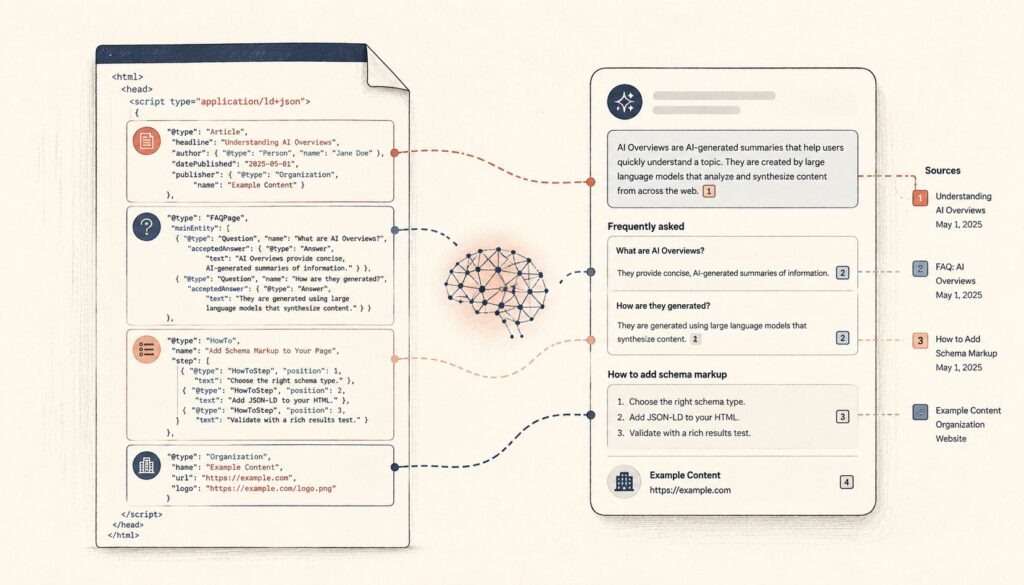
Schema markup for Google AI Overviews is the structured data optimization discipline that publishers use to increase the probability of being cited in Google’s AI-generated answer surface. Industry research across 2025-2026 has produced clear citation correlation data: 65 percent of pages cited by Google AI Mode and 71 percent of pages cited by ChatGPT include structured data, content with proper schema markup has a 2.5x higher chance of appearing in AI-generated answers, and sites with complete Tier 1 schema implementation see up to 40 percent more AI Overview appearances than otherwise-comparable sites without the markup. Google has officially stated that there’s no special markup, dedicated schema, or AI-specific file required for AI Overviews citation, but the practical data suggests the four highest-leverage schemas to implement are Article (or BlogPosting), FAQPage, HowTo, and Organization. Pages carrying that combination are 2.5 to 2.7 times more likely to be cited than pages with no schema markup at all.
This post covers what the citation data actually says about Schema.org’s role in AI Overviews, the four Tier 1 schemas that win citation correlation, the implementation patterns, the March 2026 Google update that addressed schema abuse, the diagnostic approach for measuring AI Overviews citation rates, and the practical priorities for teams investing in AI Overviews visibility. This is a focused drill-down piece; for the broader Schema.org for GEO landscape, our Schema.org for GEO pillar covers structured data across all AI-mediated answer surfaces.
What the citation data actually says
Schema markup’s role in AI Overviews has been the subject of substantial research through 2025 and 2026. The findings are consistent across multiple independent analyses:
65 percent of pages cited by Google AI Mode include structured data. Analyses of AI Mode citations across thousands of queries consistently find that the majority of cited sources have some form of Schema.org markup. The pattern is not a coincidence; it reflects how AI systems extract and rank source candidates.
71 percent of pages cited by ChatGPT include structured data. Comparable analysis of ChatGPT search citations shows similar patterns. The structured-data signal apparently helps with extraction across multiple AI surfaces, not just Google’s specifically.
Content with proper schema markup has a 2.5x higher chance of appearing in AI-generated answers. Comparing AI citation rates between pages with comprehensive Schema.org implementation and pages without, the citation lift is substantial and consistent.
Sites with complete Tier 1 schema see up to 40 percent more AI Overview appearances. Site-level analyses comparing total AI Overview impressions before and after Tier 1 schema deployment show meaningful aggregate lifts.
Pages carrying the four Tier 1 schemas (Article/BlogPosting, FAQPage, HowTo, Organization) are 2.5 to 2.7 times more likely to be cited than pages running no schema at all. The specific combination of these four schemas appears to provide most of the citation lift available; adding more obscure schemas beyond these doesn’t dramatically increase citation probability.
The data has caveats worth knowing. Correlation isn’t causation; sites that invest in Schema.org tend to also invest in other quality signals (better content, better technical SEO, better internal linking), and isolating Schema.org’s marginal contribution is difficult. Google has explicitly stated that no schema is "required" for AI Overviews citation, which is true at the policy level. But the practical pattern across the research is consistent enough that treating Schema.org as a meaningful AI Overviews input is the right operational stance.
For context on the broader GEO discipline, our GEO pillar covers the broader optimization category, and our SEO vs GEO bridge piece covers how AI-mediated search relates to classic Google search.
The four Tier 1 schemas
The Tier 1 schemas that the citation data consistently identifies as highest-leverage for AI Overviews:
Article (and the more specific NewsArticle, BlogPosting). For editorial content. Article schema signals authoritative editorial content with clear authorship, publication date, and publisher information. The required and recommended properties include headline, author, datePublished, image, description, and publisher. AI Overviews consistently prefer Article-marked-up content for queries that benefit from cited editorial sources, which is most informational queries.
FAQPage. For pages with FAQ sections. The structured question-answer pairs align directly with how AI Overviews extract answerable chunks. Adding FAQ sections (with FAQPage markup) to important pages is consistently cited as the single highest-leverage schema addition for AI Overviews specifically. The pattern works because AI Overviews answer queries by extracting the question-answer structure from cited sources; pages that already provide that structure cleanly are easier to cite.
HowTo. For procedural content. Step-by-step content with HowTo markup wins citations for "how do I do X" queries at substantially higher rates than equivalent procedural content without the markup. The schema’s structured step-by-step format gives AI Overviews a clean extraction target.
Organization. Site-level schema describing the publishing organization. Organization schema doesn’t directly drive page-level citations but contributes to authority signals that AI Overviews apparently weight. The properties include name, url, logo, sameAs (linking to verified social profiles for entity reconciliation), founder, contactPoint, and address. The sameAs links specifically appear important because they help AI surfaces reconcile the organization across entity graphs.
The four-schema combination is what the citation data identifies as the practical sweet spot. Pages carrying all four (or sites with site-wide Organization plus per-page Article, FAQPage, or HowTo as appropriate) capture most of the citation lift available from schema investment. Adding more obscure schemas beyond these four shows diminishing returns.
Implementation patterns
The implementation pattern: JSON-LD blocks in the page head. Inline microdata and RDFa are supported but more error-prone; Google has officially recommended JSON-LD for AI-optimized content because it sits cleanly outside the HTML body and parses faster than the inline alternatives.
A practical site-wide implementation pattern:
Site-wide Organization schema in the global header template. Implemented once and applied to every page.
Article (or BlogPosting) schema on every editorial article. Most SEO plugins (Yoast, RankMath, AIOSEO) generate this automatically; verify the implementation includes the right properties.
FAQPage schema on every page with a FAQ section. Add FAQ sections to important pages that don’t have them, with FAQPage markup applied. This is the single highest-leverage addition for most content publishers.
HowTo schema on every procedural page that contains step-by-step instructions. The schema’s structure (step, name, text, image per step) maps cleanly to how procedural content is typically written.
The implementation order matters because building from foundation up produces compounding returns. Site-wide Organization first (one implementation, applies to everything). Article schema on top of Organization (Article references Publisher which is your Organization). FAQPage and HowTo where the content type fits.
For WordPress implementations, most modern SEO plugins handle Article and Organization automatically once configured. FAQPage and HowTo schemas may require plugin-specific configuration or dedicated plugins. For Drupal, the Schema.org Metatag module handles the four Tier 1 schemas with appropriate configuration.
The March 2026 update
Google’s March 2026 update addressed schema abuse on pages where the markup described content that was not the primary purpose of the page. The pattern Google explicitly targeted: pages with FAQPage schema for FAQ content that wasn’t actually present on the page, HowTo schema for procedural content that didn’t actually exist, or Article schema applied to non-editorial content.
The practical implications:
Markup must match content. Pages with FAQPage schema must have actual FAQ sections visible to users. Schema that doesn’t correspond to page content is now treated as a quality signal in the negative direction.
Markup must describe the primary purpose of the page. Adding multiple schemas to a single page for SEO reasons (each one a half-implemented attempt to capture more rich results) is treated less favorably than implementing the single schema that genuinely describes what the page is.
Quality matters more than quantity. Implementing the four Tier 1 schemas well across appropriate page types is more effective than implementing dozens of schemas poorly across all pages.
The update aligns Schema.org investment with content quality investment: schema that describes high-quality content gets the citation lift; schema that’s gaming the system gets devalued. For honest publishers, the update mostly reinforces what was already the right approach.
Diagnostic patterns
Measuring whether your Schema.org investment is improving AI Overviews citations specifically uses several signals:
Google Search Console > Performance > Search Appearance > AI Overviews. Added in 2026 (and matured through the year), this filter shows impressions, clicks, and CTR for queries where your content appeared in AI Overviews. Track the trend over time; meaningful increases after Tier 1 schema deployment suggest the markup is helping. The data isn’t perfect but it’s the best official Google source for AI Overviews-specific tracking.
Search Console Enhancements reports. Track the count of valid pages per schema type. Growth in valid pages without growth in errors signals healthy markup expansion. The Article, FAQ, HowTo, and Organization sections of the Enhancements report cover the Tier 1 schemas specifically.
Third-party AI citation tracking. Ahrefs Brand Radar, Semrush AI Insights, Profound, Knowatoa, and several dedicated GEO tools provide cross-platform AI citation tracking. The data quality varies; the consistent picture across multiple tools is more useful than any single tool’s data alone.
Rich Results Test on individual pages. Validate each important page’s schema implementation; fix any errors before they accumulate. The tool also shows preview thumbnails of how the rich results might appear.
Direct testing in AI surfaces. Periodically ask Google AI Mode, ChatGPT, Perplexity, and Claude about your topic area and observe whether your content gets cited. Anecdotal but useful for understanding actual citation behavior. The pattern of which pages get cited and which don’t surfaces real insights about what’s working.
The diagnostic discipline matters because Schema.org investment without measurement is hard to justify or improve. Building a recurring monthly review of AI Overviews appearances against schema deployment produces the feedback loop that drives continuous improvement.
What teams should do this quarter
Six concrete actions:
- Implement site-wide Organization schema if you haven’t already. This is the smallest implementation and the foundation that other schemas reference. Get it right once; the work compounds.
- Add Article (or BlogPosting) schema to every editorial article. Most SEO plugins handle this automatically; verify the implementation includes headline, author, datePublished, image, description, and publisher. Fix any pages where the implementation is incomplete.
- Add FAQPage schema to your top 20 traffic-driving pages. If they don’t have FAQ sections, add them with the questions your audience actually asks (from Search Console queries, People Also Ask boxes, customer support themes). The single highest-leverage AI Overviews-specific action.
- Audit existing schema for the March 2026 quality patterns. Pages with FAQPage schema for FAQ content that’s not actually visible to users, HowTo schema for procedural content that isn’t really there, or Article schema on non-editorial pages should be fixed (either implement the content properly or remove the schema).
- Set up the diagnostic stack. Google Search Console’s AI Overviews filter plus at least one third-party AI citation tracking tool gives you the measurement infrastructure to evaluate the impact of schema investment over time. Monthly review is reasonable.
- Plan the HowTo schema additions for procedural content. If you publish how-to content, the HowTo schema is genuinely high-leverage for AI Overviews. Identify the procedural pages and implement HowTo schema across them.
The deeper takeaway is that Schema.org for Google AI Overviews is now one of the highest-leverage SEO investments available because the citation correlation data is consistent enough to treat as real, the implementation is straightforward, and the four Tier 1 schemas (Article, FAQPage, HowTo, Organization) capture most of the available lift. Teams that haven’t invested in the Tier 1 schemas are typically leaving substantial AI Overviews visibility on the table for content that’s already strong enough to win citations if the structured data signals supported it.
Frequently Asked Questions
Does schema markup actually help with Google AI Overviews citations?
The citation correlation data is consistent across multiple independent analyses: 65 percent of pages cited by Google AI Mode include structured data, content with proper schema markup has a 2.5x higher chance of appearing in AI-generated answers, and sites with complete Tier 1 schema implementation see up to 40 percent more AI Overview appearances. Google has officially stated that no schema is “required” for AI Overviews citation, which is true at the policy level. But the practical data across multiple sources is consistent enough that treating Schema.org as a meaningful AI Overviews input is the right operational stance.
What are the four Tier 1 schemas?
Article (or BlogPosting) for editorial content, FAQPage for pages with FAQ sections, HowTo for procedural content, and Organization for site-level publisher identity. Pages carrying the four-schema combination (or sites with Organization plus per-page Article, FAQPage, or HowTo as content type appropriate) are 2.5 to 2.7 times more likely to be cited in AI Overviews than pages with no schema markup. Adding more obscure schemas beyond these four shows diminishing returns for AI Overviews citation specifically.
What was the March 2026 schema update?
Google’s March 2026 update addressed schema abuse on pages where the markup described content that wasn’t actually present on the page. The pattern explicitly targeted: pages with FAQPage schema for FAQ content that wasn’t there, HowTo schema for procedural content that didn’t exist, or Article schema applied to non-editorial content. The update treats markup that doesn’t match content as a quality signal in the negative direction. For honest publishers implementing schema for content that’s actually there, the update mostly reinforces what was already the right approach.
Should I add FAQ sections just for the schema benefit?
Yes, if the FAQ content is genuinely useful. The pattern that works: identify the questions your audience actually asks (from Search Console query data, People Also Ask boxes, customer support themes, Reddit threads in your topic area) and write substantive answers to those questions on your pages. Add FAQPage schema to mark them up. The combination of useful FAQ content plus schema markup wins citations because both the content and the structure support extraction. Adding fake FAQ content just for schema benefit triggers the March 2026 abuse-detection pattern and hurts more than it helps.
What format should I use for the schema?
JSON-LD is the format Google explicitly recommends for AI-optimized content. JSON-LD sits in a script tag in the page head, outside the visible HTML body, which means it parses faster and is easier to maintain than inline microdata or RDFa. Most modern SEO plugins generate JSON-LD by default; for custom implementations, JSON-LD is the right choice.
How do I measure if schema is helping my AI Overviews citations?
Several signals combined. Google Search Console’s AI Overviews filter (under Performance > Search Appearance) shows impressions, clicks, and CTR for queries where your content appeared in AI Overviews. Search Console Enhancements reports track structured-data validity per schema type over time. Third-party tools (Ahrefs Brand Radar, Semrush AI Insights, Profound, Knowatoa) provide cross-platform AI citation tracking. Periodic direct testing in AI surfaces (Google AI Mode, ChatGPT, Perplexity, Claude) provides anecdotal but useful insight into actual citation patterns. The combination across multiple signals gives a reliable picture; any single signal alone is noisier.
Will Schema.org help with other AI surfaces too?
Yes, substantially. The 71 percent figure for ChatGPT-cited pages including structured data shows that schema correlates with citation across multiple AI surfaces, not just Google’s. Perplexity and Claude search also show similar patterns. Investing in Schema.org pays off across the broader AI-mediated search landscape, which makes the work compound. Schema.org for AI Overviews is largely the same investment as Schema.org for the broader GEO category.
What about emerging schemas like LearningResource or SoftwareSourceCode?
The data on AI Overviews specifically focuses on the four Tier 1 schemas (Article, FAQPage, HowTo, Organization) because those show the consistent citation correlation. Specialized schemas (LearningResource for educational content, SoftwareSourceCode for code samples, Recipe for food content, Event for time-bound content) can produce additional rich-result benefits in classic search but don’t show the same broad AI Overviews citation lift. The right pattern is: implement the four Tier 1 schemas everywhere they fit, then add specialized schemas where they specifically apply to your content type.