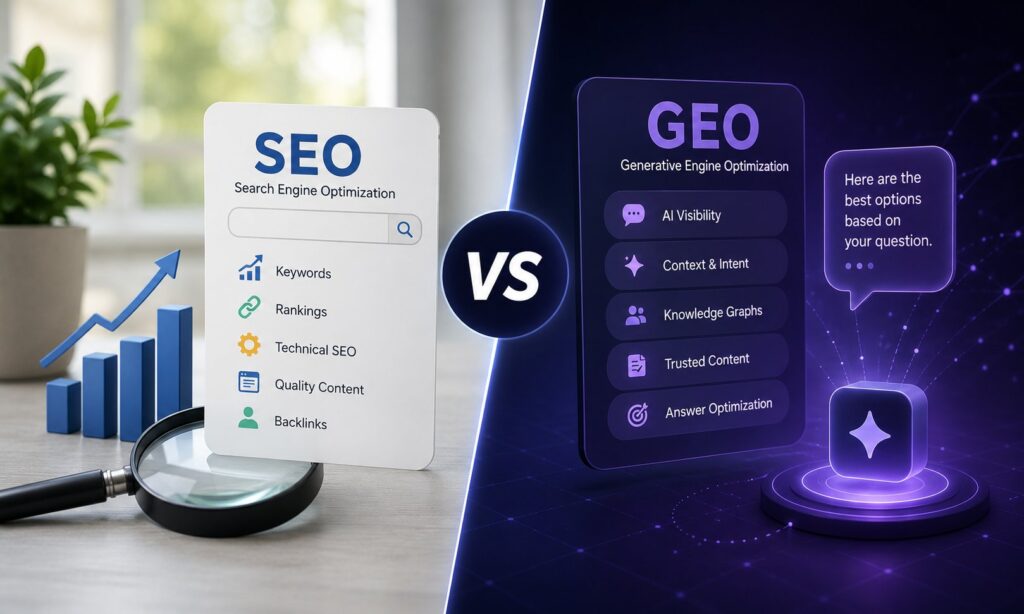
SEO vs GEO is the strategic question content publishers face in 2026: should you keep optimizing for the classic Google blue-link rankings that have defined search marketing for two decades, or shift focus to Generative Engine Optimization (GEO) for citation in Google AI Overviews, ChatGPT search, Perplexity, and the broader AI-mediated answer surface? The answer for most teams is "both, with a content strategy that recognizes the overlap and the divergences." SEO and GEO share more foundational practices than they differ on: Core Web Vitals, structured data, E-E-A-T quality signals, authoritative content depth, internal linking architecture. Content that wins at SEO usually has the foundations that also win at GEO. But the divergences are real and growing: AI Overviews favor specific question-answer extraction patterns, classic SEO favors comprehensive topic coverage, the click economy is being reshaped by zero-click AI answers, and the metric of success differs between "rank in position 1-3" and "get cited as a source." This post covers where SEO and GEO overlap, where they diverge, what the traffic economics shift means, and the practical content strategy that serves both surfaces.
This post is the bridge between our technical SEO foundations guide on the infrastructure side, our on-page SEO checklist on the content-element side, and our GEO pillar on the AI-search side. If you’ve read the other three, this piece ties them together.
What SEO is, what GEO is, and why the distinction matters
Search Engine Optimization (SEO) is the practice of making your content rank well in search engine results pages (SERPs). The metric of success is ranking position: getting your URL into the top 3, top 5, or top 10 results for queries your audience searches. The mechanics involve technical infrastructure that lets search engines crawl and understand your site, on-page elements that signal relevance for the query, off-page signals (links, mentions, brand authority) that signal trustworthiness, and content depth that satisfies the searcher’s intent. SEO is a 25-year-old discipline with well-understood best practices, established tooling (Ahrefs, Semrush, Moz, Screaming Frog, Search Console), and predictable cause-and-effect dynamics.
Generative Engine Optimization (GEO) is the practice of making your content cited as a source by AI-mediated answer surfaces. The metric of success is citation: getting your URL referenced in the responses generated by Google AI Overviews, ChatGPT search, Perplexity, Microsoft Copilot, Claude with web search, and the broader category of AI answers that synthesize source content rather than just linking to it. The mechanics involve many of the same foundations as SEO (technical infrastructure, structured data, E-E-A-T quality signals) plus specific content patterns that AI extraction algorithms favor (clear question-answer formats, comprehensive coverage of specific subtopics, structured data on FAQ sections). GEO is a much newer discipline, with rapidly evolving best practices and less mature tooling.
The distinction matters because the traffic economics of search are shifting. Classic SEO assumed the searcher saw your URL in the results and clicked through to your site. AI Overviews and competing AI answer surfaces increasingly answer the question directly in the result, with the cited sources appearing as links the user may or may not click. For some queries, the zero-click answer is enough and your traffic decreases even as your citation count rises. For other queries, the AI Overview piques curiosity and drives more clicks to the cited source than the classic blue-link result would have generated. Understanding which queries are which, and structuring your content strategy accordingly, is the modern SEO/GEO challenge.
Where SEO and GEO overlap
The shared foundations are substantial. Investing in any of these helps both surfaces:
Technical infrastructure. Crawlability, indexability, mobile-first compatibility, JavaScript rendering, fast load times. AI Overviews can only cite content that AI systems can access, render, and process. The technical SEO foundation is also the technical GEO foundation.
Core Web Vitals. Pages that pass Core Web Vitals are favored by Google for both ranking and citation. The Core Web Vitals investment compounds across both surfaces.
Structured data. Schema.org markup helps Google understand what your content is, which directly affects rich results in classic search and indirectly affects AI Overviews citation likelihood. FAQPage schema in particular is one of the highest-leverage investments for both surfaces because the FAQ structure aligns with how AI Overviews extract answerable chunks.
E-E-A-T signals. Experience, Expertise, Authoritativeness, Trustworthiness shape both classic rankings and AI citation selection. AI Overviews don’t cite random pages; they cite pages that demonstrate quality, and the same E-E-A-T signals that Google’s ranking algorithms use are signals that AI selection algorithms use.
Content depth. Pages that cover a topic comprehensively rank better in classic SEO and get cited more often in AI Overviews. The depth correlates with topical authority, which both algorithms reward.
Internal linking architecture. Sites with clean internal linking distribute authority through their content effectively for both classic ranking and AI citation. Topic clusters with pillar pages and satellite content work well for both surfaces.
Author bylines and credentials. Content with credentialed authorship that’s clearly attributed and demonstrably expert ranks better in classic SEO and gets cited more often in AI Overviews. The trust signal works for both.
The practical implication: if you’ve been investing in classic SEO best practices, much of that investment translates directly to GEO benefits. You don’t need to start over; you need to extend.
Where SEO and GEO diverge
The divergences are real and growing. Recognizing where they differ lets you make conscious choices about which surface to prioritize for specific content:
Question-answer extraction patterns. AI Overviews favor content with explicit question-answer structure: a clear question stated as an H2 or H3, followed immediately by a complete answer in 40-80 words. Classic SEO doesn’t require this pattern (although it’s compatible with featured snippets, which use similar extraction). Content that’s explicitly structured for AI extraction outperforms equivalent content that just covers the same topic in flowing prose.
Source citation hygiene. AI Overviews prefer sources that themselves cite authoritative external references. A page that backs up its claims with links to original research, authoritative organizations, primary sources, and well-known experts is more likely to be cited than a page that makes equivalent claims without sourcing. Classic SEO benefits from external linking too but less explicitly than GEO does.
Topical coverage depth on specific subtopics. Classic SEO rewards comprehensive topic coverage in long-form pillar content. GEO can reward shorter, more focused content that nails a specific subtopic completely. A 3,000-word pillar piece and a 1,200-word subtopic deep-dive can both succeed at GEO; classic SEO tends to favor the longer pillar piece. The implication: GEO content strategy can include more numerous, more narrowly-scoped pieces than classic SEO strategy typically does.
Freshness signals. AI Overviews show stronger preference for fresh content on time-sensitive topics than classic SEO does. A piece published a week ago about a current AI release will get cited in AI Overviews while a piece from six months ago covers the same topic. Classic SEO rewards freshness too but less aggressively. The implication: content velocity matters more for GEO than for classic SEO on news-adjacent topics.
Visual content prominence. AI Overviews increasingly include images and video alongside text answers. Pages with strong visual assets (custom diagrams, infographics, screenshots) are more likely to have their visuals cited. Classic SEO benefits from images but less explicitly.
Conversational tone. AI Overviews are extracting answers from your content and presenting them in conversation with the user. Content written in a conversational, direct tone reads better when extracted into an AI response. Classic SEO is more tolerant of formal, exhaustive prose.
The divergences don’t conflict with classic SEO best practices in most cases. You can write conversational content with question-answer structure that also performs well in classic search. But the optimization peaks are slightly different: peak classic SEO is comprehensive, formal, exhaustive; peak GEO is extractable, sourced, fresh.
The traffic economics shift
The most consequential change in 2026 is the click economy itself. Three patterns matter:
Zero-click answers reduce clicks for some queries. When AI Overviews answer "what time does the Mona Lisa close" or "convert 32 fahrenheit to celsius," the user has their answer without clicking through. Sites that ranked #1 for those queries previously got the click; now they get the citation but not the traffic. For informational queries with discrete factual answers, the click decline is real.
AI Overviews drive more clicks for some queries. When AI Overviews summarize a complex topic and cite multiple sources, users who want depth click through to the cited sources. The AI Overview becomes a discovery layer that drives quality traffic. For evaluation queries, comparison queries, and complex-topic queries, AI Overviews can drive more clicks than classic blue-link results.
The mix of queries that drive your traffic is shifting. Sites that depended heavily on short factual queries are seeing traffic decline. Sites that depended on long-tail informational queries that require depth are seeing traffic hold steady or grow. The query-type composition of your organic traffic is becoming as important as the volume.
The strategic implication: audit your top traffic-driving queries and categorize them. For each, ask whether AI Overviews can answer the query directly in the result (zero-click risk) or whether the AI Overview drives users to click through for depth (zero-click opportunity). Adjust your content investment accordingly: deprecate or refresh content that’s losing to zero-click answers, double down on content that benefits from the AI discovery layer.
A practical content strategy that serves both
The content strategy that wins at both SEO and GEO in 2026:
Foundation: invest in shared infrastructure. Technical SEO, Core Web Vitals, structured data (especially FAQPage on FAQ sections), E-E-A-T signals, internal linking architecture. These are table stakes for both surfaces and compound on each other.
Content structure: extractable depth. Long-form content with clear heading structure, explicit Q&A patterns, sourced claims, and visual assets. The structure makes the content extractable for AI Overviews while satisfying the depth requirements of classic SEO.
Topic strategy: pillars plus focused satellites. Build pillar pages that cover broad topics comprehensively for classic SEO authority, and surround them with focused satellite pieces that nail specific subtopics for GEO extraction. The cluster signals topical authority for both surfaces.
Question discovery: explicit Q&A sections. Add FAQ sections (with FAQPage schema) to your important pages. Identify the specific questions your audience asks (Search Console queries, "People Also Ask" boxes, customer support themes, Reddit threads) and answer them explicitly. The FAQ section becomes a citation magnet for AI Overviews while also serving the classic SEO need for featured-snippet content.
Source citation: link out generously. Include links to authoritative external sources for claims you make. The outbound linking pattern signals quality to both classic search algorithms and AI citation algorithms. The fear that outbound links "leak authority" is mostly a relic from earlier SEO eras; in 2026, well-sourced content outperforms content that hoards its links.
Freshness: maintain a content refresh cadence. Even for evergreen topics, periodic refreshes (annual at minimum for important pages, quarterly for competitive topics) signal that the content is current and increase both classic ranking and AI citation probability.
Visual investment: original diagrams and screenshots. Custom visual assets that explain concepts compactly are increasingly important. Generic stock images don’t help; specific informative diagrams do. The visual content gets cited in AI Overviews and improves classic engagement metrics.
Measure both surfaces. Track Search Console rankings and traffic (classic SEO) and track AI Overviews citations and AI-referrer traffic (GEO). The tooling for GEO measurement is less mature than for SEO measurement, but the AI Overviews data is available in Search Console as of 2026 and dedicated tools (Ahrefs Brand Radar, Semrush AI Insights, dedicated GEO tools) are emerging.
Where to start if you have to pick
Most teams don’t have unlimited capacity. If you have to prioritize, the right sequence depends on your starting position:
If your technical SEO is weak, start there. The technical foundation sets the ceiling for both SEO and GEO. Fix Core Web Vitals, implement Schema.org markup, address indexation issues, audit mobile parity. Once the technical foundation is solid, the content investments above compound.
If your technical SEO is solid but your content is thin or stale, invest in content depth. Audit your top traffic pages, identify the underperformers relative to potential, refresh them with the on-page checklist and the GEO patterns. New pillar content for important topics is also a high-leverage investment.
If your technical SEO and content are both solid but you’re not seeing AI Overviews citations, invest in the GEO-specific divergences: FAQ sections with FAQPage schema, conversational tone, sourced claims with outbound links, freshness on time-sensitive topics, original visual assets. The GEO patterns layered on top of solid SEO foundations produce the strongest results.
If you’re starting from zero, invest in the foundations first. Technical SEO, basic Schema.org, the on-page checklist, the topical cluster strategy. The GEO-specific optimizations are layered investments that work best on top of solid foundations.
The deeper takeaway is that the SEO-vs-GEO framing is less a choice than it sounds. The two disciplines share more than they differ, and a content strategy that recognizes the overlap can serve both surfaces from the same investment. The teams that thrive in 2026 search are the ones that resist treating SEO and GEO as competing priorities and instead treat them as two surfaces served by a unified content strategy that emphasizes depth, structure, sourcing, and quality.
Frequently Asked Questions
Is GEO replacing SEO?
No, but it’s expanding the SEO discipline. AI Overviews and competing AI answer surfaces are growing rapidly, but classic Google search results aren’t disappearing. Most queries still produce blue-link results that drive substantial click traffic. The shift is that AI-mediated answers are now a parallel surface that publishers should also optimize for, not that they’re replacing classic search. The smart framing is “SEO 2.0” rather than “SEO is dead” because the foundational practices that win at classic SEO largely also win at GEO, with specific additions and adjustments.
What’s the difference between an AI Overview and a featured snippet?
Featured snippets are extracted content from a single source that Google highlights in a box at the top of search results. AI Overviews are AI-generated summaries that synthesize information from multiple sources and cite them as links. Featured snippets are older (introduced in the mid-2010s); AI Overviews are newer (rolled out broadly in 2024-2025). They serve similar user needs (quick answers without clicking) but use different mechanics. The optimization patterns overlap substantially: clear Q&A structure, authoritative source content, structured data, comprehensive topical coverage. Content that wins featured snippets generally wins AI Overviews citations too, and vice versa.
How do I know if my content is being cited in AI Overviews?
Google Search Console added AI Overviews data as a search appearance type in 2026. Filter the Performance report by search appearance to see impressions, clicks, and CTR for queries where your content appeared in AI Overviews. Dedicated tools (Ahrefs Brand Radar, Semrush AI Insights, and various GEO-focused tools) provide additional visibility into AI citation patterns across multiple AI search surfaces (not just Google AI Overviews but also ChatGPT, Perplexity, etc.). The tooling is less mature than for classic SEO measurement but has progressed substantially through 2026.
Should I add FAQ sections to all my pages?
To most informational pages, yes. FAQ sections with FAQPage Schema.org markup are one of the highest-leverage on-page additions for both classic SEO (featured snippets, related questions) and GEO (direct AI Overviews citations). The questions should be ones your audience actually asks (Search Console queries, “People Also Ask” boxes, customer support themes). Answers should be 40-80 words, self-contained, factually accurate, and written in clear language. Add 5-10 FAQs per long-form post; skip the addition on pages where Q&A structure doesn’t fit (homepages, product category pages, transactional pages).
How do I handle the traffic decline from zero-click AI answers?
Recognize the shift, audit your traffic mix, and adapt. Some queries are now zero-click because the AI answer is sufficient; the traffic from those queries is gone and isn’t coming back through classic SEO investment. The right response is to identify which queries those are, decide whether the content serving them is still valuable for other reasons (brand, AI Overviews citation, internal linking authority) or whether it should be deprecated, and redirect content investment toward queries that benefit from the AI discovery layer. The honest truth: some content publishers will see traffic declines they can’t fully recover, and the strategic response is to compete for the queries that still drive traffic rather than fight the zero-click trend on queries where the AI answer is the right user experience.
Do I need different content for SEO and GEO?
Rarely. The same piece of content can serve both surfaces well if it’s structured appropriately: substantive depth for classic SEO, extractable Q&A format and sourced claims for GEO, clean technical foundation for both, original visual assets for both. The cases where different content makes sense are narrow: time-sensitive news pieces that prioritize freshness for GEO might be shorter and faster-shipping than the comprehensive pillar pieces that anchor classic SEO topic clusters. For most content, a unified strategy with structural choices that serve both surfaces is more efficient than maintaining separate SEO and GEO content streams.
What tools should I use for GEO?
The classic SEO tools (Ahrefs, Semrush, Moz, Screaming Frog) have all added GEO-relevant capabilities through 2026. Google Search Console is the primary source for AI Overviews data on your own content. Dedicated GEO tools are emerging (Profound, Knowatoa, AI Visibility tools, and several startups in the space) that focus on cross-platform AI citation tracking (not just Google AI Overviews but ChatGPT, Perplexity, Claude, Copilot). The tooling will continue to mature; for now, Search Console plus your existing SEO tool plus selective use of dedicated GEO tools is the right stack for most teams.
What’s the best single change I can make today?
Add an FAQ section with proper FAQPage Schema.org markup to your top five traffic-driving pages. The questions should be the ones your Search Console data shows your audience actually searches around those topics. The answers should be 40-80 words, self-contained, accurate, and written in clear language. The change is low-effort relative to its impact: it adds extractable content for AI Overviews citations, adds featured-snippet eligibility for classic search, and adds direct value for users who want quick answers. Most pages that don’t have FAQ sections should have them; adding them is one of the highest-leverage on-page actions available.