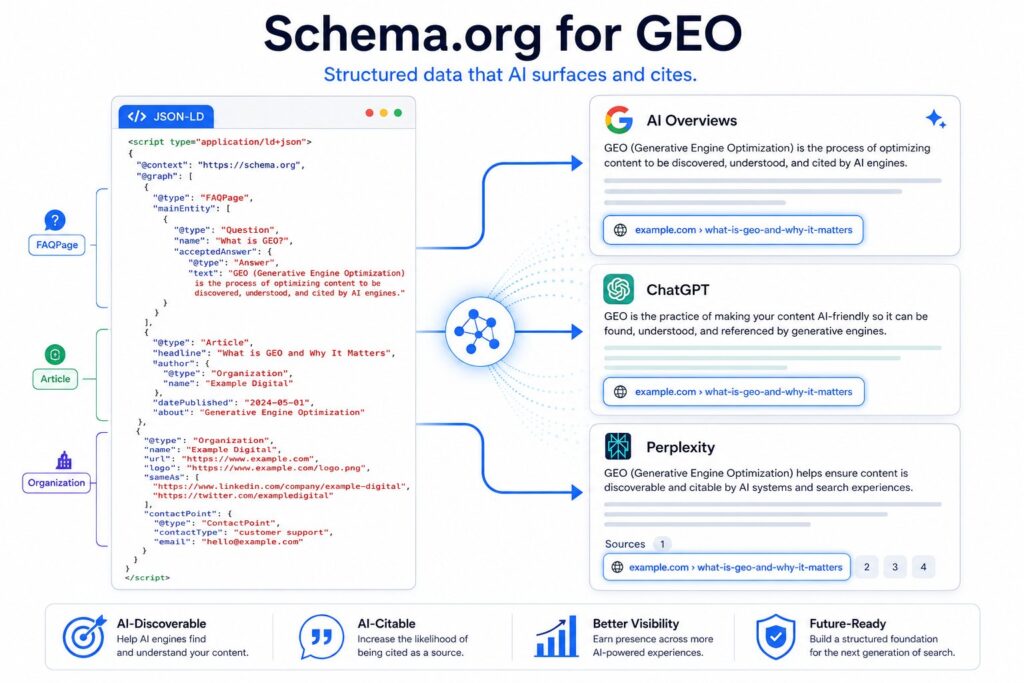
Schema.org for GEO is the structured-data optimization discipline that helps content get cited in AI Overviews, ChatGPT search, Perplexity, Claude search, and the broader category of AI-mediated answer surfaces. The pattern: implement JSON-LD markup using Schema.org vocabularies that describe what your content actually is (article, FAQ, product, how-to, organization, person, etc.) and the entities, relationships, and facts within it. AI systems use this structured data to extract answerable chunks, verify factual claims, identify entities, and decide which sources to cite when generating answers. The investment is small (JSON-LD in the page head, validated with free tools), the upside is meaningful (higher AI Overviews citation probability), and the work compounds across both classic SEO and GEO surfaces because structured data has been part of Google’s ranking signal stack for over a decade.
This post covers what Schema.org actually is in the GEO context, the high-leverage schemas that matter most for AI Overviews citation, the implementation patterns in WordPress and Drupal, the validation workflow, the diagnostic patterns for measuring whether the markup is helping, and the practical priorities for teams building Schema.org coverage as part of their broader GEO strategy. For broader context, our GEO pillar covers the broader discipline.
Schema.org in the GEO context
Schema.org is the structured data vocabulary jointly maintained by Google, Microsoft, Yahoo, and Yandex since 2011. The vocabulary defines hundreds of types (Article, FAQPage, Product, Recipe, Event, Person, Organization, etc.) and the properties that describe each type. Publishers implement Schema.org by adding JSON-LD blocks to page heads that describe what the page contains in structured terms.
For classic SEO, Schema.org powers rich results (featured snippets, FAQ accordions, recipe cards, product carousels, knowledge panels) and has been a meaningful ranking signal for over a decade. For GEO, the same structured data plays an arguably larger role because AI Overviews and similar surfaces depend more heavily on structured signal extraction than the classic blue-link results did.
The key behaviors AI surfaces exhibit with structured data:
Entity extraction. AI surfaces identify entities (people, organizations, products, places) in user queries and look for content that’s marked up with structured data about those entities. Content with strong Organization, Person, Product, and Place schemas signals entity authority.
Fact verification. AI surfaces verify factual claims against structured data when available. A claim about a product price, an event date, or a person’s role is easier to verify when the page includes Schema.org markup for the relevant entity.
Q&A extraction. AI surfaces extract question-answer pairs from FAQPage schema and use them to populate AI Overviews answers. FAQPage is one of the highest-leverage schemas for GEO because the structure aligns directly with how AI surfaces extract answerable chunks.
Procedural answer extraction. HowTo schema’s structured step-by-step content is extracted by AI surfaces for "how do I do X" queries. HowTo content with proper markup typically wins these citations.
Article and citation signals. Article and NewsArticle schemas signal authoritative editorial content with byline, publication date, and publisher information. AI surfaces use these signals to prioritize citation sources.
The high-leverage schemas for GEO
Not all Schema.org types are equally important. For most publishers, focusing on a handful of high-leverage schemas produces most of the GEO benefit:
Article (and the more specific NewsArticle, BlogPosting). For editorial content. Required fields: headline, author, datePublished. Recommended: image, description, publisher, mainEntityOfPage. The Article schema signals authoritative content with proper attribution; AI surfaces consistently prefer Article-marked-up content for citations.
FAQPage. For pages with FAQ sections. Each question-answer pair is structured for direct extraction. AI Overviews citations of FAQ content are common; the structure aligns with how AI surfaces extract answers. This is the single highest-leverage schema for most content publishers.
HowTo. For procedural content. Step-by-step instructions are structured for direct extraction. Procedural queries (how do I do X) are heavily AI Overviews-served and HowTo-marked content wins these citations frequently.
Organization. Site-level schema describing the publishing organization. Helps AI surfaces understand who the publisher is, which contributes to authority signals. Properties include name, url, logo, sameAs (linking to social profiles for entity reconciliation), founder, contactPoint.
Person. Author bylines, expert profiles, executive bios. Helps AI surfaces understand who’s writing the content (E-E-A-T signal) and reconcile authors as entities. Properties include name, jobTitle, worksFor, sameAs, image.
BreadcrumbList. For breadcrumb-style navigation. Helps AI surfaces understand site hierarchy and topical organization. Less directly tied to AI Overviews citations but signals content organization.
Product (for ecommerce). Structured product information powers shopping integrations and product-specific AI Overviews. Properties include name, image, description, brand, sku, offers (with price, priceCurrency, availability).
Event (for time-bound content). Structured event information powers event-specific queries. Properties include name, startDate, endDate, location, organizer.
Recipe (for food content). Highly structured with ingredients, instructions, nutrition, cooking time, and yield. Recipe content with proper markup consistently wins recipe-specific AI Overviews.
For most general content publishers, the priority order is: Article on every article, FAQPage on every page with FAQ sections, Organization at the site level, Person for author bylines, and BreadcrumbList for breadcrumb navigation. Those five cover most of the addressable GEO benefit. Specialized content types (Product, Event, Recipe, HowTo) layer on for sites that publish those content categories.
Implementation patterns
The implementation pattern: JSON-LD in the page head. Inline microdata and RDFa are supported but more error-prone; JSON-LD is the modern standard.
An example Article schema for a blog post:
<script type="application/ld+json">
{
  "@context": "https://schema.org",
  "@type": "Article",
  "headline": "Schema.org for GEO: What to Mark Up and How",
  "image": "https://digitalmatters.me/featured-images/schema-org-for-geo.jpg",
  "datePublished": "2026-06-26T09:00:00-04:00",
  "dateModified": "2026-06-26T09:00:00-04:00",
  "author": {
    "@type": "Person",
    "name": "Digital Matters Editorial",
    "url": "https://digitalmatters.me/about/"
  },
  "publisher": {
    "@type": "Organization",
    "name": "Digital Matters",
    "logo": {
      "@type": "ImageObject",
      "url": "https://digitalmatters.me/featured-images/Digital-Matters-color-logo-1200.jpg"
    }
  },
  "description": "Schema.org markup helps AI Overviews and other AI surfaces understand and cite your content. Here's what to mark up and how."
}
</script>
An example FAQPage schema:
<script type="application/ld+json">
{
  "@context": "https://schema.org",
  "@type": "FAQPage",
  "mainEntity": [
    {
      "@type": "Question",
      "name": "What is Schema.org?",
      "acceptedAnswer": {
        "@type": "Answer",
        "text": "Schema.org is the structured-data vocabulary jointly maintained by Google, Microsoft, Yahoo, and Yandex that web publishers use to mark up content for search engines and AI systems."
      }
    },
    {
      "@type": "Question",
      "name": "Why does Schema.org matter for GEO?",
      "acceptedAnswer": {
        "@type": "Answer",
        "text": "AI Overviews and similar surfaces extract answers from structured content. Schema.org markup makes content more extractable, which increases citation probability."
      }
    }
  ]
}
</script>
WordPress implementation patterns: Most modern SEO plugins (Yoast, RankMath, AIOSEO, SEO Framework) generate Schema.org markup automatically for common content types. Configure the plugin’s schema settings, fill in the publisher and author details, and the plugin handles the rest. Custom schemas (HowTo, Product, Recipe) often require plugin-specific configuration or custom code.
Drupal implementation patterns: Drupal has multiple Schema.org modules including Schema.org Metatag (the most actively maintained) and JSON-LD modules. The configuration is more involved than WordPress because Drupal’s flexibility means there’s no single canonical pattern.
Static-site implementation patterns: For Next.js, Astro, SvelteKit, and similar frameworks, JSON-LD is typically inserted via the framework’s head-management API. Many starter templates include Schema.org by default; verify the implementation matches what you actually need.
For custom implementations, the priority is correctness over completeness. A few well-implemented schemas beat many half-implemented ones.
The validation workflow
Two free Google tools validate Schema.org markup:
Rich Results Test at https://search.google.com/test/rich-results tests whether a specific URL or pasted code is eligible for Google’s rich results. Run this on every important page and fix any errors before publishing. The tool also shows preview thumbnails of what rich results might look like.
Schema Markup Validator at https://validator.schema.org/ validates Schema.org syntax more permissively, accepting all Schema.org types regardless of Google’s rich results eligibility. Useful for schemas that aren’t directly tied to Google rich results but still help AI surfaces.
Validation discipline: validate every important page at least once. Schedule recurring validation (quarterly is reasonable) because Schema.org standards evolve and what validates today may show warnings or errors later. Most validation errors are fixable in minutes; ignoring them accumulates technical debt that’s harder to address later.
For broader implementation testing, Google Search Console’s Enhancements report shows aggregated structured-data status across your site. Pages with errors get flagged; the report helps prioritize remediation.
Diagnostic patterns for measuring impact
Whether Schema.org markup is actually improving AI Overviews citations is hard to measure precisely (no single tool reports "AI Overviews citation rate per page"), but several diagnostic patterns help:
Google Search Console > Performance > Search Appearance > AI Overviews. Added in 2026, this filter shows impressions, clicks, and CTR for queries where your content appeared in AI Overviews. Track the trend over time; meaningful increases after schema implementation suggest the markup is helping.
Search Console Enhancements reports. Track the count of valid pages per schema type. Growth in valid pages without growth in errors signals healthy markup expansion.
Third-party tools. Ahrefs Brand Radar, Semrush AI Insights, and dedicated GEO tools provide additional visibility into AI citation patterns across multiple AI surfaces (not just Google AI Overviews).
Direct testing. Periodically ask AI surfaces about your topic area and observe whether your content gets cited. Anecdotal but useful for understanding actual citation behavior.
Featured snippet rates. Featured snippets and AI Overviews share substantial extraction logic; pages that win featured snippets often also win AI Overviews citations. Featured snippet tracking is a reasonable proxy for AI Overviews tracking.
What teams should do this quarter
Six concrete actions:
- Audit current Schema.org coverage. Run the Rich Results Test on your top 20 traffic pages. Document which schemas are present, which are valid, and which have errors. Fix the errors.
- Add FAQPage schema to FAQ sections. The single highest-leverage addition for most content publishers. Add FAQs to important pages that don’t have them; mark up existing FAQs with FAQPage schema.
- Verify Article schema on editorial content. Headline, author, datePublished, image, and publisher are the required and recommended fields. Most SEO plugins handle this; verify the implementation matches what you actually want.
- Add Organization and Person schemas at the site level. Site-wide trust signals that compound across every page. Particularly the sameAs property linking to your verified social profiles for entity reconciliation.
- Set up recurring schema validation. Quarterly review catches drift before it becomes substantial. The work is small; the prevented technical debt is real.
- Track AI Overviews appearance in Search Console. The data isn’t perfect but it’s the best available signal for whether your GEO investments are paying off. Set up monthly tracking against the queries that matter to your business.
The deeper takeaway is that Schema.org is one of the highest-leverage GEO investments available because the work compounds across both classic SEO (rich results, featured snippets) and GEO (AI Overviews citations) simultaneously. The implementation is straightforward, the validation tools are free, and the impact is real. Teams that haven’t invested in Schema.org are typically leaving substantial visibility on the table for both surfaces.
Frequently Asked Questions
What is Schema.org?
Schema.org is a structured-data vocabulary jointly maintained by Google, Microsoft, Yahoo, and Yandex since 2011. The vocabulary defines hundreds of types (Article, FAQPage, Product, Recipe, Event, Person, Organization, etc.) and properties that describe each type. Publishers implement Schema.org by adding JSON-LD blocks to page heads that describe what the page contains in structured terms. The vocabulary is freely usable and standardized across search engines.
Why does Schema.org matter for AI Overviews?
AI Overviews depend more heavily on structured signal extraction than the classic blue-link results did. Schema.org markup helps AI surfaces extract entities, verify factual claims, identify answerable Q&A pairs, and decide which sources to cite when generating answers. Content with strong Schema.org markup is consistently cited more often in AI Overviews than equivalent content without markup. The investment is small relative to the upside.
What’s the highest-leverage Schema.org type?
FAQPage, for most content publishers. The structured question-answer pairs align directly with how AI Overviews extract answers, and the schema produces both AI Overviews citations and classic featured-snippet rich results. Adding FAQPage to existing FAQ sections (or adding FAQ sections with FAQPage markup to important pages) is the single highest-leverage schema action for most sites.
How do I implement Schema.org in WordPress?
Most modern SEO plugins (Yoast, RankMath, AIOSEO, SEO Framework) generate Schema.org markup automatically for common content types. Configure the plugin’s schema settings, fill in publisher and author details, and the plugin handles the rest. For custom schemas (HowTo, Product, Recipe) that the plugin doesn’t generate by default, you may need plugin-specific configuration or custom code. The schema configuration is part of the plugin’s setup; the implementation cost is mostly configuration time rather than ongoing maintenance.
How do I validate Schema.org markup?
Two free Google tools. The Rich Results Test (search.google.com/test/rich-results) tests whether a URL or pasted code is eligible for Google’s rich results and shows preview thumbnails. The Schema Markup Validator (validator.schema.org) validates Schema.org syntax permissively, accepting all types regardless of Google’s rich results eligibility. Run validation on every important page before publishing and schedule recurring validation quarterly to catch drift as standards evolve.
Does Schema.org help with classic SEO too?
Yes, substantially. Schema.org has been a Google ranking signal for over a decade and powers rich results (featured snippets, FAQ accordions, recipe cards, product carousels, knowledge panels) that drive higher click-through rates from search results. The same markup that helps GEO (AI Overviews citations) also helps classic SEO (rich results and featured snippets). The investments compound.
What if my SEO plugin already handles Schema.org?
Verify it’s doing what you actually want. SEO plugins generate Schema.org with default templates that may not include the properties you care about (author bylines, sameAs for entity reconciliation, custom organization details). Audit the actual markup the plugin generates via the Rich Results Test on a representative page. If gaps exist, configure the plugin to include them or augment with manual schema for properties the plugin doesn’t generate.
How do I measure whether Schema.org is helping?
Several diagnostic patterns. Google Search Console’s AI Overviews filter (added in 2026) shows impressions, clicks, and CTR for queries where your content appeared in AI Overviews. Search Console’s Enhancements reports track structured-data validity per schema type over time. Third-party tools (Ahrefs Brand Radar, Semrush AI Insights, dedicated GEO tools) provide cross-platform AI citation tracking. Featured snippet appearance rates are a reasonable proxy for AI Overviews citation rates because the extraction logic is similar.