
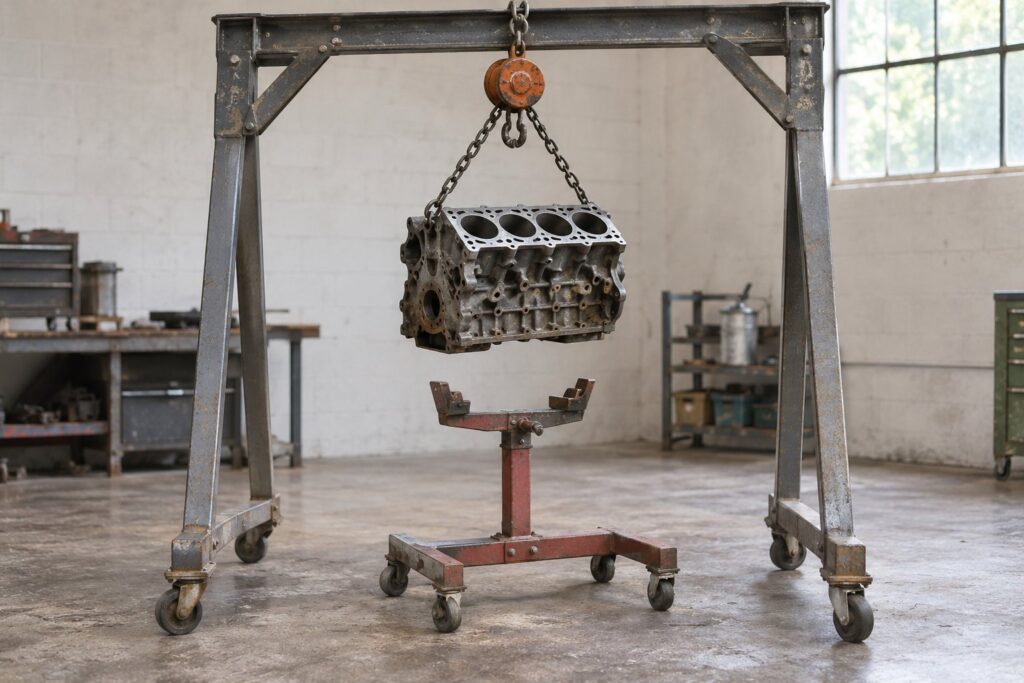
Self-hosting Mistral Large 4 takes one server with eight current data center GPUs, or two servers of older ones. The weights are free to download. The hardware to hold them in GPU memory costs tens of thousands of dollars a month to rent.
Mistral released the open weights for its 1-trillion-parameter model on October 29, 2026. Our explainer on what Mistral Large 4 is covers the model, the license and the API. This post answers one question: what self-hosting Mistral Large 4 takes, and when the API is cheaper. It uses the same method as our Kimi K3 self-hosting analysis: memory first, then hardware, then cost per token.
The short version: for most organizations, the API wins on price by a wide margin. Mistral charges $2.10 per million output tokens. At that rate, a rented eight-GPU node must produce about 17,000 output tokens per second, around the clock, to break even. Self-hosting Mistral Large makes sense when data cannot leave your systems, not as a way to save money.
How much memory self-hosting Mistral Large 4 needs
Start with the weights. Mistral’s docs list 1.05 trillion total parameters. The main checkpoint stores them in FP8, which is one byte per parameter. That gives about 1.05 TB, and the main Hugging Face repository reports 1.06 TB.
Only about 49 billion parameters run per token, but that does not shrink the memory bill. Every expert has to stay loaded, because any of them can be picked for the next token. Our Kimi K3 post explains that point in detail, and it applies to self-hosting Mistral Large the same way.
Here are the published sizes, as listed on each Hugging Face page in November 2026:
| Version | Who publishes it | Size |
|---|---|---|
| FP8 (main release) | Mistral | 1.06 TB |
| NVFP4 | Mistral | 610 GB |
| MXFP4 experts | vLLM recipe (AMD Quark) | about 578 GB |
| GGUF BF16 | ggml-org, Unsloth | 2.1 TB |
| GGUF Q8_0 | ggml-org, Unsloth | 1.12 TB |
| GGUF Q4_K_M | ggml-org | 635 GB |
| GGUF Q2_K | ggml-org | 381 GB |
| GGUF UD-IQ1_S (1-bit) | Unsloth | 233 GB |
The NVFP4 model card says that version uses NVFP4 for the MoE experts and FP8 for the other layers. Mistral reports no accuracy loss against FP8 on its listed tests. The GGUF BF16 file is larger than Mistral’s release because, per ggml-org, it is an upcast of the FP8 weights.
On top of the weights, you need room for the KV cache, which holds the working memory for each request. The vLLM recipe sets the per-GPU weight load at about 128 GiB for FP8 and 76 GiB for NVFP4, across eight GPUs.
Which GPUs can hold Mistral Large 4
The weights decide the hardware. An eight-GPU server needs more than 1.06 TB of total GPU memory for FP8, plus room for the cache. Here is how common nodes compare, using NVIDIA’s and AMD’s own spec pages and the serving guides:
| Node | GPU memory (vendor spec) | What the serving guides verify |
|---|---|---|
| 8x NVIDIA H200 | 141GB per GPU, 1,128GB per node | FP8 across two nodes (16 GPUs), per vLLM |
| 8x NVIDIA B200 (DGX B200) | 1,440GB per node | NVFP4 on one node, per vLLM |
| 8x NVIDIA B300 (DGX B300) | 2.1TB per node | FP8 on one node, per vLLM and SGLang |
| 8x AMD MI350X or MI355X | Up to 288GB per GPU, 2.3TB per platform | FP8 on MI350X, per vLLM |
Memory figures come from NVIDIA’s H200 page, its DGX B200 and DGX B300 pages, and AMD’s MI350 Series page.
The H200 row is the trap. Eight H200s hold 1,128GB, which barely clears 1.06 TB of weights and leaves almost nothing for the cache. The vLLM recipe for Mistral Large 4 says: "On H200 use TP16 (or TP16 DCP8 for long context), with PP2 x TP8 as the alternative." TP16 means splitting the model across 16 GPUs in two servers. The recipe adds that its team took no performance numbers on H200.
NVFP4 needs NVIDIA Blackwell GPUs, per the model card. The SGLang cookbook verifies NVFP4 on four GB300 GPUs. On AMD, the vLLM recipe says an MXFP4 version of about 578 GB fits four MI350 Series GPUs. It lists MI300 Series GPUs as not validated.
The serving stacks for self-hosting Mistral Large 4
Mistral’s October 29 post names vLLM and SGLang for self-hosting. It also names an NVIDIA NIM container and support in TensorRT-LLM. Here is what each project’s own docs said when we checked.
vLLM. Support ships in a dedicated Docker image, vllm/vllm-openai:mistral-large-4, with a ROCm image for AMD. The vLLM recipe, updated October 30, says "No vLLM release or nightly wheel includes Mistral Large 4 support yet." Plan on the image until a regular release adds it. The vLLM team’s launch post says the built-in DSpark draft model gives about twice the output throughput at TP8.
SGLang. The cookbook lists four verified setups: FP8 on eight B300s, NVFP4 on four GB300s, and two Vera Rubin layouts. It says commands for other GPUs are badged "Not Verified."
NVIDIA NIM and TensorRT-LLM. We could confirm these only on Mistral’s page. NVIDIA’s NIM support matrix, updated October 23, did not list Mistral Large 4 when we checked. NVIDIA’s Dynamo docs do include a Mistral Large 4 recipe, built on vLLM, for GB300 and Vera Rubin racks.
llama.cpp. The GGUF files are for large single machines. Unsloth’s page says to run its 1-bit file "on a 256GB RAM device." The ggml-org page says its Q2_K file "Fits in 512 GB of unified memory." Expect quality loss at these sizes, and expect slower output than a GPU server.
What renting the hardware costs
Cloud GPU prices move often, so here is one dated list. These are AWS’s published rates for EC2 Capacity Blocks for ML in US East (N. Virginia), as listed on November 2, 2026. AWS says the next update is scheduled for January 2027.
| Setup | AWS instance | Per hour | Per month (730 hours) |
|---|---|---|---|
| FP8 on 8x B300 | p6-b300.48xlarge | $129.168 | $94,293 |
| NVFP4 on 8x B200 | p6-b200.48xlarge | $113.666 | $82,976 |
| FP8 on 16x H200 | 2x p5en.48xlarge | $126.316 | $92,211 |
Two older H200 servers cost about the same as one B300 server and run a less tested setup. If you rent, the newer node is the simpler choice. Other clouds and on-demand rates differ, so check your own provider’s price page.
Buying is a different calculation. Our report on local AI hardware prices found that hardware prices nearly doubled in 2026 while API prices did not. That gap makes the purchase case harder this year.
When the API is cheaper than self-hosting Mistral Large 4
The formula from our Kimi K3 post still works. Your cost per million output tokens equals the hourly rate, divided by sustained output tokens per second, divided by 3,600, times one million.
Mistral’s API lists $0.70 per million input tokens, $0.07 cached, and $2.10 per million output tokens, as of November 2026. To match $2.10 on the B300 node, you need about 17,086 output tokens per second, every second of the month. On the B200 node, the bar is about 15,035. Those numbers count output only, so they flatter the self-hosted side.
Put another way, $94,293 a month buys about 44.9 billion output tokens on Mistral’s API. If your organization does not use that much, the API is cheaper.
The low API price is what makes this so lopsided. Kimi K3 was listed at $15 per million output tokens. At that rate, the same B300 node would break even at about 2,392 output tokens per second. Mistral’s price sets the bar about seven times higher.
Neither Mistral nor vLLM publishes a sustained throughput figure for a single node. Measure it on your own traffic before you sign anything. Add staff time, monitoring and idle hours, because an idle node bills the same as a busy one. Our guide to hardware for AI agents explains why memory, not raw compute, usually sets the limit.
The license when you serve the model to others
Self-hosting Mistral Large for your own staff is covered by the license. The Mistral Ecosystem Open-Weight License excludes "internal use of the Model or its derivative works" from its one condition.
The condition applies to a "Model as a Service business." The license defines that as giving a third party access for inference or post-training "in a manner that allows such third party to exercise meaningful control over the inputs, parameters, or training data." A business in that position "must enter into a separate commercial license with Mistral."
For an agency, this is the line to watch. A chatbot or summary feature built into a client’s site appears to fall under the exclusion for "end-user products with model capabilities solely embedded within specific features or harnesses." A shared endpoint that several client organizations call with their own prompts and settings looks like Model as a Service. Ask Mistral before you build on that second setup. The license points questions to Mistral’s contact form.
When self-hosting Mistral Large 4 makes sense
There are three good reasons to run it yourself, and price is not one of them for most teams.
- Data that cannot leave your systems. If a contract or policy rules out any outside API, self-hosting Mistral Large is the way to use this model.
- Steady, heavy volume. If you already spend near the figures above every month, measure throughput and run the formula.
- Fine-tuning. The license allows changes to the model, and the weights make them possible.
For everyone else, the API or a third-party host is the practical route. If you want a model that runs on hardware you already own, see our guide to local AI models. A smaller open model fits that job better.
Frequently Asked Questions
What hardware does self-hosting Mistral Large 4 need?
For the FP8 weights, a server with eight NVIDIA B300 GPUs or eight AMD MI350X GPUs, or two servers with eight H200s each. For the NVFP4 weights, eight B200s or four GB300s. Those are the setups the vLLM and SGLang guides verify.
How big is the Mistral Large 4 download?
Mistral’s main FP8 checkpoint is about 1.06 TB on Hugging Face. Its NVFP4 checkpoint is about 610 GB. Community GGUF files range from 233 GB for a 1-bit version to 2.1 TB for BF16.
Can one server with eight H200 GPUs run it?
Not for FP8, per the vLLM recipe. Eight H200s hold 1,128GB, which leaves almost no room past the weights. The recipe calls for 16 H200s across two servers.
Can I run Mistral Large 4 on a Mac or a workstation?
Only with heavy quantization and a lot of memory. Unsloth says its 1-bit GGUF needs a 256GB RAM device, and ggml-org says its Q2_K file fits in 512 GB of unified memory. Expect quality loss and slow output.
Which serving software should I use?
Mistral recommends vLLM or SGLang. vLLM support ships in a dedicated Docker image, and the SGLang cookbook lists four verified hardware setups. NVIDIA NIM and TensorRT-LLM are named by Mistral but were not yet listed in NVIDIA’s own support docs when we checked.
How much does it cost to rent a server for it?
On AWS Capacity Blocks in US East, as listed November 2, 2026, an eight-GPU B300 instance costs $129.168 per hour, or about $94,293 for a 730-hour month. Other clouds and pricing models differ.
When is self-hosting Mistral Large cheaper than the API?
Only at very high, steady volume. At $2.10 per million output tokens, a B300 node must sustain about 17,000 output tokens per second around the clock to break even on output alone.
Can my agency host Mistral Large 4 for clients?
Features built into a client’s product appear to fall under the license’s exclusion. A shared endpoint where clients control inputs or parameters looks like Model as a Service, which needs a separate commercial license from Mistral.
Does the NVFP4 version lose quality?
Mistral’s NVFP4 model card reports no accuracy regressions against FP8 on its listed tests. The card says it targets Blackwell GPUs, and the vLLM recipe says NVFP4 checkpoints are not yet supported on AMD’s ROCm.