
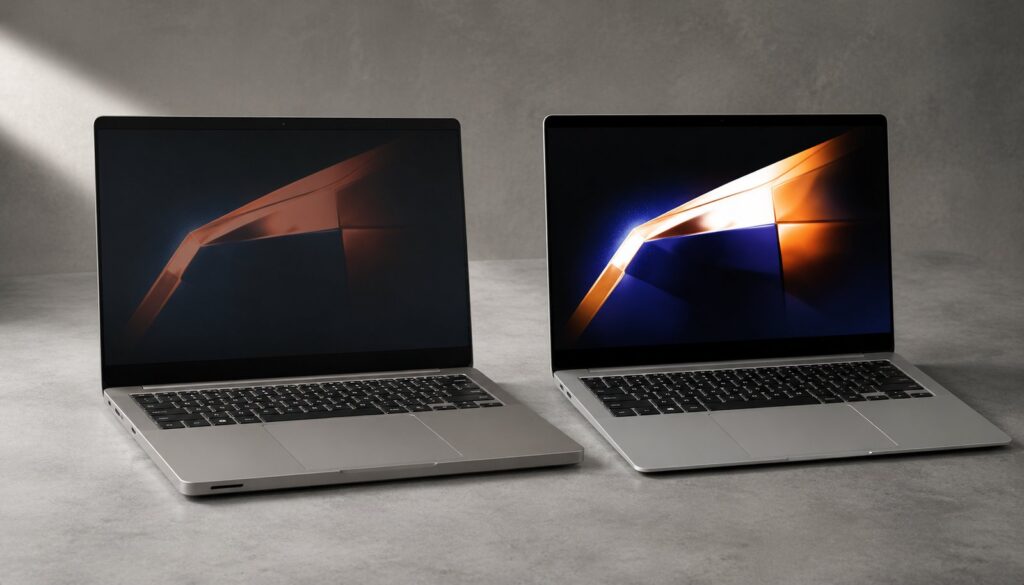
The Galaxy Book6 Pro is the biggest year-over-year change Samsung has made to its flagship thin-and-light in a while. It swaps the Galaxy Book5 Pro’s 8-core Intel chip for a 16-core one, pushes peak screen brightness past 1,000 nits, and adds a vapor chamber to keep the faster silicon in check. It also costs more, quietly drops a port some people rely on, and arrived just as the Book5 Pro fell to its lowest price ever. So the real question is not which laptop is newer. It is whether a genuine generational jump is worth paying close to double what a discounted Book5 Pro now sells for.
Both machines are 14- and 16-inch Copilot+ PCs with the same 3K AMOLED panel resolution, the same aluminum build, and the same broad port set minus one change. The differences that matter are concentrated in four places: the processor, the screen, the battery, and the price. Here is how they line up and who should buy which.
Galaxy Book6 Pro vs Book5 Pro: the short answer
For most people, the discounted Book5 Pro is now the smarter buy. It runs the same Windows 11 Copilot+ experience, drives the same sharp 120Hz AMOLED display, and lasts all day on a charge. Unless you specifically need more sustained performance, stronger graphics, or the brighter HDR panel, the year-old model delivers the large majority of the experience for a few hundred dollars less.
Buy the Galaxy Book6 Pro if you fall into one of three camps: you want the real performance headroom of the new 16-core chip, you need usable graphics power (and will therefore pay up for the right configuration, explained below), or you do enough HDR video work that a 1,200-nit screen earns its keep. Those are real upgrades. They are just not upgrades everyone needs.
Spec comparison at a glance
| Spec | Galaxy Book5 Pro | Galaxy Book6 Pro |
|---|---|---|
| Processor | Intel Core Ultra 7 258V (Lunar Lake), 8 cores | Intel Core Ultra 7 356H or Core Ultra X7 358H (Panther Lake), 16 cores |
| Graphics | Intel Arc 140V (8 cores) | Intel Graphics (356H) or Arc B390 (358H) |
| NPU | 47 TOPS | 50 TOPS |
| Display | 14" / 16" 3K (2880×1800) 120Hz AMOLED, touch | 14" / 16" 3K (2880×1800) 120Hz AMOLED, touch |
| Peak brightness | ~500 nits SDR | Up to ~1,200 nits HDR (measured) |
| Battery (16") | 76.1 Wh | 78 Wh, up to 30 hr video |
| microSD reader | Yes | No |
| Launch price | From ~$1,449 | From $1,599.99 |
Processor and performance: what Panther Lake changes
This is the headline. The Book5 Pro runs Intel’s Core Ultra 7 258V, a "Lunar Lake" chip with 8 cores tuned for efficiency in a roughly 17-watt envelope. The Book6 Pro moves to Intel’s newer "Panther Lake" generation, built on the Intel 18A process, with 16 cores and a much higher power ceiling (up to 80 watts in short bursts). Samsung claims the new chip delivers around 60 percent more CPU power, a figure that is plausible given the jump from 8 to 16 cores and the higher wattage (per Samsung’s launch announcement).
There is an important catch, and it decides which Book6 Pro you should actually buy. The base model uses the Core Ultra 7 356H, whose integrated graphics are modest. The graphics leap Samsung markets, roughly 70 percent more GPU power with Intel Arc, applies to the higher Core Ultra X7 358H configuration and its Arc B390 graphics (the full specs are listed on Intel’s product page). If graphics performance is part of why you are upgrading, the base chip will disappoint. Spend up for the X7, or the GPU gap over the old Arc 140V in the Book5 Pro narrows to almost nothing.
The faster chip runs hotter, so Samsung added a vapor chamber to the 16-inch Book6 Pro for the first time and redesigned the airflow, which it credits with about 35 percent better heat dissipation. On the AI side, both laptops clear Microsoft’s Copilot+ bar comfortably: the Book5 Pro’s neural processing unit is rated at 47 TOPS, the Book6 Pro’s at 50. That is the part of the spec sheet doing the on-device AI work, the same kind of dedicated silicon we cover in our look at on-device AI hardware. In practice, a 3-TOPS difference changes nothing day to day. Both run Windows Studio Effects, live captions, and local Copilot features the same way.
Display, design, and the microSD you will miss
The panel resolution did not change: both are 3K (2880 by 1800) Dynamic AMOLED 2X displays at 120Hz, in 14- and 16-inch sizes, and both are touchscreens. What changed is brightness. The Book5 Pro tops out around 500 nits in standard content, while independent testing of the Book6 Pro measured roughly 1,200 nits of peak HDR brightness (Notebookcheck’s review has the full measurements). For HDR video and bright-room use, that is a real, visible improvement. For everyday work in an office, both panels look excellent.
Samsung also tidied the chassis. The 16-inch Book6 Pro is slightly slimmer than its predecessor, gains a larger haptic touchpad, and drops the numeric keypad for a more centered layout. The catch sits on the left edge: the Book6 Pro removes the microSD card reader that the Book5 Pro included. If you offload photos or video from a camera, that is a daily annoyance and a point in the older model’s favor. Everything else carries over, including two Thunderbolt 4 ports, one USB-A port, HDMI 2.1, a headphone jack, a 1080p webcam, Wi-Fi 7, and quad speakers with Dolby Atmos.
Battery life
Battery capacity inched up rather than jumped. The 16-inch Book5 Pro carries a 76.1 Wh battery; the Book6 Pro moves to about 78 Wh. The bigger story is Samsung’s rating of up to 30 hours of video playback on the new model, which it calls its longest-lasting Galaxy Book yet. Real-world numbers will land below any lab figure, but both generations already deliver genuine all-day endurance, and the Book5 Pro routinely clears 20-plus hours in lighter use. Fast charging is on both, returning roughly a third of capacity in about half an hour.
Price and value: the part that flips the decision
The Book6 Pro launched in the United States on March 11, 2026, starting at $1,599.99, and Samsung raised prices again about a month later, pushing some configurations several hundred dollars higher. The Book5 Pro went the other direction. As the new model shipped, the outgoing one fell to clearance pricing, with the 14-inch version hitting an all-time low near $900 and 16-inch configurations widely discounted from their original $1,449 to $1,749 range.
That gap is the whole decision. You are often comparing a roughly $900 to $1,200 Book5 Pro against a $1,600-and-up Book6 Pro that can climb well past $2,000 once you add the X7 chip, more memory, and storage. The newer machine is better. It is not twice-as-good better. Planning a fleet purchase rather than a single laptop only sharpens the math, which is the kind of tradeoff we walk through in our guide to planning a hardware refresh.
Which Galaxy Book should you buy?
If you want one clear recommendation: most buyers should get the discounted Book5 Pro and put the savings toward more storage or a dock. It is a current-generation Copilot+ laptop with a beautiful screen and all-day battery, now selling at a discount the Book6 Pro will not see for a year.
Choose the Galaxy Book6 Pro if you need the performance and will buy it correctly. That means the Core Ultra X7 358H configuration with Arc B390 graphics, where the CPU and GPU gains are real, the 1,200-nit HDR screen matters for your work, and the higher sustained performance justifies the premium. Buying the base Book6 Pro at a higher price for a modest real-world gain over a half-price Book5 Pro is the one outcome to avoid. As with any device decision, the right answer follows the workload, the same way it does across the rest of the IT hardware stack.
Frequently asked questions
Is the Galaxy Book6 Pro worth upgrading to from the Book5 Pro?
For most Book5 Pro owners, no. The two laptops share the same screen resolution, build, and Copilot+ feature set, and the Book5 Pro is barely a year old. Upgrade only if you specifically need the 16-core chip’s sustained performance, the stronger Arc B390 graphics in the X7 configuration, or the brighter HDR display. For routine productivity, the difference will not feel like the price.
Does the Galaxy Book6 Pro have a touchscreen?
Yes. Both the Galaxy Book6 Pro and the Galaxy Book5 Pro use Dynamic AMOLED 2X touch displays at 3K resolution and 120Hz. Touch is standard on the Pro line in both the 14-inch and 16-inch sizes.
Did Samsung remove the microSD card reader?
Yes. The Galaxy Book6 Pro drops the microSD card reader that the Book5 Pro included. If you regularly import from camera cards, that is a meaningful downgrade and a reason some users will prefer the older model or plan for a USB-C card reader.
Which Galaxy Book6 Pro has the good graphics?
The Core Ultra X7 358H configuration, which pairs with Intel Arc B390 graphics. The base Core Ultra 7 356H uses weaker integrated graphics, so Samsung’s marketed graphics gains apply mainly to the higher-end chip. Check the exact processor before buying if GPU performance matters to you.