
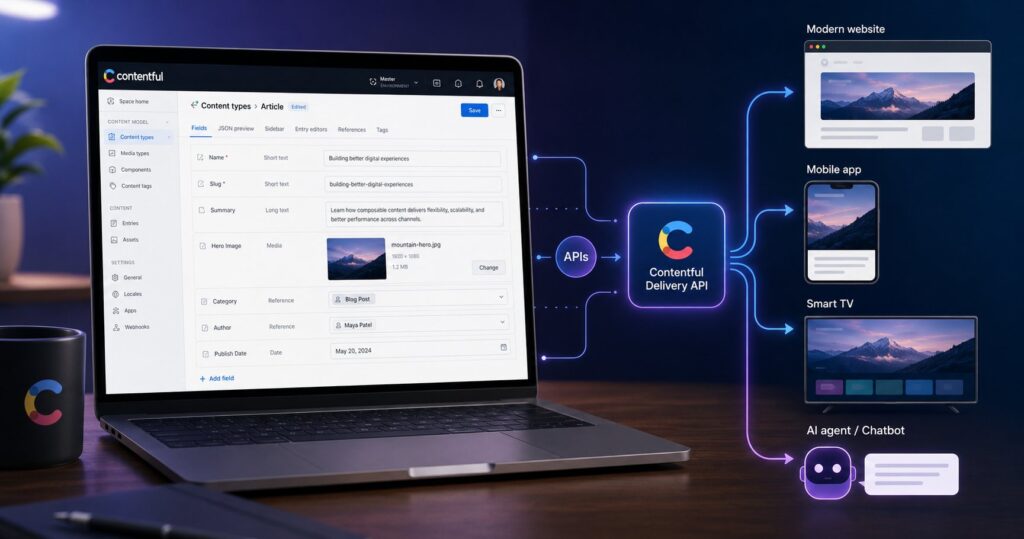
Contentful is a composable headless content management system that lets teams manage content as structured data and deliver it to any frontend, channel, or AI agent through APIs. Founded in 2013 in Berlin by Sascha Konietzke and Paolo Negri, Contentful grew through the mid-2010s on the strength of being the most enterprise-credible option in the then-nascent headless CMS category. By 2026, the platform serves over 4,800 leading brands for personalized digital experiences at scale, with a mature ecosystem of integrations, an App Framework for extensions, multi-language and multi-environment workflows, and the kind of compliance and governance posture that enterprise procurement teams require. And in the most consequential strategic event of Contentful’s history, on June 1, 2026, Salesforce announced a definitive agreement to acquire Contentful as the content layer for the Agentforce AI agent platform, with the deal expected to close in the third quarter of Salesforce’s fiscal 2027 (roughly late 2026 calendar). The Salesforce acquisition reframes what Contentful is becoming, and any decision to adopt or stay on the platform in mid-2026 has to factor in the post-acquisition trajectory.
This post covers what Contentful actually is, the composable headless architecture, the editor and developer experience, pricing tiers, where Contentful fits competitively against Sanity, Storyblok, Strapi, and other headless CMS alternatives, and the strategic implications of the Salesforce acquisition for current customers and teams evaluating new CMS investments. For broader context on the headless CMS category, our What Is a Headless CMS? pillar covers the architectural pattern Contentful is the market-leading example of.
What Contentful actually is
Contentful is a content infrastructure platform. The technical positioning: instead of pairing content management with a fixed presentation layer (the WordPress model where the same system that lets editors write content also serves the rendered HTML to browsers), Contentful separates the two. Editors work in Contentful’s web app, structure content in Content Models (custom content types with custom fields), and publish entries. The published content lives in Contentful’s cloud as structured JSON data, accessible via REST and GraphQL APIs. Any frontend, mobile app, agent, or downstream system can consume that content over the API.
That architecture sounds abstract until you think about what it enables. The same content (an article, a product, a campaign) can power a Next.js website, an iOS app, an Android app, a smart-TV experience, a kiosk display, an AI agent’s knowledge base, and a partner’s downstream syndication, all from the same source-of-truth. Editorial teams write the content once. Engineering teams build the frontend channels they need. The content layer and the presentation layer decouple, which is the architectural shift composable content makes possible.
Contentful’s specific contributions to the headless CMS category in 2026:
Mature content modeling. Content Types in Contentful support a wide range of field types (short text, long text, number, date, boolean, media, JSON object, location, reference to other entries, rich text with full WYSIWYG controls), with validation rules, conditional appearance, and computed fields. The modeling system is flexible enough for genuinely complex content while remaining approachable for non-developer editors.
The App Framework. Contentful exposes the editor experience as an extensible surface. Apps (Contentful’s term for editor extensions) can add custom field types, custom sidebar widgets, custom page entries, and custom dialogs. The App Framework is the most mature of any headless CMS in 2026 and is the foundation for Contentful’s AI Actions feature (which we cover in detail in next week’s Contentful AI Actions post).
Multi-environment workflow. Contentful supports multiple environments per space (a "space" is a content container, typically one per brand or product line). Environments let teams stage content changes, run A/B tests on content models, and promote changes through dev/staging/production workflows. Critical for enterprises that can’t accept direct production edits.
Localization and translation. First-class support for multi-language content, with field-level locale variants and integration patterns for translation management systems (Lokalise, Phrase, Smartling, etc.). For brands operating in multiple markets, this is foundational.
Strong delivery APIs. Both REST (Content Delivery API, CDA) and GraphQL endpoints. The GraphQL API in particular has matured substantially through 2024-2026 and is now the default for new Contentful implementations. CDN-backed for global low-latency delivery.
Enterprise governance. SOC 2 Type 2, ISO 27001, HIPAA-eligible configurations, GDPR-compliant data handling, SSO via SAML, fine-grained role-based access control, audit logging, and content versioning. The full enterprise procurement checklist.
For broader CMS context, our What Is a CMS? pillar covers the broader category and our Drupal primer covers the open-source enterprise alternative.
The composable content architecture
Contentful pioneered (and benefits from being the highest-profile example of) the composable content architecture. The pattern in plain language:
Content lives in Contentful as structured data. Each piece of content is an entry of a defined Content Type with fields that hold the content’s substance. An "Article" entry has fields like Title, Body, Author (reference to a Person entry), Publish Date, Featured Image. A "Product" entry has fields like Name, SKU, Price, Description, Category, Images.
The content has no inherent presentation. The same Article entry doesn’t know whether it’s going to render as a blog post on a marketing site, a notification email body, an AI agent’s response context, or an in-app card. Each consumer (frontend, app, agent, downstream system) reads the structured content and decides how to present it.
This decoupling has several practical implications:
Content reuse compounds. Write the article once; reuse it across every channel. Translate it once; the translations apply everywhere. Update it once; the update propagates to every channel that consumes it.
Frontend evolution is independent. Rebuild your website on a different framework; the content doesn’t move. Add a new mobile app; the content is already there. The frontend technology choice becomes a much smaller commitment than it is with a tightly coupled CMS.
AI agents become natural consumers. AI agents that need brand-approved content (product descriptions, support knowledge, marketing copy) can consume Contentful’s API the same way a frontend would. The structured nature of the content makes it directly usable by agents without scraping or parsing.
Partner syndication becomes easy. Any partner with API access can pull the content they need, in the structure they need, in real-time. The integration overhead drops substantially compared to file-based content exchange.
The composable architecture is now the dominant pattern for new enterprise content infrastructure decisions, and Contentful’s positioning at the top of the category is what made it the acquisition target Salesforce paid for.
The editor experience
The editor experience is where headless CMSs typically differ most, and Contentful’s editor experience is form-based rather than visual. Editors work with structured forms that match the Content Type definitions, see preview options when the frontend supports it, and use the App Framework extensions for custom workflows.
The strengths:
Predictable for content modelers. A well-designed Content Type produces editor forms that are clear, consistent, and constrained. Editors can’t accidentally break the structure because the structure is enforced.
Strong rich-text editing. Contentful’s rich text editor handles inline references to other entries (linking to a Person entry inline in body text, embedding a Product card inline in an article, etc.) elegantly. The output is structured JSON that frontends render however they need to.
Excellent media handling. Built-in image transformation API (resize, crop, format conversion at the edge), alt text and caption support, focus point selection for responsive crops, video support, and asset management.
Genuine workflow support. Draft, In Review, Approved, Published workflow states, with custom workflows possible via the App Framework. Comments on entries for editorial collaboration. Scheduled publishing for embargoed content.
Strong search and organization. Tags, content type filters, full-text search across entries, and the ability to bookmark frequently-used views.
The honest constraints:
Not visual. Editors who expect WordPress-style in-page editing (see the content as it will appear, edit it inline) will find Contentful’s form-based approach awkward initially. Visual page builders exist as App Framework extensions but they’re not the default experience.
Steeper initial learning curve. Contentful expects editors to understand Content Types, references, and the structural model. Teams transitioning from WordPress or a similar platform typically need a few weeks of onboarding before editors feel fluent.
Preview requires setup. Frontend previews don’t happen by default; they require Preview API integration on the frontend. Most production teams set this up; teams evaluating Contentful in trial often miss it and underrate the editor experience as a result.
The right framing: Contentful’s editor experience is excellent for teams that commit to structured content. It’s awkward for teams expecting visual editing, and that mismatch is the single most common reason teams that try Contentful end up choosing Storyblok or similar visual-first alternatives instead.
The developer experience
For developers, Contentful is one of the strongest CMSs on the market in 2026. The reasons:
Mature SDKs. Official SDKs for JavaScript/TypeScript, Python, Ruby, PHP, .NET, Java, Swift, Kotlin, plus community SDKs for nearly every other language. The TypeScript types are auto-generated from your Content Models, which catches a substantial class of bugs at compile time.
Strong CLI tooling. The Contentful CLI handles content model migrations, content import/export, environment promotion, and most administrative tasks. CI/CD integration is straightforward.
Predictable APIs. The REST API is RESTful in the boring, predictable sense. The GraphQL API is well-designed and exposes the Content Models cleanly. Both are well-documented.
App Framework for custom needs. When the platform doesn’t do what you need natively, the App Framework lets you build custom apps in React that run inside the Contentful editor. The capability scope of the App Framework has expanded substantially through 2024-2026.
Webhooks and Functions. Built-in webhooks for content events, plus Contentful Functions (serverless functions that run on Contentful’s infrastructure) for custom logic that doesn’t fit elsewhere.
Strong Git-like workflow primitives. Environments support tagging and merging in patterns that map well to how engineering teams already think about code branches.
The framework integrations that work well: Next.js (with the official Contentful integration and ISR support for content updates), Nuxt, SvelteKit, Astro, Remix, React Native, Flutter (community SDK), Swift/Kotlin native. For React-based modern frontends, the integration is essentially turnkey.
Pricing tiers in 2026
Contentful’s pricing is opaque relative to its competitors and tends toward the high end of the market. The current tiers as of mid-2026:
Free. Limited to one space, basic features. Sufficient for evaluation and very small projects; the free tier was tightened significantly in 2024 and is no longer suitable for any production workload.
Lite. ~$300/month for small teams. Includes more record allowances, more locales, basic role-based access control. The entry point for small commercial implementations.
Premium. Custom pricing, typically starting in the low thousands per month for mid-market customers. Includes the full App Framework, enterprise governance features, SSO, more environments, and more API quotas. This is the tier most production Contentful customers actually use.
Enterprise. Custom pricing, typically $10,000+/month for large customers. Includes everything in Premium plus advanced SLAs, dedicated support, custom enterprise features, and enterprise-grade governance and compliance.
The honest pricing reality: Contentful is more expensive than Sanity, Storyblok, or Strapi for equivalent workloads in nearly every comparison. The premium is paid for the mature platform, the enterprise governance, the ecosystem maturity, and the implicit assurance that Contentful as a vendor will still be operating in five years.
The Salesforce acquisition makes the long-term pricing trajectory uncertain. Salesforce’s pricing philosophy has historically been premium-with-volume-discounts, and the integration of Contentful into Agentforce-bundle offerings is a likely path for net-new pricing strategies. Existing customers should expect contract renewals to start positioning Contentful alongside other Salesforce products in unified pricing conversations.
Competitive positioning
The headless CMS market in 2026 has several mature players. The relevant alternatives:
Sanity. Developer-focused, real-time collaboration is a standout feature, the Studio interface is fully customizable. Stronger developer ergonomics than Contentful for teams that want to invest in the customization. Less enterprise-mature than Contentful on procurement/governance dimensions.
Storyblok. Visual-editing-first headless CMS. Editors get a visual page builder that translates to structured content underneath. Better for teams that need editorial workflows closer to WordPress’s visual model. Less developer-flexible than Contentful or Sanity.
Strapi. Open-source headless CMS that can be self-hosted (avoiding vendor lock-in and SaaS pricing). Mature enough for production. Best for teams with strong DevOps capability who want full control of the stack.
Sitecore XM Cloud. Enterprise alternative for organizations already on Sitecore. Best for large enterprises with substantial Sitecore investments.
Adobe Experience Manager (AEM). The enterprise alternative for Adobe Creative Cloud customers. Best for large enterprises with substantial Adobe investments.
WordPress as headless. Headless WordPress (WP REST API or WPGraphQL) is a credible alternative for teams that want the headless architecture but with WordPress’s editor familiarity and broad plugin ecosystem.
The 2026 positioning summary: Contentful is the enterprise default for new composable content projects, Sanity is the developer-favored alternative, Storyblok is the visual-editing alternative, Strapi is the open-source alternative, Sitecore and AEM are the legacy-enterprise alternatives, and headless WordPress is the existing-investment alternative. Each occupies a real niche and the right choice depends on your specific team capabilities and constraints.
What the Salesforce acquisition means
The Salesforce-Contentful acquisition is the most strategically significant event in Contentful’s history. Several implications worth understanding:
Strategic rationale. Salesforce announced the acquisition as part of its Headless 360 vision and as the content layer for Agentforce. The strategic logic is that Agentforce AI agents need brand-approved, structured content to assemble customer experiences on the fly, and Contentful is the platform best positioned to provide that content layer at enterprise scale. The acquisition gives Salesforce a content infrastructure that competes with Adobe Experience Manager (Adobe’s competing CMS bundle) and that integrates natively with the rest of the Salesforce Customer 360.
Customer experience implications. Existing Contentful customers will keep their current implementations and contracts. The technical platform isn’t expected to change in disruptive ways in the short term. Over time, expect deeper Salesforce-native integrations (Sales Cloud, Service Cloud, Marketing Cloud), Agentforce integration patterns, and gradual product-roadmap alignment with Salesforce’s broader strategy. Non-Salesforce customers will likely see continued investment in non-Salesforce integrations because Contentful’s commercial value depends on its broad ecosystem appeal.
The Sanity, Storyblok, Strapi positioning advantage. Headless CMS competitors that aren’t owned by a CRM platform have a positioning angle they’re already using: "vendor-independent content infrastructure." For teams that have specific reasons to not be locked into Salesforce’s ecosystem (multi-CRM strategy, anti-vendor-lock-in stance, regulated-industry constraints), the competitive alternatives become more attractive after the Contentful acquisition.
Pricing trajectory uncertainty. Salesforce’s pricing model and Contentful’s pricing model are different. The integration of Contentful into Salesforce will likely produce bundled offerings that reshape the per-product pricing conversation. Existing customers should plan for the possibility that contract renewals over the next 12-18 months come with Salesforce-account-team conversations that include other Salesforce products.
Talent retention risk. Acquisitions often produce talent attrition. Contentful’s engineering and product leadership going through the integration process will be where the platform’s near-term execution risk lies. Watch the changelog and the release cadence for signals.
The Agentforce integration roadmap. The Contentful AI Actions feature is already a strategic asset, but expect deeper integration into Agentforce specifically over the 12-18 months following the acquisition closing. Contentful’s content layer becoming the canonical knowledge source for Agentforce agents is the most likely product trajectory.
For customers evaluating Contentful for the first time in mid-2026, the acquisition is a meaningful consideration but not a deal-breaker. The platform is strong, the technical roadmap is funded by Salesforce’s substantial resources, and the strategic positioning is more concrete than it was as an independent company. For customers who have explicit reasons to avoid Salesforce-ecosystem dependencies, the alternative platforms are credible.
What teams evaluating Contentful should think about
Six concrete actions:
- Evaluate the editor experience with actual editors. Contentful’s form-based approach is divisive; some teams love it, others bounce off it. Run a hands-on trial with the editors who will use it daily before committing.
- Model your actual content in Contentful. The Content Type modeling is where the platform’s power lives. Build out your real content model (or a realistic subset) and see whether the structure feels natural or forced.
- Audit the integration path for your frontend stack. For Next.js, Nuxt, SvelteKit, Astro, Remix, and most modern frontend frameworks, the integration is excellent. For less common stacks, verify the SDK and the integration patterns before committing.
- Factor the Salesforce acquisition into your strategic story. If your organization has existing Salesforce investments, the acquisition is broadly favorable for ecosystem integration. If your organization has explicit reasons to not commit to Salesforce’s ecosystem, the alternative platforms are credible.
- Model the multi-year pricing carefully. Contentful is more expensive than alternatives at most usage levels. The premium is justified for many use cases but should be entered with eyes open. Model the cost over a three-to-five-year horizon, not just year one.
- Set up cost monitoring before production. API quotas, record counts, asset storage, and bandwidth all carry overage charges. Build cost visibility into your operations from day one.
The deeper takeaway is that Contentful is the enterprise default for composable headless content in 2026, and the Salesforce acquisition consolidates that positioning rather than disrupting it. For teams starting new composable content projects with enterprise governance requirements, Contentful is the safe, well-supported, increasingly Salesforce-aligned choice. For teams with reasons to prefer alternatives, the headless CMS market has credible options that are not part of any large vendor ecosystem.
Frequently Asked Questions
What is Contentful?
Contentful is a composable headless content management system. Editors create content in Contentful’s web app as structured entries of defined Content Types, and the published content becomes available via REST and GraphQL APIs that any frontend (websites, mobile apps, AI agents, partner systems) can consume. Founded in 2013 in Berlin by Sascha Konietzke and Paolo Negri, Contentful became the market-leading enterprise headless CMS through the mid-2010s and into the 2020s. As of June 2026, Salesforce announced a definitive agreement to acquire Contentful as part of its Agentforce AI agent strategy.
How is Contentful different from WordPress?
The structural difference is presentation coupling. WordPress is a coupled CMS: the same system manages content and serves the rendered HTML to browsers. Contentful is a headless CMS: content lives as structured data accessible via APIs, with no built-in presentation layer. WordPress is better for teams that want a single integrated stack and the broad plugin ecosystem. Contentful is better for teams that want to use the same content across multiple frontends, mobile apps, or AI agents, and that have the engineering capability to build the frontend layer separately.
What does Contentful cost?
Pricing tiers as of mid-2026: Free (one space, basic features, evaluation only), Lite (~$300/month for small teams), Premium (custom pricing in the low thousands per month for mid-market), and Enterprise (custom pricing typically $10,000+/month for large customers). Contentful is more expensive than competing headless CMS platforms (Sanity, Storyblok, Strapi) at most usage levels; the premium is paid for the mature platform, enterprise governance, and ecosystem depth.
Is Salesforce really acquiring Contentful?
Yes. On June 1, 2026, Salesforce announced a definitive agreement to acquire Contentful. The transaction is expected to close in the third quarter of Salesforce’s fiscal year 2027 (roughly late 2026 calendar), subject to customary regulatory approvals. Contentful was valued at over $3 billion in its last independent funding round in 2021; the acquisition price was not publicly disclosed in the initial announcement. The strategic rationale is for Contentful to serve as the content layer for Salesforce’s Agentforce AI agent platform.
Should I evaluate alternatives like Sanity or Storyblok?
Yes, especially for the editor experience comparison. Contentful’s form-based editor is divisive; Sanity offers a customizable Studio with real-time collaboration; Storyblok offers visual editing. Strapi offers self-hosting and open-source flexibility. For most enterprise customers in 2026, Contentful is still the safe default, but the alternatives are credible enough that a hands-on evaluation is worth the time. The Salesforce acquisition adds a strategic dimension to the evaluation: if you have explicit reasons to avoid Salesforce-ecosystem dependencies, the alternatives become more attractive.
What is the App Framework?
The App Framework is Contentful’s extensibility surface that lets developers build custom editor extensions in React. Apps can add custom field types, custom sidebar widgets, custom page entries, custom dialogs, and integrations with external systems. The App Framework is the most mature extensibility framework in the headless CMS market and is the foundation for Contentful’s AI Actions feature, custom workflow integrations, and the broad ecosystem of marketplace apps.
How does Contentful handle AI?
Contentful’s primary AI integration is AI Actions, a feature that lets editors invoke AI-powered workflows directly from the editor interface. AI Actions support a Bring Your Own Model (BYOM) architecture allowing organizations to run their preferred model (OpenAI, Azure OpenAI, AWS Bedrock, Gemini). The May 19, 2026 update added assignment and filtering configurations that let admins control where AI Actions appear and how they run. We cover AI Actions in detail in next week’s dedicated post.
Is Contentful right for my project?
Contentful is the right choice if you need a mature composable headless CMS with strong enterprise governance, broad framework integration, and willingness to invest in structured content modeling. It’s the wrong choice if you need WordPress-style visual editing as the default editor experience, if your budget is significantly smaller than the platform’s pricing tiers, or if your team lacks the engineering capability to build and maintain the frontend layer separately. For mid-market teams in the right scope, Contentful is a strong default; for very small or very budget-constrained teams, the alternatives often fit better.